
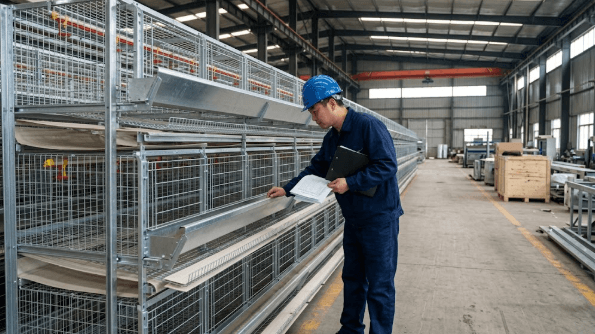
How to Check Chicken Cage Quality Before Shipment: A Factory Inspection Checklist for Buyers
Before making the final payment for a chicken cage system, overseas buyers should inspect more than product photos and a total quotation.
A commercial layer cage project can include cage frames, wire mesh, drinking lines, feeding equipment, manure removal equipment, egg collection equipment, motors, electrical parts, spare parts, packing materials, and installation documents.
A clear pre-shipment inspection helps buyers confirm that the delivered equipment matches the agreed cage system, bird capacity, automation level, and project layout.
This checklist explains what buyers should check before a chicken cage system is packed and loaded into containers.
Why Is a Pre-Shipment Inspection Important?
A chicken cage system is a project-based purchase. The equipment needs to fit the poultry house, support the planned bird capacity, and include the equipment required for daily farm operation.
Before shipment, buyers should confirm:
- The cage type is correct
- The total bird capacity matches the quotation
- The cage structure and accessories are complete
- Drinking system components are included
- Automation equipment is included as agreed
- Motors and electrical components are protected
- Spare parts are listed separately
- Packing labels are clear
- The packing list matches the quotation
- Layout and installation documents are available
Checking these points before shipment can make unloading and installation more organized after the equipment arrives at the farm.
1. Check the Cage Type and Total Bird Capacity
The first inspection point is whether the finished equipment matches the cage type shown in the final quotation.
For example, A-type and H-type layer cage systems have different structures, capacity arrangements, installation methods, and automation options.
A-Type Layer Chicken Cage System
H-Type Galvanized Layer Chicken Cage System
Ask the supplier to confirm the following information:
| Inspection item | What the buyer should check |
|---|---|
| Cage type | A-type, H-type, or the agreed system configuration |
| Cage tiers | Number of tiers included in the project |
| Cage rows | Number of cage rows included in the layout |
| Cage quantity | Total number of cage sections or cage units |
| Bird capacity | Designed total capacity for the project |
| Cage dimensions | Whether the cage dimensions match the agreed drawing |
| Feed troughs | Quantity and condition of feed troughs |
| Doors and accessories | Cage doors, clips, bolts, brackets and connectors |
Do not check only the number of packages. The buyer should understand how the final bird capacity is calculated based on cage rows, cage sections, and birds per cage.
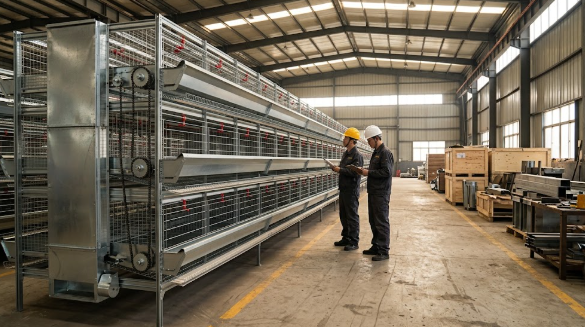
2. Check Wire Mesh, Frames and Welded Parts
The cage wire and support structure are important parts of the layer cage system.
During inspection, request clear photos or videos showing:
- Cage wire mesh
- Welded joints
- Cage doors
- Support frames
- Cage legs
- Brackets
- Feed trough supports
- Connection points
- Edge finishing
- Fasteners and clips
The inspection should focus on whether the cage structure looks complete, consistent, and suitable for assembly.
Buyers can ask for close-up images of sample cage sections before loading. For larger projects, it is useful to review photos of both the overall finished cage system and detail photos of connection points.
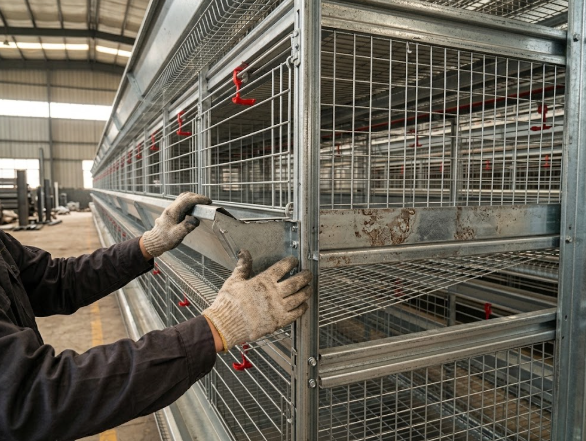
3. Check the Galvanizing Finish
Galvanizing is an important point for poultry equipment because the cage system will operate in an environment with moisture, dust, manure, and ammonia.
Before shipment, buyers can check:
- Whether the cage wire surface is evenly finished
- Whether support parts match the agreed corrosion-protection scope
- Whether there are visible scratches or damage before packing
- Whether different equipment sections have been clearly identified
- Whether the final equipment matches the material description in the quotation
Do not rely only on a general statement such as “galvanized chicken cage.” Ask the supplier to explain which cage parts, support parts, and accessories are included in the quoted configuration.
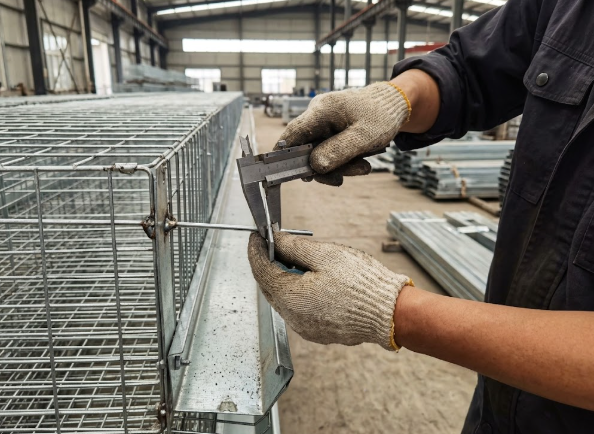
4. Check the Drinking System Components
A complete drinking system includes more than nipple drinkers.
The buyer should confirm whether the shipment includes the agreed drinking components:
| Drinking system item | What to confirm |
|---|---|
| Nipple drinkers | Quantity and type match the cage rows |
| Water pipes | Suitable quantity for the layout |
| Connectors | Included and packed with the water system |
| Pressure regulators | Included where required |
| Water filters | Included if listed in the quotation |
| Water inlet parts | Connection method for the farm water source |
| Flushing components | Included where required |
| Spare drinkers | Listed separately in the spare-parts package |
Small water system parts should be packed in clearly marked cartons or bags. This prevents connectors, drinkers, and regulators from being mixed with general cage hardware.
5. Check Automatic Feeding Equipment
Some projects use manual feeding. Others include automatic feeding equipment. Buyers should confirm the exact scope before shipment.
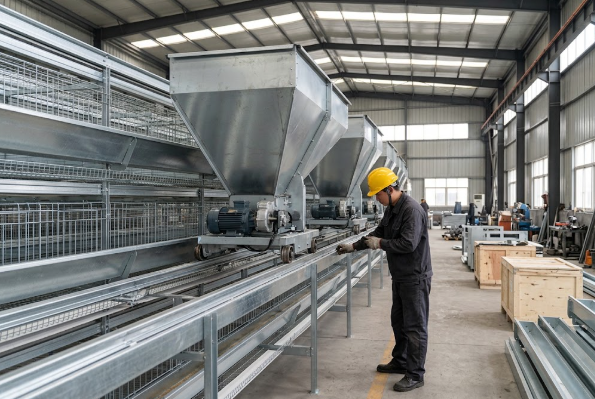
Automatic Poultry Cage Feeding Machine
For an automatic feeding system, check whether the shipment includes:
- Feeding machine
- Feed troughs
- Track or travel rail
- Motor
- Supporting brackets
- Electrical control components
- Connection parts
- Equipment for each cage row, where applicable
- Spare parts for high-wear components
The buyer should ask for photos of the feeding machine, motor, track, and accessories before the equipment is packed.
6. Check the Manure Removal System
For farms using automatic manure removal, the manure belt system should be inspected as a separate equipment section.
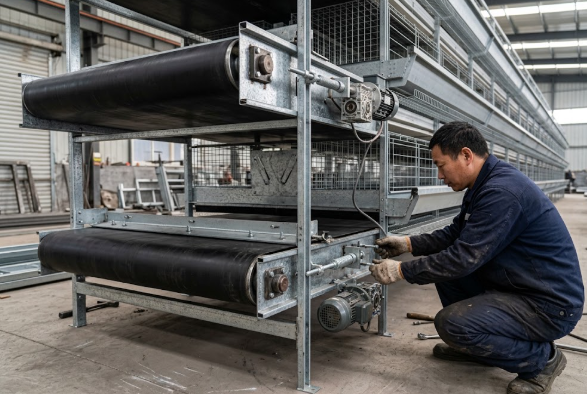
Automatic Manure Belt Removal System
Before shipment, check whether the quotation and packing list include:
- Manure belts
- Belt rollers
- Drive units
- Motors
- Scrapers
- Belt tensioning parts
- Discharge-end components
- Electrical parts
- Spare parts
The buyer should confirm which packages contain the belts, motors, and drive components. These parts should be stored in a dry and organized area after arrival.
7. Check the Egg Collection Equipment
For projects with automatic egg collection, buyers should verify that the egg collection equipment matches the cage layout.
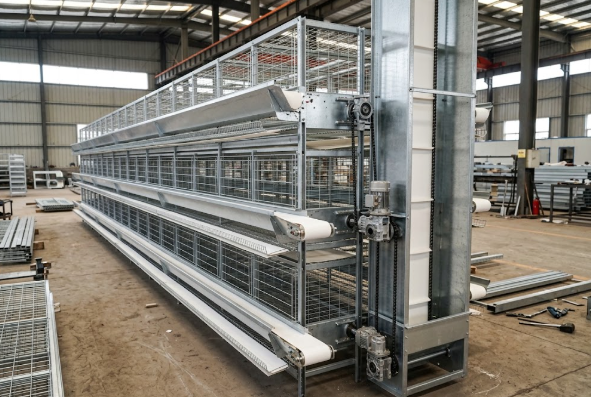
Vertical Egg Collection System for Layer Cages
Check whether the system includes:
- Egg belts
- Egg elevator
- Transfer section
- Motors
- Electrical control components
- Supporting brackets
- Connection parts
- Spare parts
Ask the supplier to identify the egg collection direction on the layout drawing. This helps the farm prepare the egg collection area before installation begins.
8. Check Motors and Electrical Components
Motors, controllers, sensors, and electrical components should be packed carefully because they can be damaged by moisture, pressure, or rough handling during transport.
The buyer should confirm:
- Which motors are included
- Which equipment each motor belongs to
- Whether electrical control parts are packed separately
- Whether package labels identify electrical components clearly
- Whether wiring information is included
- Whether the power requirement has been confirmed for the destination country
For farms using feeding, manure removal, egg collection, or environmental control equipment, electrical planning should be prepared before the container arrives.
9. Check Spare Parts and Small Accessories
Spare parts are especially important for overseas poultry farm projects. Some small parts can be difficult to replace quickly after installation.
The supplier should provide a separate spare-parts list.
| Spare parts category | Examples |
|---|---|
| Drinking system | Nipple drinkers, connectors, pipe fittings |
| Cage system | Cage clips, bolts, screws, fasteners |
| Feeding system | Wear parts, small mechanical components |
| Manure removal | Belt-related components and high-wear parts |
| Egg collection | Belt-related parts, connectors and wear parts |
| Electrical system | Selected electrical accessories and control components |
Buyers should ask for spare parts to be packed separately and labeled clearly. This avoids using spare parts during initial installation by mistake.
10. Compare the Packing List With the Final Quotation
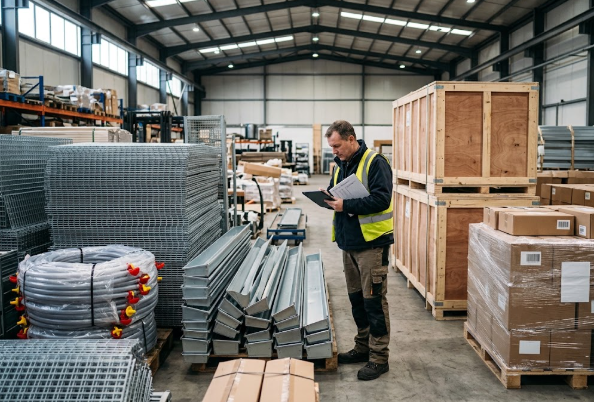
Before the container is loaded, compare four documents:
- Final quotation
- Equipment list
- Packing list
- Poultry house layout drawing
The equipment names, quantities, and project scope should be consistent across these documents.
If the project includes cages, drinking lines, feeding, manure removal, egg collection, and ventilation, each equipment section should be listed clearly.
Poultry House Ventilation and Cooling System
A complete packing list normally includes package number, package description, quantity, weight, dimensions, and equipment section.
11. Request Photos and Videos Before Container Loading
Before the container is sealed, request photos or videos showing:
- Finished cage system
- Cage wire and frame details
- Drinking system components
- Feeding machine and accessories
- Manure belt equipment
- Egg collection equipment
- Motors and electrical packages
- Spare parts packages
- Package labels
- Equipment loaded into the container
- Container number
- Final container loading condition
These records help the buyer check the shipment after arrival and organize equipment by installation area.
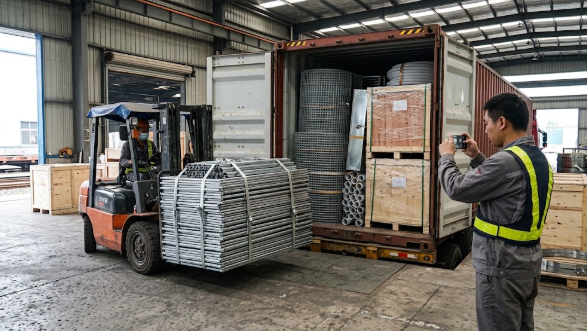
Final Pre-Shipment Inspection Checklist
Before container loading, confirm:
- Does the cage type match the quotation?
- Does the total bird capacity match the project plan?
- Are cage frames, wire mesh, feed troughs, doors and accessories complete?
- Is the drinking system included as agreed?
- Are automatic feeding components included, if ordered?
- Are manure belt components included, if ordered?
- Are egg collection components included, if ordered?
- Are motors and electrical components packed safely?
- Is there a separate spare-parts list?
- Does the packing list match the final quotation?
- Are packages labeled clearly?
- Are layout drawings and installation documents ready?
- Are photos or videos available before the container is sealed?
Final Recommendation
A chicken cage system should be checked as a complete project, not only as cage wire and frames.
Before shipment, verify the cage type, bird capacity, drinking system, automation equipment, motors, spare parts, packing list, and installation documents. This gives overseas buyers a clearer understanding of what will arrive at the farm and how the equipment should be installed.
Our team can help check whether the cage system and accessories match your farm project.
Want to know more?
Get in touch with us for more information about our services and products.