
Layer Cage Replacement: What to Check Before Ordering
A layer cage replacement project starts with two decisions: what needs to be removed, and what can remain. Replacing cage structures, replacing selected sections and adding automation to existing cages require different drawings, equipment and site work.
Before comparing prices, define the replacement scope for each poultry house. A quotation for new cages alone is not the same as a package covering removal, retained-equipment connections, installation and commissioning.
Choose Between Replacement and an Automation Retrofit
Identify the problem you need to solve. Record visible damage, recurring faults, access restrictions, maintenance difficulties and the equipment functions you want to change. These observations are inputs for a technical assessment, not proof that the cages are safe to retain or must be replaced.
| Project option | What needs checking before selecting it |
|---|---|
| Full cage replacement | Whether the proposed cage layout fits the building, and which associated systems must also change |
| Partial cage replacement | Whether replacement sections match retained structures, connections and equipment |
| Automation retrofit | Whether retained cages can accommodate the proposed feeding, egg collection or manure equipment |
| Expansion | Whether the building, utilities and equipment can support the proposed additional capacity |
Do not choose an option from cage age or appearance alone. Have the responsible technical reviewer assess the existing structures and proposed modifications. Adding tiers or retaining old supports requires project-specific review; neither should be assumed acceptable from available floor space.
Record the Existing House and Equipment
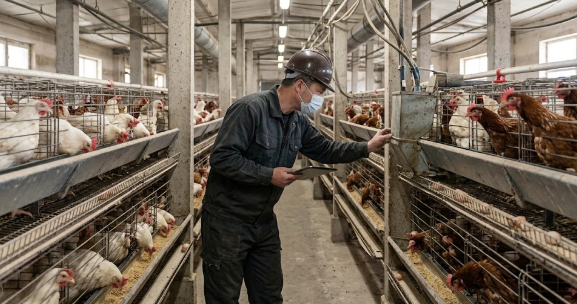
Provide the usable internal length, width and clear height of each house. Mark columns, doors, fixed equipment, aisles, access routes and obstructions on a drawing. Note floor condition and any planned building work.
For the cages, record the model if known, rows, tiers, unit dimensions and any previous alterations. If rows differ, document each configuration separately. Label dimensions as measured, taken from a drawing or still to be confirmed.
Then prepare a retained-equipment list:
- Feeding equipment, troughs and feed supply points.
- Drinking lines, water connections and available supply information.
- Egg belts, transfer heights, belt direction and downstream collection equipment.
- Manure belts or other removal equipment, discharge points and receiving areas.
- Ventilation equipment, electrical supply and controls.
Include model references, available manuals, condition notes and photographs showing both the complete arrangement and connection details. Ask the supplier and farm technical team to document proposed connections and required modifications. Similar cage labels or matching belt widths do not establish compatibility.
For equipment-specific questions, use the layer farm equipment quotation checklist. If only egg handling needs changing, review the existing-cage egg elevator retrofit guide before assuming a complete cage replacement is necessary.
Agree on the Work Window Before Confirming the Order
Give the project team the current flock schedule and target date for the next flock. Agree who coordinates bird removal, cleaning and disinfection, dismantling, delivery, installation, commissioning and house release for the next placement.
Separate the equipment delivery date from the date the house must be ready. Allow the responsible parties to review access, unloading, storage, building repairs, utility work and testing before agreeing on the installation window. A requested farm date is not an accepted supplier completion date.
Do not assume replacement can proceed while birds remain in the affected house or connected equipment stays operational. If the farm requires partial operation, obtain a project-specific work plan from the responsible farm and installation personnel covering access, shutdowns, isolation and separation of work areas. This guide is not a dismantling or electrical-work procedure.
Separate New Equipment from Site Work
Ask each supplier to mark scope items as included, optional, buyer-provided, excluded or awaiting confirmation.
| Scope | Written confirmation needed |
|---|---|
| Old equipment | What is removed, what remains, and who handles dismantling, removal from site and disposal or resale |
| Building and utilities | Required repairs, supports, openings, drainage, water connections and electrical work; responsible parties |
| New equipment | Exact models, quantities, cage arrangement, proposed capacity basis and connecting components |
| Retained interfaces | Equipment to be connected, modifications, drawings and the party responsible for reviewing each connection |
| Installation and commissioning | Work offered, site prerequisites, personnel, agreed checks and responsibility for unresolved items |
| Documents and support | Drawings, manuals, training, spare parts and any warranty or service offered, with terms and exclusions |
| Delivery and price | Packing, delivery terms, named destination, freight, applicable charges, payment and quotation validity |
Do not assume a supplier will dismantle old cages, buy used equipment, provide free installation or cover retained components under a new-equipment warranty. Request confirmation for the particular order.
Compare the same scope across proposals. If a required connection or site measurement is unresolved, keep it open and ask what evidence is needed. Treat a price based on unconfirmed assumptions as preliminary, not as the final specification for purchase.
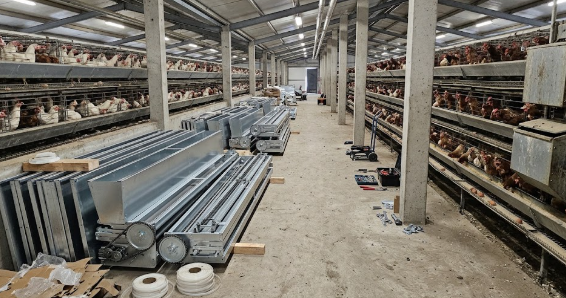
Confirm the Drawings and Handover Requirements
Before ordering, check that the quotation, equipment list and layout refer to the same model, capacity assumptions and drawing revision. Have the farm’s responsible reviewer check the proposed stocking and environmental requirements for the flock and destination; available cage space alone does not establish an acceptable stocking plan.
Record changes to retained equipment, supports, connections and installation scope in the revised documents. Do not order a dimensional change on the strength of a general customization statement: request written acceptance and a drawing for that configuration.
Agree on commissioning checks, records and acceptance criteria before installation. Keep outstanding work separate from accepted items. A moving feeder or conveyor demonstration does not establish that the full connected system meets the agreed requirements.
Use the equipment-arrival preparation checklist for site readiness and the post-installation handover checklist for equipment, records and outstanding items. These checklists do not replace technical or contractual acceptance.
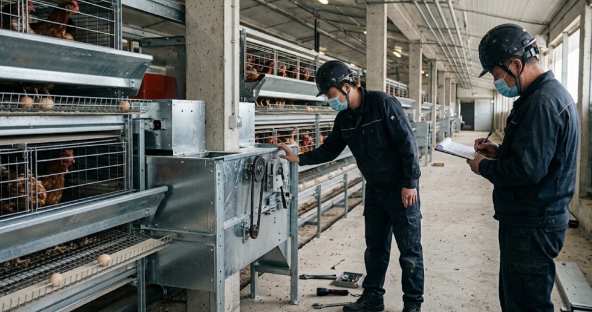
Send a Replacement Inquiry Based on the Existing Farm
Prepare one project brief containing:
- Country, project location and delivery point.
- Houses affected, current flock schedule and target work window.
- Measured house drawing, existing cage arrangement and site photographs.
- The problem to solve and whether you are considering full replacement, partial replacement or an automation retrofit.
- Equipment to retain, model information and connection measurements.
- Required new functions, site-work responsibilities and any information still missing.
Mark unknown details as “to be measured” or “to be confirmed.” Send these details through the poultry equipment inquiry page, stating that this is an existing-farm replacement project. Ask the supplier to identify the proposed equipment, layout information available, unresolved interfaces and items included or excluded from the offer.
Confirm the project-specific configuration and responsibilities before placing the order, rather than treating a cage price as a complete replacement plan.
Want to know more?
Get in touch with us for more information about our services and products.