
Manure Belt vs Scraper System for Layer Farms: Layout and Quotation Checklist
Two suppliers can both quote "automatic manure removal" for the same layer house and still be pricing two different systems. A manure belt system carries manure out of the house on belts. An independent scraper system drags manure along a channel or pit with a blade. They collect manure in different places, need different house conditions and create different work at the end of the row.
That is why the useful question is not "which system is better?" in general. It is:
- Which system fits this house, this cage layout and this manure condition?
- Where does manure leave the building, and who provides that last part?
- What is included in each quotation, and what is still missing?
This guide gives you a like-for-like way to compare a manure belt and a scraper system before you ask for a final layout or price. It does not set belt width, motor size, channel dimensions or removal frequency for your farm. Those depend on the house, the manure load, the climate and the supplier's design.
1. First, make sure you are comparing two different systems
What a manure belt system does
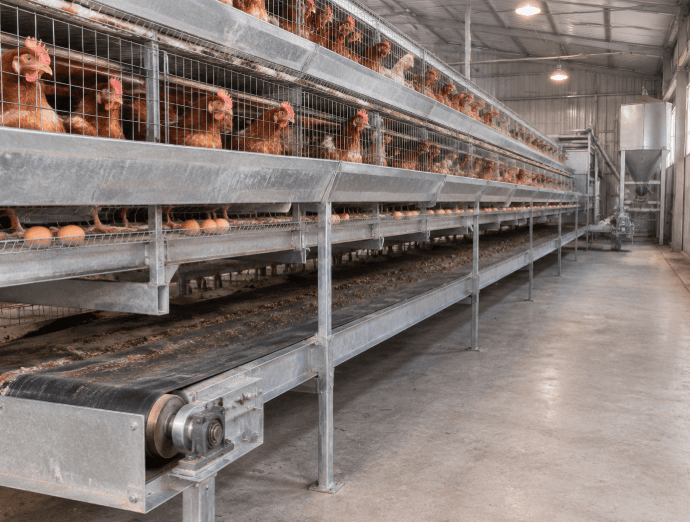
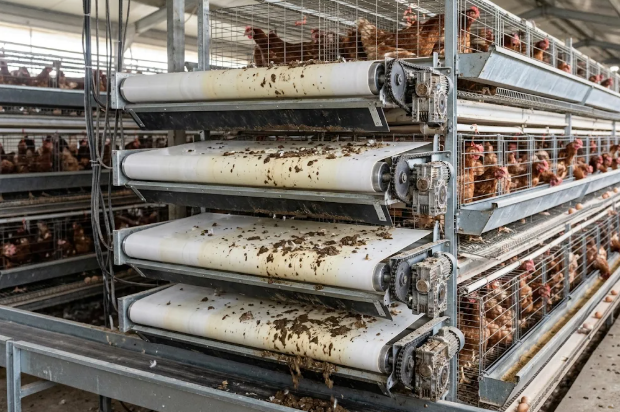
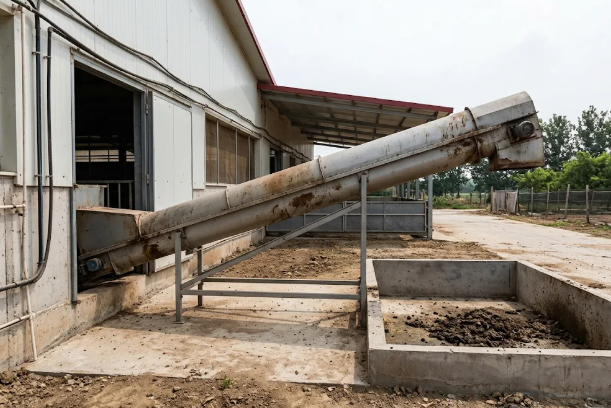
In a cage house with a manure belt system, a belt runs under each tier of cages. Fresh manure drops onto the belt and is carried to one end of the cage row. At the head unit, the belt turns over and a scraper blade removes the manure from the belt surface. The manure then drops onto a cross conveyor or an inclined conveyor and leaves the house.
The main parts are the tier belts, the drive and tension units, the head unit, the cross or inclined conveyor, the support frame and the controls. The exact arrangement changes with cage type, row length, tier count and the discharge point.
What an independent scraper system does
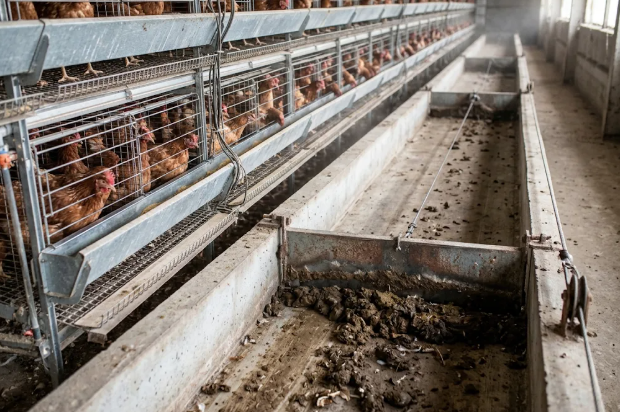
In a channel scraper system, a driven scraper moves manure along a purpose-built channel beneath the cages to a collection point. The drive arrangement and onward transfer depend on the system design. Scrapers on dropping boards may instead move manure into a pit below; they should not be assumed to provide the same route out of the house.
The main components are channels or pits, blades, drive devices, cables or chains, return or corner devices, and discharge points. The condition, alignment, and depth of concrete channels are as important as the blades themselves.
One confusion to clear up first
Many belt systems use scrapers at the head. Scrape off the feces on the belt. It is a belt cleaning component, rather than an independent scraper manure removal system that allows blades to pass through the channel below the cage. If two quotations use the term 'scraper', but one of them represents a belt head scraper, then the quotations are not comparable.
2. What each system needs from the layer house
Manure belt system
A belt system needs a continuous path under each cage tier, a drive and tension point at the end of the row, and enough space at the discharge end for the head unit and the cross or inclined conveyor. The belt cannot turn a tight corner, so the row layout and the discharge direction have to be settled early.
The system also requires a conveyor belt to transport feces. Some layouts use pits. Some layouts use an above-floor cross conveyor connected to an inclined conveyor that lifts manure into a trailer or storage area.
Due to the belt being located below the cage layer, it is necessary to check the space between the bottom of the cage and the floor or pit. The modification also requires confirmation that the row end has enough space for drive units, tensioning devices and conveyors without blocking walkways, doors, or service channels.
Scraper system
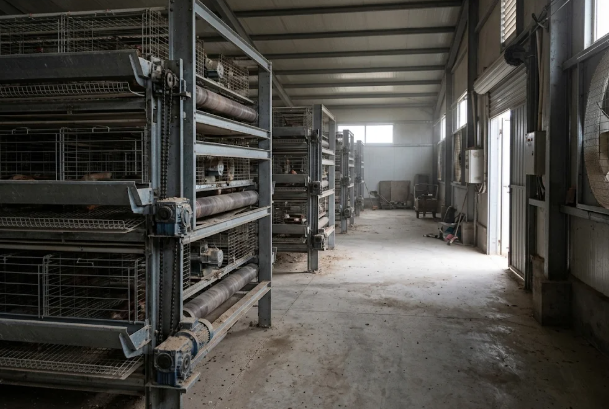
The scraper system requires a straight, intact, and sized channel or pit suitable for the blade. The channel must transport feces without leakage, and the drive unit must be securely anchored in the position specified by the supplier. Blades, cables or chains, pulleys, and corners all require maintenance and replacement.
The house also has to suit the way manure reaches the channel. If manure drops directly into a pit, the pit depth and the air movement above it affect drying. If manure is scraped from dropping boards, the boards, supports and scraping path have to be in good condition. Wet manure, leaking drinkers and surface water make a scraper system harder to manage, just as they make a belt system harder to manage.
The Purdue University Extension Department described the shallow pit under the cage as approximately 3 to 8 inches deep and 3 to 6 feet below the cage, where feces are scraped or washed away. Consider it as an example of dimensions that must be checked, rather than the specifications of the house. The channel size, slope, and structure must be designed by your building and equipment suppliers.
Side-by-side comparison
| Decision area | Manure belt system | Independent scraper system |
|---|---|---|
| Where manure is collected | On a belt under each cage tier | In a channel, gutter or pit under the cages, or on dropping boards |
| Main house requirement | Clear belt path under each tier; drive and conveyor space at the row end | Straight, sound channel or pit; drive anchoring; access for blade and cable |
| How manure leaves the row | Head unit transfers manure to a cross or inclined conveyor | Blade moves manure along the channel to one discharge end |
| Typical discharge | Pit, trailer, storage area or drying point | Pit end, discharge chute, trailer or storage area |
| Retrofit work | Check under-cage clearance, row ends, conveyor route and openings | Check channel dimensions, condition, fall, covers and drive position |
| Floor space at discharge | Cross conveyor and incline take space at the end of the house | Drive and discharge point take space at one end of the channel |
| Civil works | Supports, openings and possibly a pit or plinth | Channel or pit construction, repair, covers and anchoring |
| Daily attention | Belt tracking, tension, belt condition, head scraper, conveyor and controls | Blade condition, cable or chain tension, pulleys, channel condition and drive |
| Wet manure | Belts can become difficult to clean and dry | Wet manure increases volume, odor and scraping load |
| Main limitation | Needs a clear belt and conveyor route | Needs a suitable channel and reliable drive access |
3. The discharge route decides more than the equipment
A poultry manure removal system ends where the next handling step begins. If that step is not planned, both a belt and a scraper can leave manure at the wrong place, at the wrong height, or in a form that is difficult to store and transport.
Before comparing equipment, draw the route from the cage row to the final receiving point:
- Cage row or channel end.
- Head unit or scraper discharge.
- Cross conveyor, incline or discharge chute.
- Trailer, pit, storage shed or composting area.
- Loading or removal from the farm.
At each point, record the height, horizontal distance, turning space, and who provides the structure. The conveyor that is discharged into the trailer requires a safe vehicle passage. The scraper discharged into the pit requires sufficient capacity and a emptying plan. The storage area needs to be protected from rainwater and surface water.
The promotion guidelines are consistent on one point: fecal treatment does not stop at moving out of the house. Storage, drying, and land use are all part of the same system, and wet manure can generate more odors, flies, and transportation costs. Like the cage arrangement, carefully plan the receiving points.
4. Measure the house before you choose
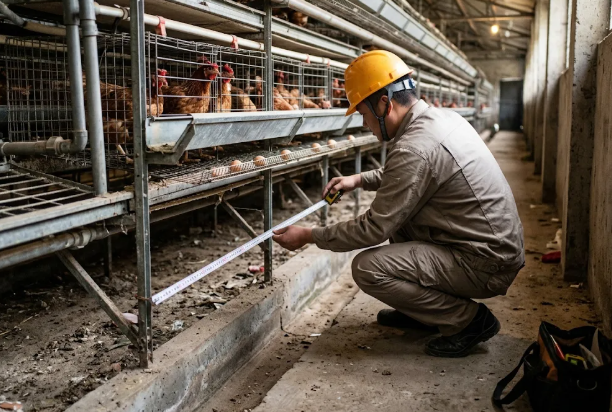
For an existing house, do not compare quotations from an old drawing alone. Measure the actual building and record what is already there. The following list is the minimum information a supplier needs to check whether either system fits.
| What to measure or record | Why it matters |
|---|---|
| Internal length, width and eave height | Sets row length, conveyor route and available headroom |
| Cage type, row count and tier count | Determines belt paths or channel positions |
| Row length and distance between rows | Affects drive count, belt splices and scraper stroke |
| Clearance under the lowest cage tier | Confirms whether a belt, channel or pit fits |
| Floor level, slope and condition | Affects supports, drainage and channel construction |
| Existing pit or gutter: length, width, depth, condition | Decides whether a scraper can use it or it must be repaired |
| Discharge end and opening size | Confirms conveyor, chute or blade access |
| Door, walkway and maintenance access | Prevents a system that cannot be serviced |
| Power supply: voltage, phase, capacity | Confirms drive and control requirements |
| Water supply and drainage | Needed if flushing or cleaning is part of the design |
| Existing feeding, egg collection and ventilation equipment | Identifies interfaces and obstructions |
| Available shutdown or installation window | Affects how the work can be phased |
| What stays and what is removed | Prevents quoting for the wrong scope |
For a belt retrofit, check the available space beneath each relevant cage tier, the proposed belt supports, the drive and tensioning positions, and the cross-conveyor route. Confirm that the equipment will not obstruct walkways, doors or maintenance access.
For a scraper retrofit, verify the existing channel dimensions, alignment and concrete condition against the proposed equipment requirements. Have the drive anchoring and any structural alterations reviewed before ordering.
5. Use one quotation checklist for both offers
The fastest way to compare a manure belt vs scraper system is to send both suppliers the same project table and ask them to answer every line. A low equipment price is not useful if it leaves out the conveyor, the civil works or the controls.
| Quotation item | What the offer should state | Why it matters |
|---|---|---|
| System definition | Belt system or independent scraper system; what is included | Prevents comparing a belt head scraper with a full scraper system |
| Layout drawing | Plan and section showing the row, drive, transfer and discharge | Shows whether the system fits the building |
| Collection elements | Belts per tier, or channel/blade arrangement | Establishes the core scope |
| Drive units | Motor, gearbox, number and location | Affects power supply and maintenance access |
| Transfer and discharge | Head unit, cross conveyor, incline, chute or pit connection | Often the largest hidden cost |
| Controls | Timer or PLC, sensors, alarms, manual override | Defines daily operation and fault response |
| Supports and covers | Frames, anchors, covers, guards | Affects safety and civil works |
| Civil works | Who builds or repairs the pit, channel, opening or plinth | Prevents a gap between equipment and building work |
| Installation | Supervision, labor, commissioning and testing | Clarifies who is responsible on site |
| Spare parts | Belts or blades, rollers, scrapers, cables, bearings | Shows the real cost of ownership |
| Documents | Layout, parts list, operation and maintenance manual, wiring diagram | Needed for handover and future repair |
| Training | Operator and maintenance training | Reduces avoidable downtime |
| Warranty and exclusions | What is covered, for how long, and what is not | Prevents assumptions after delivery |
| Performance basis | Capacity and removal frequency stated with their conditions | Makes two offers comparable |
| Interface responsibilities | Who connects to power, ventilation, feeding and egg collection | Avoids gaps at the battery limit |
Ask each supplier to mark every line as "included", "excluded" or "by others". If a line is blank, treat it as unresolved. Do not compare totals until the scope matches.

6. Selection conditions: when each system fits
There is no universal winner. The right layer farm manure removal choice depends on the building, the manure condition and the work the farm can support.
A manure belt system is usually worth checking when
- The project is a new cage house or a major renovation where the row ends and discharge route can be planned from the start.
- The house uses multi-tier A-type or H-type layer cages and manure has to be removed frequently.
- The farm wants to reduce the amount of manure stored under the cages.
- There is space at the end of the rows for drives and a cross or inclined conveyor.
- The house has enough ventilation to help dry manure on the belt.
- The farm can carry out belt tracking, tension and head-scraper checks.
An independent scraper system is usually worth checking when
- The existing house already has a suitable passage or pit that can be inspected and repaired.
- A supplier has confirmed that the proposed scraper can handle the measured channel length and expected manure load.
- The maintenance team of the farm is familiar with the maintenance of cables, chains, blades, and drives.
- The fecal treatment plan includes a discharge point that matches the stroke and height of the scraper.
- The drive anchoring and any channel alterations have been checked for structural suitability.
Conditions that should pause the decision
- No clear discharge route or receiving area.
- No safe access for maintenance.
- A wet-manure source that has not been corrected, such as leaking drinkers or poor drainage.
- Unclear responsibility for civil works.
- A quotation that gives one capacity number without stating the belt width, manure condition, row length or removal frequency behind it.
Both systems depend on regular attention. A belt system is not maintenance-free because it runs automatically, and a scraper system is not automatically simpler because it has fewer belts. The daily checks are different, not absent.
7. Common comparison mistakes
Comparing a belt head scraper with a complete scraper system. The words are similar, but the scope is not. Ask for a layout showing where manure is collected and where it leaves the house.
Leaving the conveyor out of the belt price. The tier belts do not remove manure from the building on their own. The head unit, cross conveyor and incline are part of the route.
Leaving the channel out of the scraper price. A blade and drive are only part of the system. The channel, covers and discharge point can change the project cost.
Ignoring civil works. Pits, plinths, openings and anchoring are often the items that delay installation. Decide who provides them before the order.
Choosing on price per meter or per bird. A price without the system scope, layout and performance basis is not comparable.
Forgetting spare parts and documents. Belts, blades, cables and bearings wear. A quotation without a parts list and manual is incomplete.
8. What to send before requesting a layout or quotation
Prepare one project pack and send it to every supplier:
- Country, site location and climate.
- Bird type and current or planned bird number.
- Cage type, row count, tier count and row length.
- Poultry house length, width and height.
- Current manure removal method and the main problem.
- Manure condition: dry, wet, sticky or mixed.
- Preferred discharge end and the outside receiving point.
- Power supply and water supply.
- Installation window and whether the house must stay in production.
- Who is responsible for civil works.
- Budget range and required delivery terms.
Write "to be measured" or "to be confirmed" where a value is unknown. Do not fill the gap with a catalogue number. A supplier who asks for these details is more likely to give a layout-based quotation instead of a rough equipment price.
9. Next step
Walk the house with a tape measure and a camera. Photograph the under-cage area, both ends of the rows, the existing pit or gutter if there is one, the discharge point and the vehicle access. Sketch the route from the cage row to the storage or loading area. Mark every unknown on the sketch.
Then send the same project pack to each supplier and ask for the quotation checklist in Section 5 to be completed line by line. Compare the layout, the scope and the exclusions before comparing the total price.
Auto ChickenCage supplies belt manure removal systems for A-type and H-type layer cage projects. This guide includes scraper systems so that buyers can compare the two options on the same house information. It is not a statement that every scraper configuration is available from us. If your project includes an existing scraper, tell us what is already installed and which supplier is responsible for the channel, drive and discharge. We will confirm what our scope can cover before issuing a quotation.
Send your house dimensions, cage layout, manure condition and discharge plan through the contact page to request a layout review.
Want to know more?
Get in touch with us for more information about our services and products.