
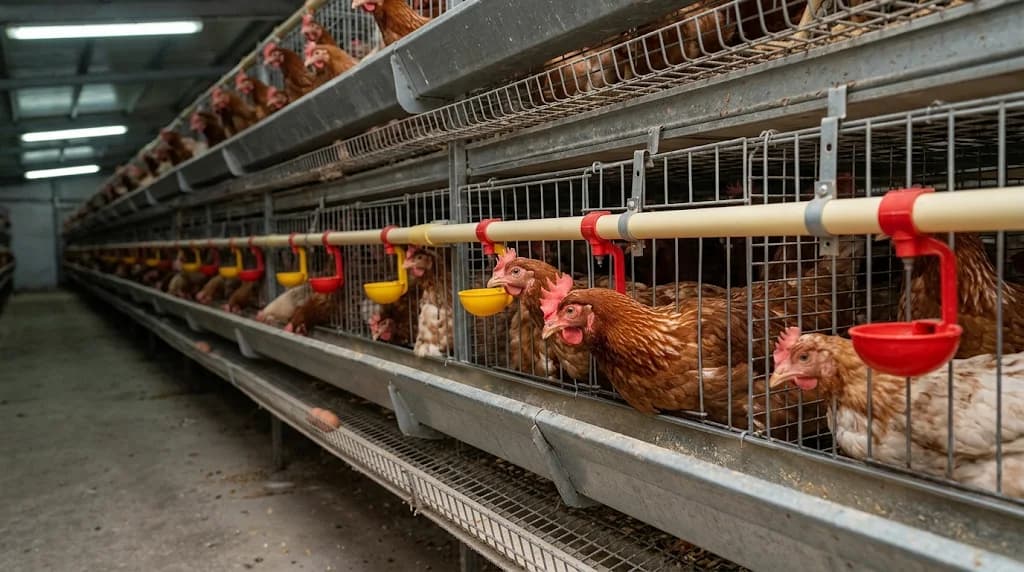
Nipple Drinkers for Layer Cages: Supply & Leakage Checks
Before buying nipple drinkers for layer cages, check three things: whether the farm can deliver enough water to the house, whether the line operates within the selected equipment's pressure requirements, and whether the hens can reach the nipples correctly. A new nipple will not resolve a restriction in the supply pipe, and a larger pump will not repair a damaged seal.
For a new installation, compare the drinking line and its upstream connections as one system. For an existing house with leakage or uneven water delivery, first record where and when the problem occurs. That information helps the supplier distinguish a component replacement from a wider water-supply review.
1. Start With the Water Route, Not the Nipple Count
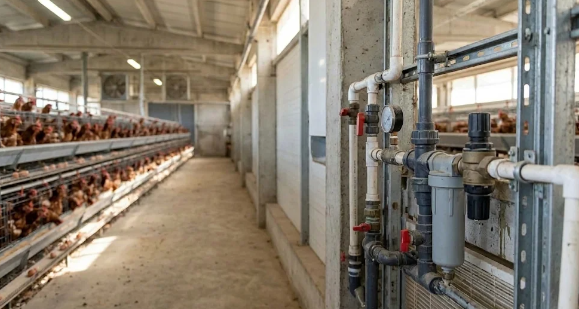
Mark the complete actual pipeline from the water source to the final drinking point, including the water storage tank, water pump, main water supply pipe, filter, pressure control device, chicken coop inlet, and cage branch pipe. The arrangement sequence and position of each component depend on the on-site installation, and it is necessary to use the on-site drawings instead of using general schematic diagrams.
For the water supply system of a chicken farm, it is necessary to record the number of supply chicken houses, the length and diameter of pipelines, the elevation difference of the terrain, and the cooling equipment or other water equipment that shares this set of water supply. A pressure reading at the well or tank does not show the pressure available at the end of the drinking line while the farm’s water systems are operating.
Mississippi State University Extension's water-supply guidance identifies pump capacity, pipe size, distance and elevation as factors in water delivery. Although that publication addresses broiler farms, these supply-system considerations are also relevant when preparing a layer-house equipment enquiry. Its broiler consumption figures and sizing examples should not be copied into a layer project.
Selection condition: if problems appear across several rows or mainly when other water users are running, have the upstream supply assessed before ordering a full set of replacement nipples. If the problem is confined to a few locations, record those points for a component and local-line inspection.
2. Match Water Pressure and Flow to the Selected Line
Keep main-supply pressure, regulated drinking-line pressure and nipple flow rate separate. They describe different parts of the system. A supplier needs the measurement location, units and operating conditions to interpret a reading.
Ask for the selected nipple and regulator models, their operating requirements, and the method for checking delivery along the proposed row length. Have the installer or responsible technician record readings at the locations specified in the equipment instructions, including the relevant row ends.
For an existing installation, provide:
- The regulator model and current setting, if known.
- Where pressure or flow was measured, with the instrument and units.
- Whether birds, cooling equipment or other houses were using water at the time.
- Which rows or tiers showed reduced delivery or leakage.
Low delivery can involve restrictions, filters, supply capacity or pressure regulation. Excessive line pressure can contribute to leakage, but a leaking nipple is not proof that pressure is the only cause. Request a documented check rather than turning the pressure up or down by guesswork.
Selection condition: accept a proposed line only after its pressure and flow requirements have been checked against the planned supply and layout. There is no single setting suitable for every cage row, nipple model and flock stage.
3. Check Nipple Height, Access and Cage Fit
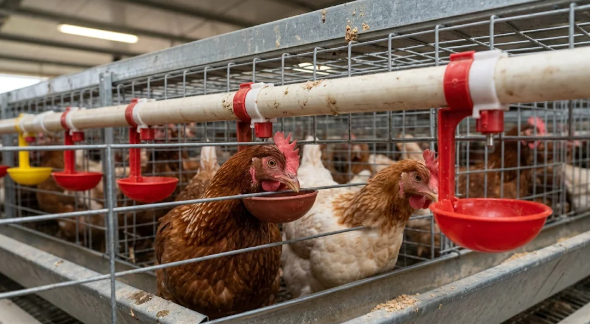
The drinking point must suit the birds and the cage compartment. Ask how nipple position, actuation direction and access will be checked for the flock stage and stocking arrangement. Where adjustment is provided, confirm its range and how the pipe remains supported after adjustment.
For an A-type layer cage or an H-type layer cage, request the actual row-and-tier drinking layout. The cage-type name alone does not specify nipple quantity, location, regulator arrangement or replacement-part compatibility.
On a retrofit, photograph the whole compartment and the drinking point. Record the existing pipe, nipple mounting or thread, connector details and supports. A replacement that looks similar may still need a different connection or operating condition.
Use the selected cage and drinker instructions to establish height and access. A fixed measurement taken from another farm is not a substitute for checking the proposed arrangement with the birds that will use it.
4. Record Leakage Before Choosing a Repair
Give each observation a location: house, row, tier and section. Photograph the wet area and the nearby nipple, joint or pipe. Note whether water appears continuously or during drinking, and whether the problem affects one point, one row or several houses.
| What you observe | What to record for the technician |
|---|---|
| A few nipples drip while nearby ones do not | Nipple model, visible condition, deposits, pressure reading and photographs |
| Several rows have reduced delivery at the same time | Shared supply route, filter condition, pump information and other water users running |
| Water appears at a connector | Connector type, seal reference, pipe condition and a close photograph |
| Wet areas recur near the same section | Line support and alignment, nipple position and when the wet area develops |
| Water use changes unexpectedly | Meter location, flock details, flushing activity, cooling use and visible leaks |
These observations help define the investigation; they do not identify a fault by themselves. Avoid replacing every nipple before checking a shared restriction or regulator problem.
Water entering the manure area also matters to manure-removal planning. Keep leakage checks alongside manure handling and ventilation checks. A wet area alone does not establish its cause or the ammonia level in the house.
5. Include Water Quality and Filter Access in the Review
Provide available water test results, dates, and sampling locations. Ask the farm's water consultant what additional microbiological or mineral testing is required for the water source and facilities.
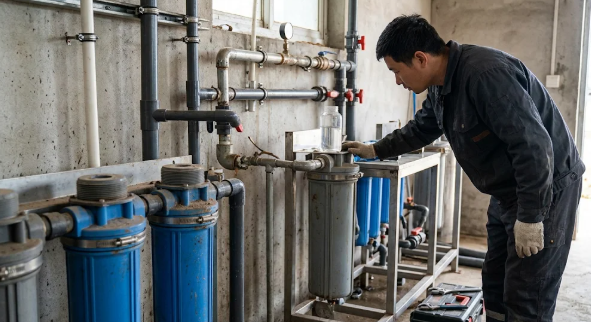
MSU Extension's water-quality guidance describes how minerals and microbial growth can affect water-system components. Its separate supply guidance also explains that clogged filters can restrict flow. A filter therefore needs a documented purpose and operating requirements, not just a place on the equipment list.
Ask the supplier to identify the filter type, the water conditions it is intended to address, its maintenance instructions and the access needed for servicing. Have the responsible designer check the proposed filter's flow and pressure-loss characteristics against the supply requirements.
Sediment filtration, dissolved mineral treatment, and water sanitation are different tasks. Don't assume that one filter can perform all three. The selection of treatment, chemical compatibility, and any dosing scheme require water test results, equipment specifications, and appropriate professional advice.
For a storage tank, establish its purpose, usable capacity, refill arrangement, cleaning access and connection to the house. MSU's poultry water-planning guidance includes storage and backup planning among the questions to resolve. Tank volume alone does not establish usable supply during an interruption; the delivery route must also work.
6. Compare the Same Supply Boundary in Every Quotation
“Drinking system included” can mean different things. One offer may cover cage-row pipes and nipples; another may include regulators and a house connection assembly. List upstream equipment separately until its supply is confirmed.
| Part of the project | Written confirmation to request |
|---|---|
| Cage-row equipment | Nipple model and quantity, pipes, connectors, supports and end fittings |
| Pressure control and filtration | Models, operating requirements, included fittings and service access |
| Source, storage and pumping | Existing equipment retained, new items required and who supplies each item |
| House connections | Exact connection points, pipe specifications and installation responsibility |
| Monitoring and flushing | Metering scope, inspection points, flushing outlets and drainage arrangements |
| Documents and support | Layout, instructions, parts list, commissioning records and agreed support scope |
Mark each item as included, optional, buyer-supplied or awaiting confirmation. Use the equipment quotation checklist to compare offers on that basis.
If pumps or controls depend on electricity, identify what would stop during an outage. Ask the responsible designer to review backup supply, alarms and the delivery arrangement. The poultry-farm power-outage guide provides related planning questions; it does not establish a generator or tank size for the project.
7. Send One Project Brief and Agree the Handover Checks
For a quotation or replacement enquiry, prepare:
- Farm location, house count, flock stage and bird numbers.
- House drawing with cage rows, tiers and drinking-line lengths.
- Water source and any existing tank, pump, filter and regulator details.
- Available water-test results and pressure or flow records with units and measurement conditions.
- Photographs and references for the equipment to be retained.
- Required equipment quantities, current problems and the requested purchase schedule.
Identify unknown information instead of estimating it as a fact. Ask the supplier which items it can quote, what site information remains missing, and which connections need technical review.
Before handover, agree how the installed line, bird access, leakage, water delivery and flushing arrangements will be checked against the equipment documents. Retain the settings and results with the installation handover record. Request model-specific maintenance instructions and part references rather than adopting a universal replacement or flushing interval.
Send your cage and drinking-line enquiry through the Auto ChickenCage contact page. Include the upstream water-supply details and ask for a written equipment list identifying the proposed models, included components, connection requirements and unresolved questions.
Want to know more?
Get in touch with us for more information about our services and products.