
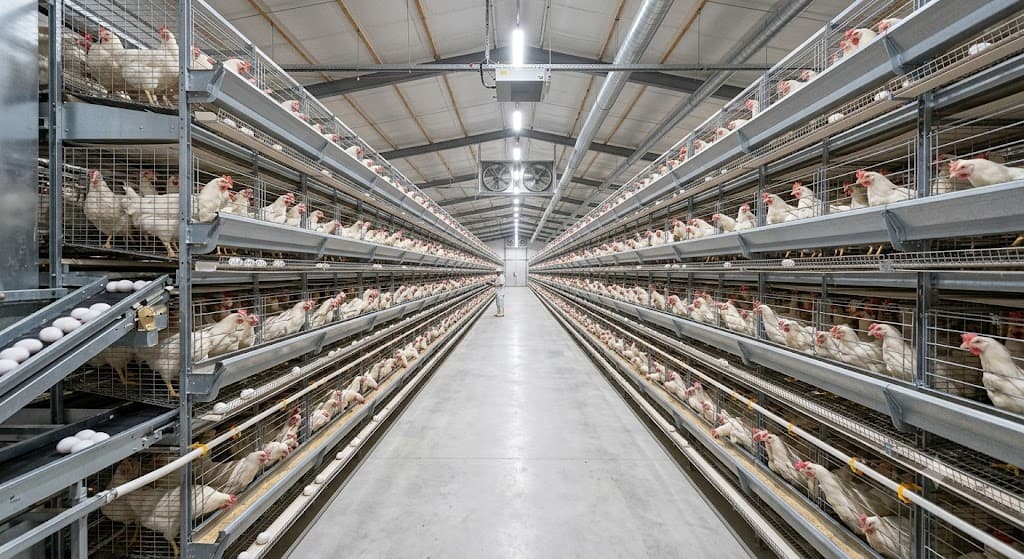
How to Plan Poultry House Size Before Buying Layer Chicken Cages
Before buying layer chicken cages, many farm owners first ask about cage price. But in real poultry farm projects, one of the most important questions is not only “How much is the cage?” It is also:
Can the cage system fit my poultry house properly?
If the poultry house size is not planned before ordering cages, the farm may face problems during installation and daily operation. The house may be too narrow, the aisle may be too small, manure may be difficult to remove, or ventilation may not work well.
This article explains what poultry house information you should prepare before buying layer chicken cages, so the supplier can recommend a suitable cage layout and equipment plan.
1. Start with Your Target Bird Quantity
The poultry house size should be planned according to the number of birds you want to raise.
Before asking for a quotation, confirm your target capacity:
Target capacity: 5,000 / 10,000 / 30,000 / 50,000 layers
The cage layout for 5,000 birds is very different from a layout for 50,000 birds. The number of cage rows, cage tiers, house width, manure system, egg collection method, and ventilation design will all change.
You should also tell the supplier whether you want to expand later. If you plan to start with 10,000 layers and expand to 30,000 layers, the house layout and land use should leave space for future equipment and manure discharge.
2. Choose the Cage Type Before Finalizing House Size
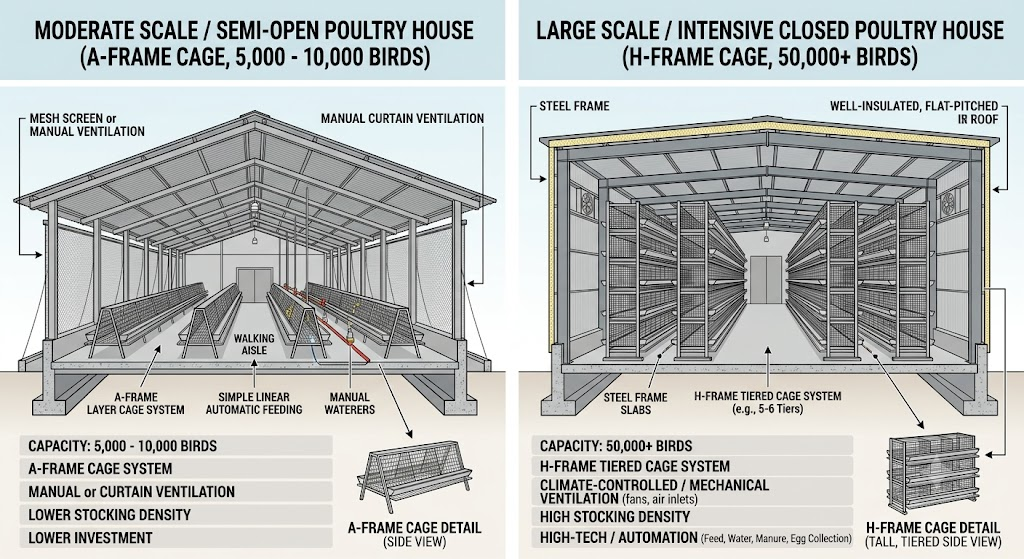
Different cage types need different house sizes. For layer farms, the two common options are A Type cages and H Type cages.
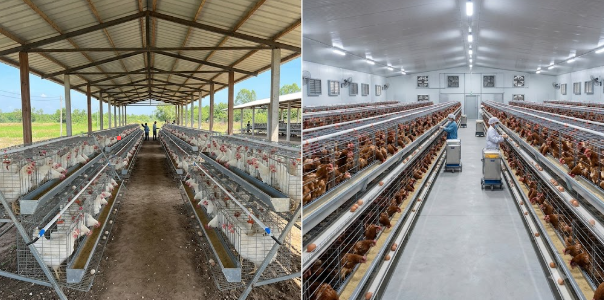
A Type layer cages are often used in small and medium poultry farms. They are suitable for open or semi-open houses and usually need more house width because of the stepped cage structure.
A Type cages may be suitable if:
- The farm has enough land
- The budget is limited
- The poultry house is open or semi-open
- Labor cost is acceptable
- The farm wants a simple cage system
H Type layer cages are usually used in medium and large commercial poultry farms. They have a stacked structure, so they can hold more birds in the same floor area.
H Type cages may be suitable if: - Land or house area is limited
- The farm wants higher bird capacity
- The project needs automatic feeding and manure cleaning
- Labor cost is high
- The farm wants long-term commercial egg production
Before building the house, it is better to decide whether you will use A Type or H Type cages. If the house is already built, the supplier needs the exact size to check which cage type can fit better.
3. Measure the Poultry House Length, Width, and Height
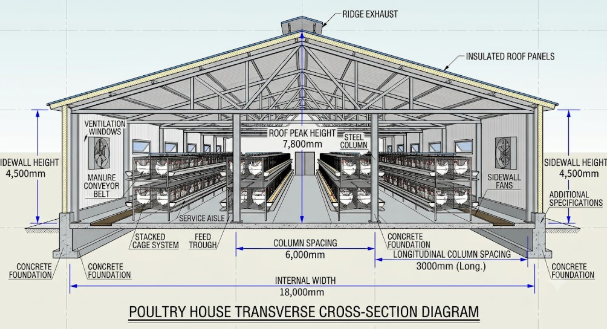
If you already have a poultry house, prepare accurate measurements.
You should provide:
- Inside length
- Inside width
- Sidewall height
- Roof height or total height
- Column position, if any
- Door position
- Window position
- Floor condition
For example:
House size: 80 m length x 12 m width x 3.5 m sidewall height
House type: open house
Column position: every 4 m
The supplier needs this information to design the cage row arrangement, aisle width, feeding system, manure cleaning system, and ventilation layout.
If the height is too low, some H Type cage systems may not be suitable. If the width is too narrow, there may not be enough space for cage rows and worker aisles. If columns block the cage rows, the layout may need adjustment.
4. Reserve Enough Aisle Space
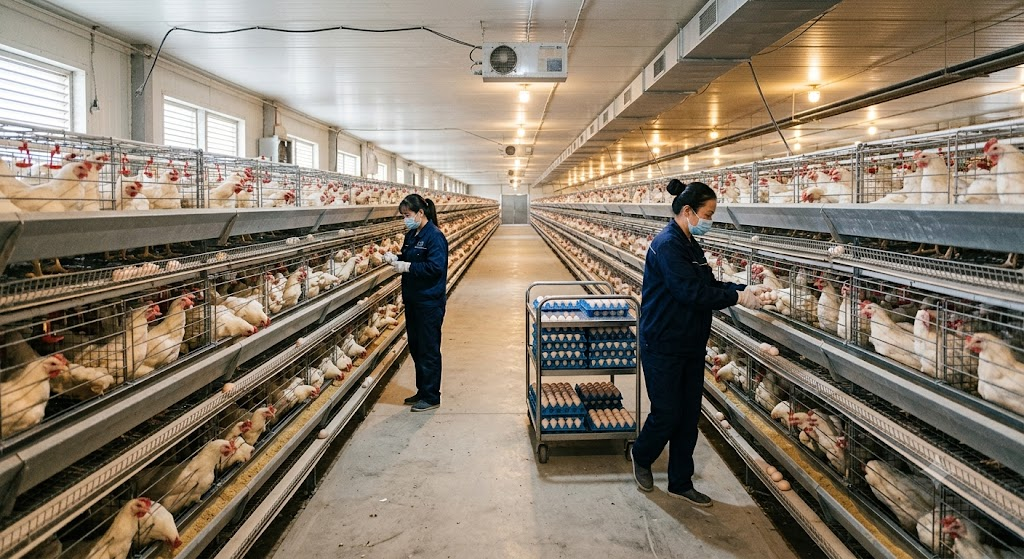
A poultry house is not only for cages. Workers also need space for feeding, inspection, egg collection, cleaning, maintenance, and bird management.
When planning house width, you should reserve space for:
- Side aisles
- Middle aisles
- Cage row spacing
- Feeding machine movement
- Egg collection area
- Manure belt or conveyor space
- Equipment maintenance access
If the aisle is too narrow, daily operation becomes difficult. Workers may not be able to inspect birds easily, collect eggs smoothly, or repair equipment when needed.
This is one reason why the poultry house should not be built only according to cage width. The full operation space must be considered.
5. Plan Space for Feeding Equipment
For small farms, manual feeding may be acceptable. But for medium and large farms, automatic feeding is often recommended.
Suggested product link: Automatic Feeding Machine / Overhead Feeding System
If the farm uses an automatic feeding machine, the house layout should leave enough space for the machine to move and operate.
Before quotation, confirm:
- Manual feeding or automatic feeding?
- How many cage rows need feeding?
- Is there enough space at the front and end of the cage rows?
- Will feed be stored in bags or feed silo?
- Is power supply available for the feeding equipment?
If feeding equipment is considered after the cage layout is fixed, the farm may need to change the layout or lose operation space.
6. Plan Manure Cleaning and Discharge Space
Manure cleaning is a key part of poultry house design. If manure discharge is not planned before installation, daily cleaning can become difficult.
Before buying cages, decide whether you will use:
- Manual manure cleaning
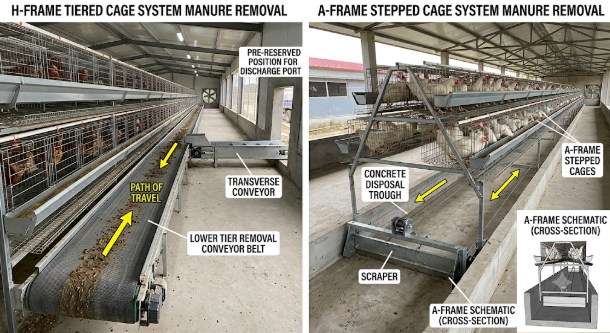
- Scraper manure cleaning
- Manure belt cleaning
For H Type cage systems, manure belt cleaning is commonly used. The house should reserve space for manure belts, cross conveyors, and discharge points outside the house.
You should also decide where the manure will go after leaving the house: - Manure pit
- Manure storage area
- Truck loading area
- Composting area
Good manure discharge planning can reduce ammonia smell, moisture, flies, and cleaning labor.
7. Plan Egg Collection Space
Egg collection also affects house layout.
For small farms, manual egg collection can be used. But for larger farms, automatic egg collection can reduce labor and make egg handling more organized.
Before confirming the house size, consider:
- Manual or automatic egg collection?
- Where will eggs be collected?
- Is there enough space at the front or end of the house?
- Will eggs be moved to a grading or packing area?
- Do you need a central egg collection line?
If you plan to add automatic egg collection later, it is better to reserve space during the first layout design. Otherwise, future upgrading may be difficult.
8. Consider Ventilation and Cooling Layout
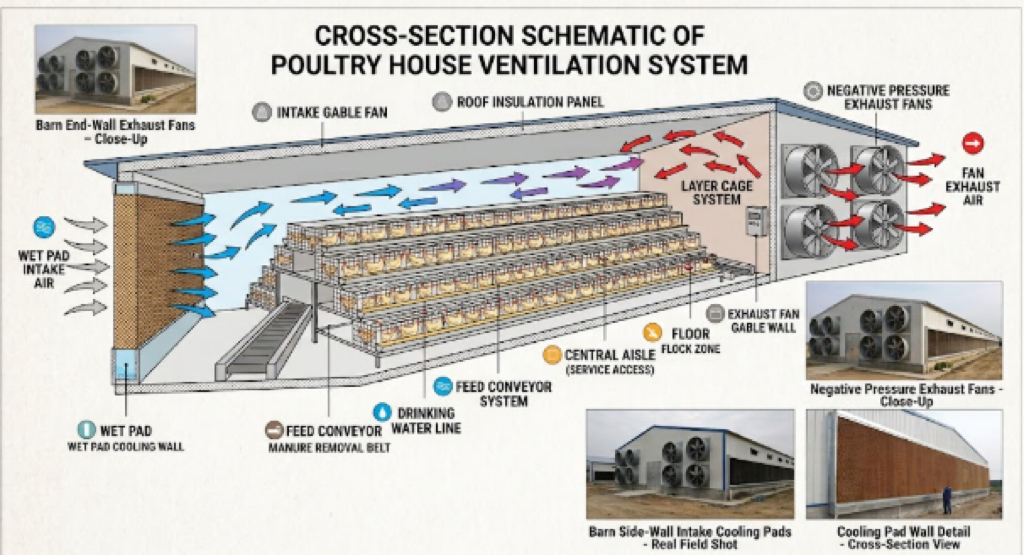
Ventilation should be planned together with cage layout. A poultry house with many layer cages will produce heat, moisture, dust, and manure gas.
Before buying cages, tell the supplier:
- Your country and city
- Local temperature in hot season
- Humidity condition
- Open house or closed house
- Natural ventilation or mechanical ventilation
- Whether fans and cooling pads are needed
- Where fans and air inlets can be installed
For hot climate areas or high-density H Type cage houses, ventilation design is especially important. If the house is too crowded or airflow is blocked by cage rows, birds may face heat stress and poor air quality.
9. Avoid Building the House Before Checking Cage Layout
One common mistake is building the poultry house first, then looking for cages later.
This can cause problems such as:
- House width does not match cage rows
- Height is not enough for H Type cages
- Columns block equipment installation
- Aisle space is too narrow
- Manure discharge direction is not suitable
- No space for egg collection equipment
- Fan and cooling pad positions are not ideal
If the poultry house has not been built yet, the better process is:
Confirm bird quantity → Choose cage type → Design cage layout → Confirm house size → Build poultry house → Install equipment
This process can reduce installation problems and help the farm use space more efficiently.
10. Information to Send Before Requesting a Layout
To get a useful cage layout and quotation, prepare the following information:
| Information | What to Provide |
|---|---|
| Bird quantity | Target number of layers |
| House size | Length, width, sidewall height, roof height |
| House status | Existing house or new project |
| House type | Open, semi-open, or closed |
| Cage type | A Type, H Type, or need recommendation |
| Automation level | Manual, semi-automatic, or fully automatic |
| Feeding method | Manual or automatic feeding |
| Manure cleaning | Manual, scraper, or manure belt |
| Egg collection | Manual or automatic |
| Climate | Country, temperature, humidity |
| Ventilation | Natural ventilation, fans, cooling pads |
| Expansion plan | Whether you will increase bird quantity later |
Sample Inquiry Message
Hello, we are planning a layer chicken cage project.
Target bird quantity:
Poultry house size:
House status: existing / new project
House type: open / semi-open / closed
Preferred cage type: A Type / H Type / need recommendation
Automation level:
Feeding method:
Manure cleaning method:
Egg collection method:
Country and local climate:
Future expansion plan:
Please recommend a suitable poultry house layout and cage system.
This helps the supplier check whether the cage system can fit your house and recommend a practical equipment list.
Final Recommendation
Before buying layer chicken cages, do not only compare cage price. The poultry house size should be planned according to bird quantity, cage type, aisle space, feeding method, manure cleaning, egg collection, and ventilation.
If you are building a new poultry house, confirm the cage layout before construction. If you already have a poultry house, send accurate measurements, photos, and your target bird quantity to the supplier.
A practical layout can help the farm avoid installation problems, improve daily operation, and prepare for future expansion.
If you are not sure what house size is suitable for your layer farm, send us your target bird quantity, house dimensions, country, and automation requirements. Our team can help recommend a suitable A Type or H Type layer cage layout for your poultry house.
Want to know more?
Get in touch with us for more information about our services and products.