
How to Choose Between A Type and H Type Layer Chicken Cages
How to Choose Between A Type and H Type Layer Chicken Cages
Choosing the right layer chicken cage system is one of the most important decisions when building or upgrading a poultry farm. For most commercial egg farms, the choice usually comes down to two common options: A Type layer chicken cages and H Type layer chicken cages.
Both systems can be used for layer farming, but they are designed for different farm sizes, budgets, house structures, labor conditions, and automation requirements. If you choose only by cage price, it is easy to buy a system that does not match your poultry house or long-term operation plan.
This guide explains the practical differences between A Type and H Type layer cages, so you can choose a more suitable system before requesting a quotation.
What Is an A Type Layer Chicken Cage?
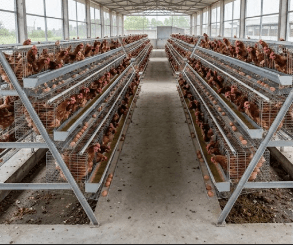
An A Type layer chicken cage is a stepped cage system. The cage tiers are arranged like the shape of the letter “A”, so the upper cages do not completely cover the lower cages.
This design allows better natural ventilation and lighting, which makes A Type cages suitable for many open-house poultry farms and small to medium layer projects.
A Type cages are commonly used in:
- Small and medium egg farms
- Open poultry houses
- Farms with lower investment budgets
- Projects upgrading from floor rearing to cage farming
- Farms where manual feeding or semi-automatic equipment is still acceptable
For many first-time poultry farm investors, A Type cages are easier to understand, easier to install, and more flexible in daily operation.
What Is an H Type Layer Chicken Cage?
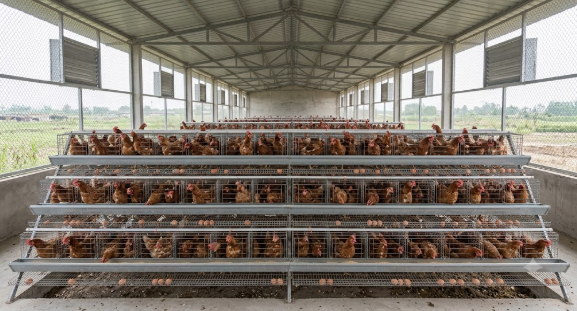
An H Type layer chicken cage is a stacked cage system. The cages are arranged vertically in straight tiers, forming a compact structure similar to the letter “H”.
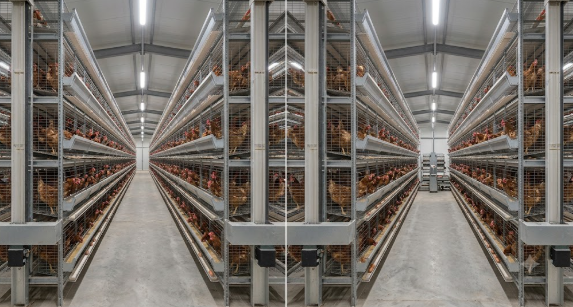
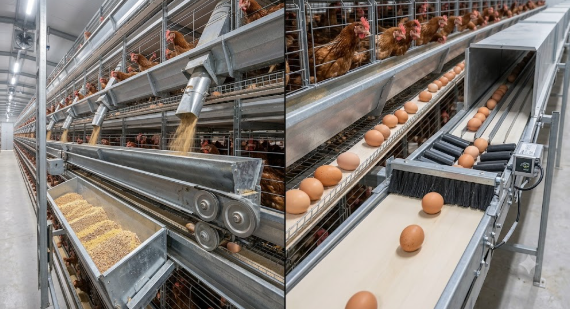
Compared with A Type cages, H Type cages can hold more birds in the same poultry house area. They are usually combined with automatic feeding, automatic drinking, manure belt cleaning, egg collection, and environmental control systems.
H Type cages are commonly used in:
- Medium and large commercial layer farms
- High-density poultry houses
- Closed or semi-closed chicken houses
- Farms with higher labor costs
- Projects requiring automatic feeding, manure removal, and egg collection
- Investors who want long-term scalable egg production
If the farm plans to raise tens of thousands of layers and reduce daily labor, H Type cages are usually a more suitable choice.
Quick Comparison: A Type vs H Type Layer Chicken Cages
| Item | A Type Layer Cage | H Type Layer Cage |
|---|---|---|
| Farm size | Small to medium farms | Medium to large farms |
| Initial investment | Lower | Higher |
| Bird capacity per house | Medium | Higher |
| Land use efficiency | Moderate | Better |
| Ventilation requirement | Easier for open houses | Usually needs better ventilation design |
| Automation level | Manual, semi-automatic, or automatic | Usually semi-automatic or fully automatic |
| Labor requirement | Higher | Lower |
| Installation difficulty | Easier | More technical |
| Suitable poultry house | Open or semi-open house | Closed, semi-closed, or well-designed house |
| Long-term expansion | Limited compared with H Type | Better for large-scale expansion |
1. Choose by Farm Size
Farm size is usually the first factor to consider.
If your farm is around 5,000 to 20,000 layers, A Type cages may be a practical choice. The investment is easier to control, and the system does not require very complex house design.
Product to link: Small Layer Chicken Cage System for 5,000-6,000 Birds
This is especially suitable for small poultry farms that want to start with a manageable number of birds.
If your farm is around 30,000 to 100,000 layers or more, H Type cages are often more suitable because they can increase bird capacity without requiring much more land.
For example, if two farms have the same house length and width, the H Type cage system can usually place more birds than the A Type system. This matters a lot when land is expensive or the farm wants to increase egg production within a limited area.
Simple suggestion:
- 5,000-20,000 layers: consider A Type or small stacked cages
- 20,000-50,000 layers: compare both A Type and H Type based on house size and budget
- 50,000+ layers: H Type is usually more suitable for long-term operation
2. Choose by Investment Budget
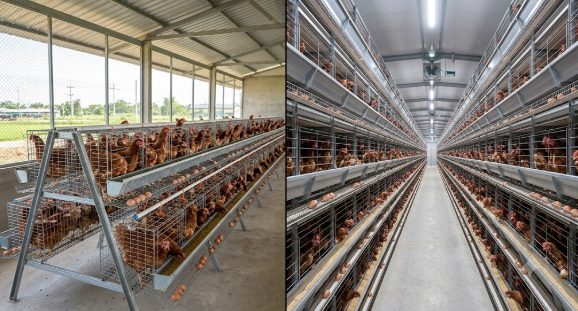
A Type cages usually have a lower initial cost. The structure is simpler, and the farm can choose manual feeding, semi-automatic feeding, or other basic configurations.
This makes A Type cages a good option for farms that want to control the first investment.
H Type cages require a higher initial investment because the system usually includes more equipment, such as:
- Automatic Feeding Machine / Overhead Feeding System
- Manure Belt Cleaning System
- Automatic Egg Collection System
The upfront cost is higher, but the long-term labor saving and higher stocking density may make it more economical for large farms.
So the question is not simply “Which cage is cheaper?”
The better question is:
Which cage system matches your farm scale, labor cost, and long-term production plan?
For a small farm, choosing a full H Type automatic system may create unnecessary investment pressure. For a large farm, choosing a low-cost A Type system may save money at the beginning but increase labor pressure later.
3. Choose by Poultry House Type
The existing or planned poultry house structure will strongly affect the cage choice.
A Type cages are often easier to use in open houses because the stepped structure allows better natural airflow. In many warm regions, farmers use A Type cages with natural ventilation or simple fan systems.
H Type cages have higher bird density, so the poultry house needs a more reliable ventilation and cooling design. If the house is not properly ventilated, heat, humidity, dust, and ammonia can become problems.
Product to link: Poultry House Environmental Control System
For H Type cage houses, the farm may need:
- Exhaust fans
- Cooling pads
- Air inlets
- Temperature control system
- Proper manure removal
- Good aisle and house layout design
If you already have an old open poultry house, A Type cages may be easier to install. If you are building a new closed or semi-closed poultry house, H Type cages can be planned together with the ventilation and automation system from the beginning.
4. Choose by Labor Cost
Labor is one of the biggest daily costs in egg farming.
With A Type cages, some operations can still be manual or semi-automatic, such as feeding, egg collection, and manure removal. This is acceptable for smaller farms or regions where labor cost is not very high.
However, as the number of birds increases, manual work becomes more difficult. Feeding takes longer, egg collection requires more people, and manure cleaning becomes harder to manage.
H Type cages are more suitable when the farm wants to reduce labor through automation.
A typical H Type system can be equipped with:
- Automatic Feeding Machine / Overhead Feeding System
Used to deliver feed evenly to each cage row. - Manure Belt Cleaning System
Used to remove manure regularly and keep the poultry house cleaner. - Automatic Egg Collection System
Used to reduce manual egg picking and improve egg handling efficiency.
If your farm is planning to expand and labor is becoming difficult to manage, H Type cages with automation may be the better long-term choice.
5. Choose by Manure Cleaning Method
Manure management affects poultry house air quality, disease control, and daily labor.
In A Type cage houses, manure may fall naturally to the ground or be removed by scraper or belt systems, depending on the design. This can work for smaller farms, but the cleaning frequency and house environment need to be managed carefully.
In H Type cage systems, manure belt cleaning is commonly used. Each tier can have a manure belt under the cages, and manure can be transported out of the house regularly.
Product to link: Manure Belt Cleaning System
This helps reduce:
- Ammonia smell
- Moisture in the house
- Fly problems
- Manual cleaning work
- Manure accumulation under cages
For large farms, a manure belt system is usually more practical than manual cleaning because the manure volume is much higher.
6. Choose by Egg Collection Method
Egg collection is another important point.
For small A Type cage farms, workers can collect eggs manually. This keeps the equipment cost lower, but it takes time every day.
For medium and large farms, manual egg collection can become slow and labor-intensive. More handling may also increase the risk of egg damage if the operation is not careful.
Product to link: Automatic Egg Collection System
An automatic egg collection system can move eggs from cage rows to the collection area. It is especially useful for H Type cage systems and larger poultry farms.
If your farm produces a large number of eggs every day, automatic egg collection can help improve work efficiency and reduce dependence on manual labor.
7. Choose by Future Expansion Plan
Some farms start small, then expand step by step. In this case, the cage system should not only fit the current budget but also support future growth.
A Type cages are good for starting or upgrading a small farm. But if the land area is limited and the farm wants to increase bird numbers in the future, A Type cages may reach capacity faster.
H Type cages are more suitable for farms that already have a clear expansion plan. The system is more compact and easier to combine with automatic feeding, egg collection, manure removal, and environmental control.
If your goal is to build a commercial egg farm for long-term production, H Type cages may provide better space efficiency and automation potential.
Which Cage System Is Better for Your Farm?
There is no single answer for every poultry farm.
A Type cages are better when:
- Your farm size is small or medium
- Your budget is limited
- You use an open or semi-open poultry house
- Labor cost is still acceptable
- You want a simple and practical cage system
- You are upgrading from floor rearing to cage farming
H Type cages are better when: - Your farm size is medium or large
- You want higher bird capacity in the same house area
- You need automatic feeding, egg collection, and manure removal
- Labor cost is high or workers are difficult to manage
- You are building a new commercial layer farm
- You want a system suitable for long-term expansion
For many farms, the best choice depends on the poultry house size, target bird quantity, local climate, budget, and automation requirements.
Information Needed Before Choosing A Type or H Type Cages
Before requesting a quotation, it is better to prepare the following information:
- Target number of layers
- Poultry house length, width, and height
- Open house or closed house
- Local climate condition
- Manual, semi-automatic, or fully automatic operation
- Preferred feeding method
- Preferred manure cleaning method
- Egg collection method
- Budget range
- Whether the farm will expand in the future
With this information, the cage supplier can recommend a more suitable layout and equipment list.
For example, two farms may both plan to raise 20,000 layers, but the best cage solution may be different if one farm has enough land and low labor cost, while the other has limited land and wants more automation.
Final Recommendation
If you are starting a small or medium layer farm and want to control the first investment, an A Type layer chicken cage system is often a practical choice.
If you are building a medium or large commercial layer farm and want higher capacity, lower labor dependence, and better automation, an H Type galvanized layer chicken cage system is usually more suitable.
The most important thing is to match the cage system with your real farm condition, not just compare the cage price.
If you are not sure which system fits your project, you can send us your poultry house size, target bird quantity, climate condition, and budget. Our team can help recommend a suitable A Type or H Type layer cage layout for your farm.
Want to know more?
Get in touch with us for more information about our services and products.