
How to Match Egg Collection and Packing Line Capacity Before Ordering
To match egg collection and packing line capacity, compare the eggs entering the line during collection with what every connected stage can handle under the same operating conditions. Daily egg numbers alone are not enough. The collection schedule, shared conveyors, tray format, packing hours and removal of filled trays all affect whether the proposed line can complete the job.
Before ordering, request a layout and a capacity table covering the route from the cage-row egg belts to the filled-tray receiving area. Ask the suppliers to identify the limiting stage, explain how incoming flow will be controlled, and state how the proposed configuration will be checked.
1. Separate Daily Volume, Collection Flow and Packing Time
Prepare three figures: the number of eggs expected to enter the line each day, the rate at which they arrive during collection, and the time available for packing.
Eggs collected on the conveyor belt can be released within a shorter collection period. Several houses can also feed the same conveyor. Therefore, dividing the daily output by the length of the working day can mask a higher arrival rate in the packaging area.
For an existing farm, count eggs at the proposed line infeed over clearly stated time intervals. Record which houses or rows were being collected and when collection stopped. For a new project, mark the figures as planning estimates and ask how the proposed collection sequence will affect them.
A useful starting calculation is:
Average intake requirement = planned eggs entering the line ÷ net operating hours available
Net operating hours exclude planned periods when the line cannot run, such as cleaning, breaks without replacement staff, and tray-format changes.
Arithmetic illustration, not a farm case or equipment recommendation: 48,000 incoming eggs over four net operating hours require an average intake of 12,000 eggs per hour. If only three hours remain, the average becomes 16,000. Neither figure describes the peak arrival rate or selects a suitable machine.
Keep incoming egg counts separate from correctly packed output. Rejected eggs, empty tray cells and damaged eggs need their own records; a high intake count does not establish saleable output.
2. Put Every Capacity Figure on the Same Basis
The quoted capacity for an egg collection system may refer to one elevator, one row or a particular combination of tiers. The capacity of an automatic egg tray packing machine may be expressed in eggs, trays or cases per hour. Establish what each figure covers before comparing it.
| Capacity question | Written clarification to request |
|---|---|
| What is being counted? | Incoming eggs, transferred eggs, filled trays or correctly packed eggs |
| What does the rating cover? | One unit, one lane, one house or the complete proposed line |
| Which package is assumed? | Tray or carton reference, eggs per package and packages per case |
| Under what conditions? | Egg-size mix, tray format, infeed pattern, staffing and machine settings |
| Does it include interruptions? | Whether the figure is gross running capacity or measured output over an elapsed period |
| Where was it measured? | Counting point, test duration and the equipment included in the test |
To convert trays per hour into eggs per hour, multiply by the number of eggs per tray. If capacity is quoted in cases per hour, confirm how many trays or cartons each case contains and how many eggs each tray or carton holds. Use the same packaging basis when comparing suppliers.
A gross running capacity does not show how many eggs will actually be packed during a shift that includes downtime. Ask what operating conditions and interruptions the quoted rate allows for, rather than applying an assumed efficiency percentage.
For tray dimensions, egg samples and format changes, use the automatic egg tray packing machine selection guide. Those details remain part of the capacity conditions.
3. Find the Limiting Stage Along the Actual Route
Trace each egg route on the layout:
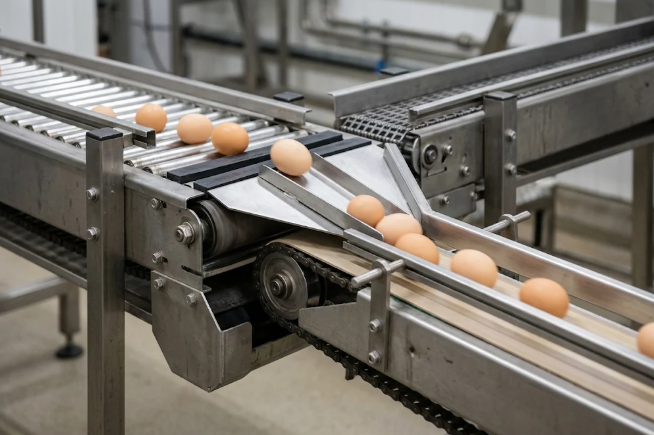
Cage-row belts → elevator or transfer unit → shared conveyor → grading or inspection, if included → packing machine → filled-tray removal.
For each stage, record its model, operating mode, stated capacity basis and connection points. Mark which units run in parallel and which share a downstream route.
| Stage | What may limit the proposed flow |
|---|---|
| Cage-row belts and elevators | Collection sequence, active rows or tiers, and transfer conditions |
| Shared conveyors | Combined arrivals from several houses, junctions and downstream availability |
| Grading or inspection, if included | Capacity of the selected process and handling of diverted eggs |
| Packing machine | Tested tray format, egg range, infeed conditions and tray replenishment |
| Filled-tray removal | Take-away conveyor, manual handling, stacking arrangement and receiving space |
Adding the ratings of several elevators does not establish the capacity of their common conveyor or packer. Likewise, buying a faster packer will not increase the flow through an unchanged upstream restriction.
When collection equipment is retained, check the physical connections as well as the rates. The vertical egg elevator retrofit guide covers belt positions, transfer direction and installation space.
Selection condition: ask the supplier to name the limiting stage for the proposed route and schedule. A list of separate machine ratings is not a verified whole-line output figure.
4. Choose Between Simultaneous Collection, Sequencing and Buffering
If eggs from several houses are collected at the same time, check their combined arrival rate at each shared section of the line. If collection is organised in groups, request a schedule showing the houses in each group, expected egg volumes, collection periods and total completion time.
Collecting eggs from houses in sequence may reduce peak demand on shared equipment, but the farm must still finish collection within its operating window. Have the farm team review the proposed timing; do not assume that delaying egg collection from a house is always acceptable.
The accumulation area can absorb the temporary difference between inflow and outflow flow. However, if the number of arrivals is still higher than the number of departures, the queue will continue to increase. Extra buffer space cannot compensate for the persistent capacity shortage.
For an agreed review interval, the approximate additional queue is:
Excess incoming rate × duration, using matching time units.
This is a flow-balance calculation, not a specification for a safe egg-holding area. Actual usable accumulation depends on the equipment, occupancy, egg handling and controls.
Ask how the proposed line detects a full downstream section, limits further arrivals and responds when trays run out or packing stops. Have the responsible technical personnel define and approve the stop and restart sequence. Any manual alternative needs its own capacity, access and staffing review.
Selection condition: where peak flow exceeds the receiving stage's rate, require a documented collection schedule, verified accumulation arrangement or revised equipment proposal before accepting the configuration.
5. Check Capacity and Handling Quality in the Same Trial
Ask if it is possible to test the proposed configuration, what it covers, and what the cost is. The independent packaging demonstration cannot verify the excluded elevators, shared conveyors, or control connections in this test.
Agree on the test conditions and acceptance criteria in writing. Use the intended tray references, a stated egg-size distribution and the planned egg-infeed arrangement. Include representative operating conditions and agreed stop-and-restart scenarios that the test setup can reproduce.
Record:
- Equipment models, configuration, settings and tray references.
- Incoming eggs and correctly packed output at defined counting points.
- Elapsed time, actual running time and reasons for interruptions.
- Empty cells, misloads, jams, damaged eggs and manual interventions.
- Accumulation at shared sections and filled-tray removal.
- Conditions that were not tested and how they will be checked later.
For damage checks, establish incoming egg condition and the observation points before the trial. Otherwise, damage already present may be attributed to the wrong stage. See the collection and packing breakage guide for related inspection points.
Keep the test result tied to the configuration and conditions actually assessed. If a factory test excludes retained equipment or site connections, list the remaining site acceptance checks and who will perform them.
6. Compare Quotations With One Capacity and Interface Table
For a complete on-farm egg packing line, ask each supplier to complete the same table. Include retained and buyer-supplied equipment so that gaps remain visible.
| Stage or interface | Information required in the proposal |
|---|---|
| Collection from each house | Models retained or supplied, active groups and expected collection flow |
| Shared transfer route | Connection dimensions, combined flow and proposed control response |
| Packing and tray handling | Model, tray references, capacity conditions and filled-tray receiving method |
| Accumulation and stops | Available arrangement, operating limits and responsibility for control integration |
| Testing and acceptance | Equipment tested, counting method, acceptance criteria and unresolved site checks |
| Supply boundary | Included, optional, buyer-supplied and excluded items, with a responsible party for each connection |
Compare controls, sensors, connecting conveyors, supports, site services, installation, commissioning and documents alongside the machines. Confirm commercial terms separately. The layer farm equipment quotation checklist provides a wider scope check.
Next Step: Send the Production Plan and Egg Route Together
Prepare one enquiry pack containing the farm location, current and planned egg volumes, house and cage-row layout, collection sequence, net packing hours, tray references, retained equipment details and photographs of transfer points. Add available flow records and identify where figures are estimates or still unknown.
Send it through the Auto ChickenCage contact page. Ask which equipment can be quoted and request a written configuration with the capacity basis, proposed flow-control arrangement, interface responsibilities and outstanding questions. Have the farm and equipment technical teams review that proposal before confirming the order.
Want to know more?
Get in touch with us for more information about our services and products.