
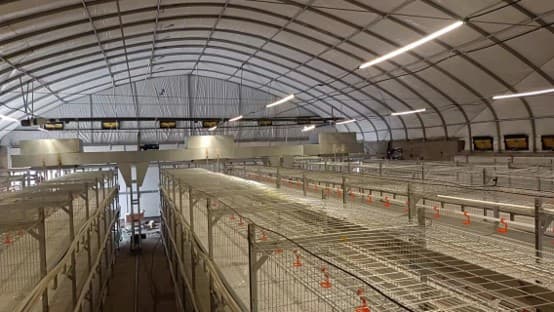
Overhead Travelling Feeding Machine for Poultry Cages
Overhead Travelling Feeding Machine for Poultry Cage Systems
Product Overview
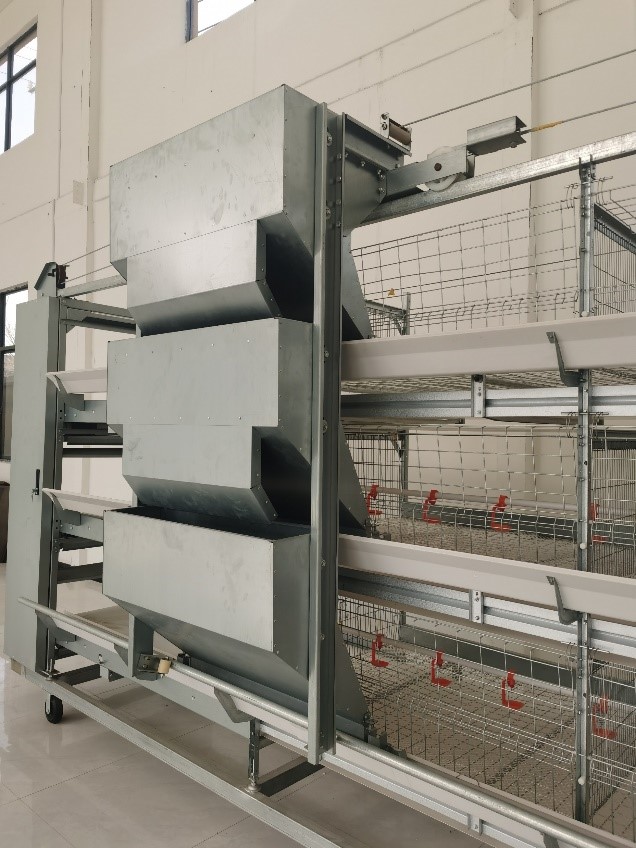
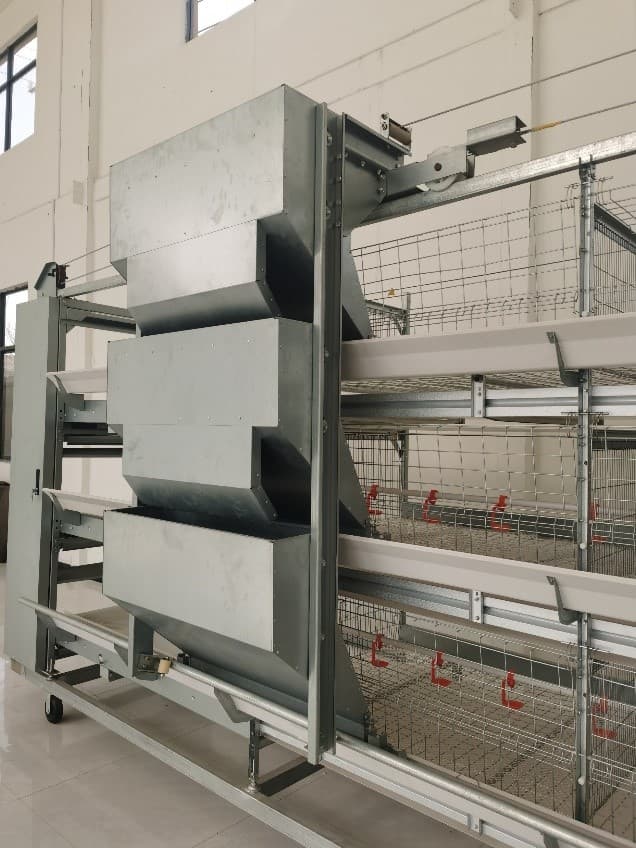
The overhead travelling feeding machine is a rail-mounted automatic feeder exclusively designed for layer, breeder, and pullet houses equipped with cage systems (H-type/A-type). Mounted on steel rails above cage rows, it travels the full length of the poultry house while precisely dispensing feed into troughs across all tiers – ensuring uniform feed distribution that is critical for consistent bird growth and stable egg production (boosting laying rate by 3–5% vs. manual feeding).
The system integrates a large-capacity feed hopper, adjustable discharge outlets, a robust drive mechanism, heavy-duty travelling wheel assemblies, overhead rails, and an intelligent electric control unit. Feed is supplied to the hopper from a central silo or auger system; during operation, the machine moves at a preset speed (6–20 m/min) and dispenses a fixed feed volume per meter (50–200g/m) in line with pre-programmed feeding schedules, eliminating manual intervention in feed distribution.
Working Principle
- Centralized feed supplyFeed is transported from the farm’s main silo or feed preparation room to the feeder’s hopper via auger or chain conveyor, eliminating manual feed hauling to cage rows.
- Rail-guided travellingThe machine is mounted on polyurethane wheels that run on galvanized steel overhead rails (installed 2.5–4.0m above cage rows). A 0.75–2.2kW electric motor drives forward/backward movement via corrosion-resistant chain or helical gear transmission, with speed adjustable to match feed discharge needs.
- Precision feed dischargeAdjustable slide outlets (0–50mm) or screw distributors along the hopper bottom release feed into troughs. Discharge rate is synchronized with travelling speed to ensure the exact ration per meter of cage – no overfeeding, underfeeding, or trough overflow.
- Automated cycle operationLimit switches at rail endpoints trigger deceleration, stop, and reverse movement. The feeder completes 1–3 fully automatic feeding cycles daily (programmable via control panel), with overload sensors pausing operation if jams occur to protect the drive system.
Key Features
- Ultra-uniform feeding: Synchronized speed and discharge control keep feed level variation <5% across all troughs, reducing bird competition and improving flock uniformity (CV <8%) by 15–20%.
- 70% labor reduction: One operator initiates full-house feeding via the control panel; replaces 3–5 workers needed for manual barrow feeding in large houses (100,000+ birds).
- Durable corrosion-resistant construction: Hopper (galvanized steel/304 stainless steel) and frame (hot-dip galvanized steel) withstand high humidity/ammonia – service life 10–12 years.
- Flexible feed rate adjustment: Outlet openings and travelling speed adapt to pullet (100g/bird/day), layer (120–150g/bird/day), or breeder (180g/bird/day) rations, and different feed types (pellets, mash).
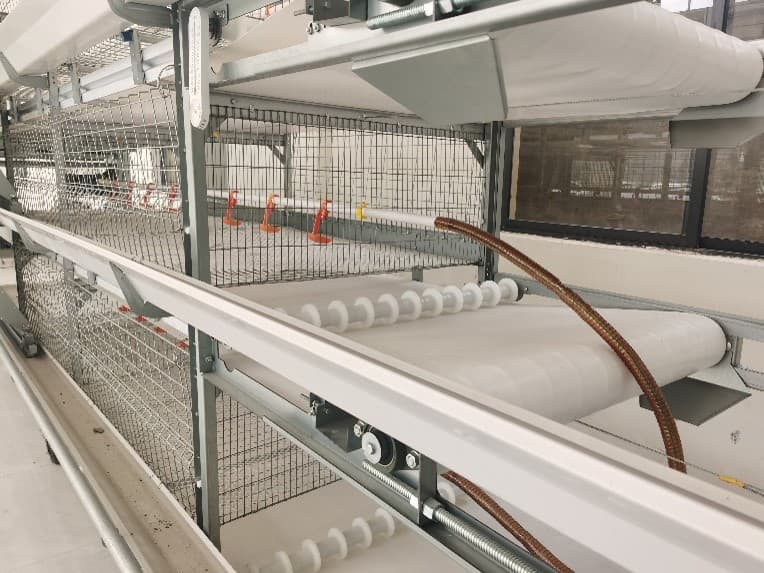
- Versatile layout compatibility: Fits H-type/A-type layer cages, breeder cages (3–8 tiers); serves single rows (one-side feeding) or dual rows (both-side feeding) for house widths 8–20m.
- Safe & reliable operation: Equipped with limit switches, overload protection (1.5x rated load), emergency stop buttons (machine + control panel), and anti-derailment wheels – annual downtime <0.5%.
Technical Specifications (Typical)
The following values are typical ranges. Exact specifications (hopper volume, motor power, rail length) can be fully customized to match cage row length (10–100m), house width, and daily feed demand.
| Item | Specification (Typical Range) |
|---|---|
| Product Name | Overhead Travelling Feeding Machine |
| Application | Layer / breeder / pullet cage houses (5,000–500,000 birds) |
| Installation Type | Overhead rail type, travelling along cage rows (rail height 2.5–4.0m) |
| Hopper Material | Galvanized steel (1.5–2.0mm) or 304 stainless steel (1.2–1.5mm) |
| Hopper Volume | 200L (small model) – 800L (large model) |
| Frame Material | Hot-dip galvanized steel structure (2.0–2.5mm thickness) |
| Power Supply | 380V/220V, 50/60Hz, 3-phase (110V/440V available on request) |
| Motor Power | 0.75kW (small) – 2.2kW (large) |
| Drive System | Electric motor + stainless steel chain / helical gear transmission |
| Travelling Speed | Adjustable, 6–20 m/min (precision ±0.5 m/min) |
| Feed Discharge Control | Adjustable slide outlets (0–50mm) or screw distributor (50–200g/m) |
| Suitable Cage Types | H type layer cages, A type layer cages, breeder cages (3–8 tiers) |
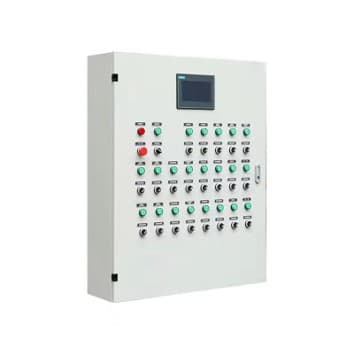
| Control Mode | Central PLC control panel (automatic/manual modes) + remote control option |
| Protection | Limit switches, overload protection, emergency stop, anti-derailment wheels |
| Machine Weight | 300kg (small) – 800kg (large) |
You can replace the ranges with your exact model data (hopper volume, motor power, rail length, minimum house height, etc.) before publishing.
Application & House Layout
The overhead travelling feeder is optimized for medium-to-large poultry houses (10,000+ birds) requiring fast, uniform long-distance feed delivery – suitable for new builds or retrofits to existing cage systems.
Typical Layout Configurations:
- Single-row feeding: One machine serves a single long cage row (10–100m), feeding troughs on one side – ideal for narrow houses (8–10m width).
- Dual-row feeding: One machine positioned between two cage rows, feeding troughs on both sides – maximizes efficiency in wide houses (12–20m width).
- Multi-machine layout: Multiple feeders installed in extra-long houses (>100m) or segmented sections, cutting total feeding time by 50%.
Integrating the feeder with central silos, feed weighing scales, and flock management software enables precision phase-feeding programs – reducing feed waste by 8–10% and optimizing feed conversion ratio (FCR) to 2.0–2.2:1 for layers. It is widely deployed in Africa, the Middle East, Southeast Asia, and Latin America, adapting to closed environmental control houses and open-sided naturally ventilated houses.
Advantages for Poultry Farms
- Drastic labor cost reductionAutomatic feeding eliminates manual feed barrowing – a single operator manages 50,000+ birds (vs. 10,000 birds/worker with manual feeding), cutting annual labor costs by 60–70%.
- Superior flock uniformity & production performanceEven feed access improves body weight uniformity and boosts egg production (layers) by 3–5% or fertility rate (breeders) by 4–6%, directly increasing farm revenue.
- 8–10% lower feed wasteControlled discharge and synchronized speed eliminate trough overflow/spillage – for a 100,000-bird layer farm, this saves $15,000–$20,000 annually (feed accounts for 60–70% of total production cost).
- Enhanced feed hygieneClosed/semi-closed hopper and rail system reduces feed contamination from dust, manure, or pests – lowering feed-borne disease risk (e.g., salmonellosis) by 40%.
- Low maintenance & long service lifeSimple mechanical design with minimal moving parts; routine maintenance (monthly lubrication, quarterly inspection) is completed by farm staff. Galvanized/stainless steel construction delivers 10–12 years of reliable operation with no major repairs.
Packaging, Installation & Service
Packaging
The feeder is shipped in modular sections (hopper unit, drive unit, wheel assemblies, rails, control cabinet) to maximize container space (25% shipping cost savings). All metal parts are coated with anti-rust oil; electrical components (control panel, motor) are packed in waterproof boxes with clear labeling for easy identification.
Installation & Commissioning
- Detailed 3D installation drawings, rail mounting guidelines, and wiring diagrams (multilingual) are provided.
- Our engineers offer 24/7 remote technical support (video call/phone) during installation, calibrating travelling speed and discharge rate to match your cage trough dimensions and feed rations – commissioning takes 1–2 days per machine.
After-Sales Service
- Warranty: 1-year warranty for core components (motor, control panel, transmission); 2-year warranty for galvanized/stainless steel frame/hopper.
- Spare parts: Common replacement parts (wheels, chains, outlets) are in stock, with 7–15 day delivery to major poultry farming regions.
- Lifecycle support: Free technical consultation for the machine’s 10–12 year service life, including maintenance schedules and efficiency optimization advice.
When combined with automatic drinking, egg collection, and manure removal systems, the overhead travelling feeding machine forms a core component of fully automated poultry production – reducing overall operational costs by 15–20% and boosting farm profitability.
If you need region-specific adjustments (e.g., rail height for low-ceiling houses, voltage adaptation for local grids, or corrosion-resistant upgrades for coastal environments), we can refine the specifications to align with your target market’s requirements.
Interested in this product?
Get in touch for more information, pricing, or custom requirements.
Frequently Asked Questions
Get answers to common questions about our poultry farming equipment and services