

Cold-Weather Ventilation for Layer Houses
A layer house may be warm, but there are still moisture issues. The condensation on the roof, the damp areas below the drinkers, and the uneven conditions between the cages are the reasons for inspecting the entire house, not just reducing ventilation to maintain heat.
Ventilation in cold weather must remove moisture, maintain air quality, and limit heat loss to avoid bird level cold winds. Drinking water loss, manure handling, insulation, and air distribution can all affect this balance.
This guide focuses on enclosed buildings with mechanical ventilation, especially negative pressure systems. Open-sided houses require different evaluations of wind, curtains, and natural air exchange. Nurturing chicks also requires one's own management plan; The setting of the adult layer should not be transferred to them.
1. Understand What Minimum Ventilation Must Achieve
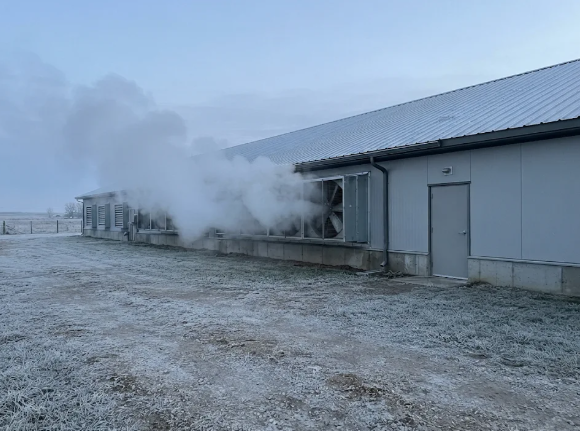
Minimum ventilation provides the fresh-air exchange needed when cooling is not the main requirement. It still has to address moisture and air contaminants. Depending on the installed design, airflow may be delivered through timed fan operation, staged fans or variable-speed control.
The University of Kentucky’s cold-weather ventilation guidance explains the moisture balance between water entering the house environment and water leaving through ventilation. Its operating examples concern broilers, so its fan settings and per-bird rates should not be copied into a layer house. The underlying principle remains useful: moisture production and removal must be considered together.
Heating air lowers its relative humidity, but heating alone does not remove water from the building. Air exchange must carry moisture outside. Equally, circulation fans can redistribute air within the house without supplying fresh air.
Condensation forms when a surface is cold enough for moisture in the surrounding air to condense. A cold roof section or uninsulated metal surface can therefore remain wet even when other parts of the house appear satisfactory. The University of Georgia’s guidance on condensation identifies ventilation, insulation and internal air movement as related parts of this problem.
For the farm team, this means reviewing indoor conditions, outdoor temperature and humidity, surface conditions and water sources together. Outdoor relative humidity alone does not tell you how much drying the incoming air can provide after it warms.
2. Record Conditions Across the House and Cage Tiers
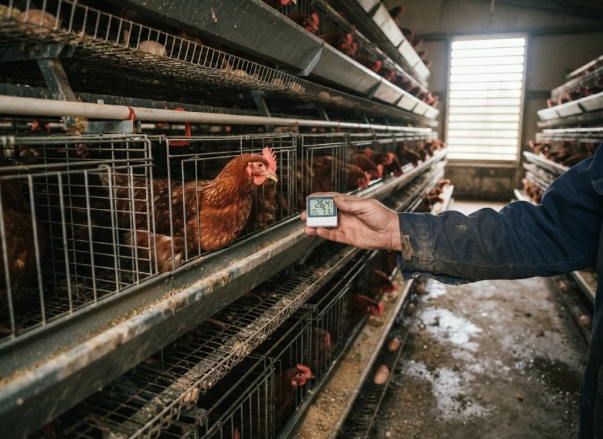
A controller reading describes conditions at its sensor. It does not establish that every cage row or tier has the same environment.
LOHMANN’s cage-housing management guide identifies temperature, humidity and air quality as relevant environmental factors and relates temperature requirements to bird age. Use the applicable flock guide and project plan to establish targets, then check whether the house achieves them where the birds are housed.
Build a repeatable observation record rather than collecting unrelated spot readings:
| Location | What to record | What the comparison can help investigate |
|---|---|---|
| Designed air inlets and nearby cage rows | Inlet position, fan stage, outdoor conditions and local temperature | Whether incoming air is distributed as intended or concentrated near birds |
| Representative lower, middle and upper cage tiers | Temperature, relative humidity, sensor location and bird behaviour | Differences between tiers that a single controller sensor may miss |
| House ends, doors, walls and roof sections | Cold or wet areas, visible condensation and its timing | Unintended air leakage, cold surfaces or uneven distribution |
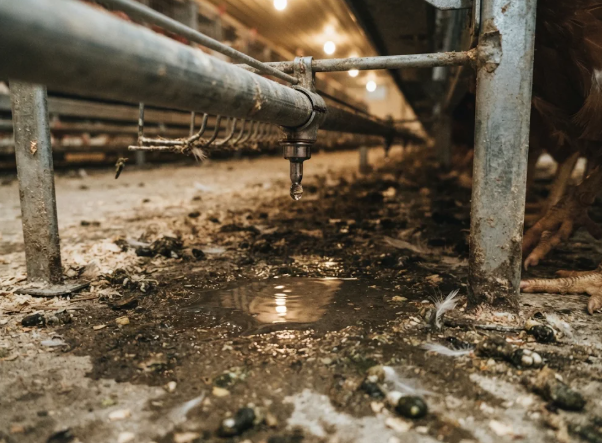
| Beneath drinking lines and along manure belts | Local wet patches, drips, manure condition and removal records | Water losses, uneven moisture loading or manure-handling problems |
Record the house, row, tier, time, and operational status observed each time. Compare the readings during representative fan cycles with changes in outdoor conditions. Check the portable instruments and controller sensors according to the calibration procedure of the farm.
These observations have identified areas that need to be evaluated; They won't diagnose the cause themselves. Unexpected bird behavior or damp feces may also require a flock adviser or veterinarian, especially when there are changes in health or water usage patterns.
3. Check the Air Path Before Changing Fan Settings
In a negative-pressure house, exhaust fans create a pressure difference that draws replacement air through the available openings. Expected inlets, unintended leaks and the resistance of the air path all influence where that air travels.
Cold-weather inlet arrangements are commonly designed to direct incoming air toward the warmer upper part of the house for mixing before it reaches birds. Whether this happens depends on inlet design, opening, pressure, house width, ceiling conditions and the indoor–outdoor temperature difference.
If a row is cold while the controller reports an acceptable temperature, ask the ventilation technician to assess the air path. Closing more inlets or lowering fan speed without that review may change both air distribution and fresh-air delivery.
The assessment should cover:
- Whether the intended inlets open and move as specified for each operating stage.
- Unintended leakage around doors, curtains, unused openings and fan shutters.
- Fan condition and the airflow available at the operating pressure.
- Controller operation, pressure sensing and the location of temperature and humidity sensors.
- Insulation defects and cold surfaces associated with persistent condensation.
Repairs to the building envelope should preserve the designed ventilation and emergency provisions. Do not treat every opening as a leak to be sealed.
Mississippi State University’s fan-selection guidance explains why fan diameter alone is insufficient and why pressure affects delivered airflow. For purchasing comparisons, use our poultry ventilation fan selection checklist. This article addresses how the selected equipment operates with the rest of the house during cold weather.
4. Review Drinking Water and Manure Removal Together
When drinking equipment discharges water into the house, ventilation needs to manage more moisture. Increasing fan operation while the leakage persists may not address the root cause of the problem.
Compare the trend of the water meter with the usual pattern of the flock and check the area below the drinker. Please have the responsible technical personnel inspect leaking nipples, pipe joints, line support and the pressure arrangement according to the instructions of the drinking water system.
Do not restrict birds from drinking water just to make the house drier.
LOHMANN’s laying-hen management recommendations discuss water-meter monitoring and the benefit of reducing water wastage for the house climate. That document covers alternative housing, so its housing-specific arrangements are not specifications for a cage installation.
Next, trace manure from beneath the cages to the final collection point. Record when it is removed, where it accumulates, whether transfer points are obstructed and whether water is entering the route. If manure drying is installed, include that equipment and its air supply in the review; a manure belt does not by itself establish that a drying system is present.
Manure removal carries material out of the house. Ventilation exchanges air. Neither function replaces the other. Our article on when to use an automatic manure belt system explains why the cage layout, drinking line, ventilation and discharge route need to be considered together.
There is no single removal interval suitable for every belt, manure load and house. Agree the schedule and any permitted changes using the installed equipment instructions and the farm’s management plan. Keep the discharge route available so that manure leaving a row can continue to its intended destination.
5. Ask for a Project-Specific Winter Operating Plan
A fixed fan percentage, inlet opening or timer cycle is not a complete cold-weather plan. The required arrangement depends on the flock, building, climate and installed equipment.
Before ordering equipment or changing an existing system, request written answers to these questions:
| Item | What to confirm |
|---|---|
| Design basis | Flock age, bird numbers and weight, house dimensions, cage tiers, local winter conditions and insulation assumptions |
| Airflow and inlets | How fresh-air demand is established, fan performance at the design pressure and the matching inlet arrangement |
| Controls and sensors | Which measurements control each stage, sensor locations, calibration, heating interaction and how settings are documented |
| Drinking and manure systems | How water losses are identified, what manure-removal or drying equipment is included and the operating limits |
| Alarms and power interruption | Which faults are monitored, who receives alarms, backup arrangements and the farm’s approved response procedure |
| Commissioning | Who verifies airflow distribution and environmental conditions, under what test conditions and against which agreed criteria |
For modification, determine the equipment to be retained and the interfaces that need to be inspected. Separate the supplied equipment from building maintenance, electrical engineering, heating, backup power, and commissioning services. Request the quotation to specify the contents included and excluded.
Do not accept summer cooling demonstrations as evidence that minimum ventilation is effective in cold weather. If debugging is carried out under warmer conditions, record which winter functions can be checked and which require seasonal validation later.
6. Prepare One House Record for the Supplier Review
To discuss an existing problem or a new layer-house project, assemble:
- Farm location and related outdoor winter conditions.
- House drawings, dimensions, cage-row and tier layout, age and number of birds in the flock.
- Details of fans, inlets, controllers, sensors, and heating, as well as available model references.
- Location based temperature and humidity records, fan stages, and any available air quality measurements.
- Water usage trend, observed leaks, manure condition and removal records.
- Safely obtain photos of the affected area and clearly describe the necessary decisions.
Take photographs and readings from safe access points. Equipment access, cleaning and adjustment require the installed isolation procedures and authorised, competent personnel. Do not reproduce a fault by disabling ventilation or alarms.
Auto ChickenCage’s poultry house environmental control system page provides a starting point for discussing fans, inlets and controls. Send the house record using the website contact details, and ask whether the proposed equipment and requested assessment fall within the available supply and service scope.
Request a written configuration and list of outstanding site questions before placing an order. A useful cold-weather solution should explain how fresh air reaches the birds, how moisture leaves the building and how drinking-water and manure conditions are managed alongside ventilation.
Want to know more?
Get in touch with us for more information about our services and products.