
Overcoming Poultry Production Hurdles: How Automated Systems Drive Scalability and Profitability in Modern Farming
Overcoming Poultry Production Hurdles: How Automated Systems Drive Scalability and Profitability in Modern Farming
Introduction: The Evolving Landscape of Poultry Production – Challenges and Opportunities
The poultry industry faces unprecedented pressure: from the 2024 closure of major operations like Cooks Venture, leaving over 1 million birds in limbo, to labor shortages plaguing processing lines and growing concerns over welfare in fast-growing breed farming (State of the Chicken Industry Report 2024).
For commercial poultry farmers, these challenges—coupled with rising feed costs and demand for consistent egg and meat production—highlight a critical need: moving beyond traditional, labor-intensive systems to scalable, automated solutions.
This article explores how integrated automatic poultry equipment transforms these pain points into opportunities, driving efficiency, reducing risk, and boosting profitability for modern layer and broiler farms.
The High Stakes of Traditional Poultry Farming: Why Status Quo Isn’t Sustainable
Manual feeding, inefficient housing, and outdated environmental control leave farms vulnerable to labor shortages, feed waste, and flock health issues—exacerbated by the 76% failure rate of unproven housing models (White Paper on the Failure of Cage-Free Housing).
Operations with space constraints struggle, while large-scale operations face rising costs from inconsistent feeding, poor ventilation, and manual egg collection, all of which erode profit margins.
The solution lies in automation: systems designed to address labor intensity, optimize resource use, and create stable, replicable production environments—key to navigating today’s industry challenges.
Industry Trends Reshaping Poultry Farming in 2024: Automation as the Critical Differentiator
State of the Chicken Industry Report 2024 data shows 90% of high-performing farms now rely on at least partial automation, citing labor reduction (up to 60%) and improved feed conversion ratios as primary drivers.
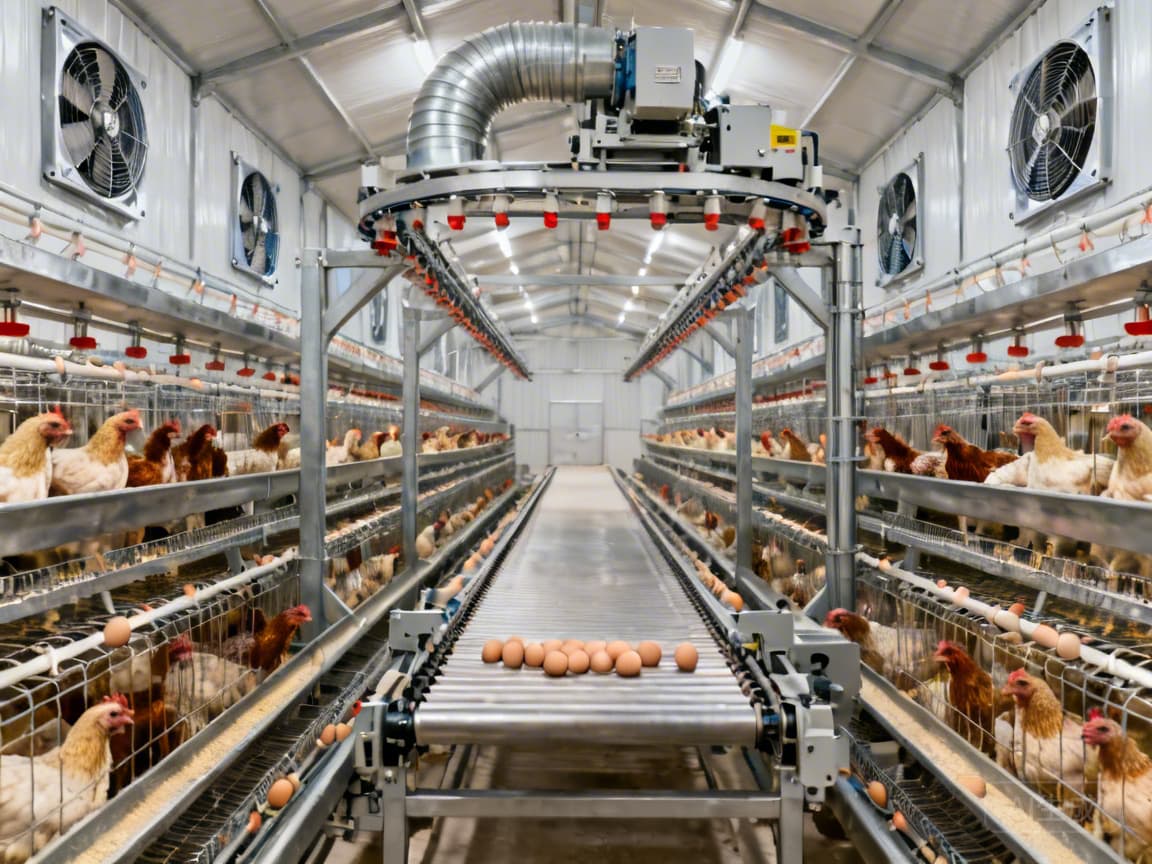
The shift toward intensive, large-scale production demands systems that maximize space (e.g., three-dimensional stacked cages) and minimize human error—from feeding to manure management. Insights from vertical poultry automation 10x density 60 lower operating costs 59 confirm that vertical integration is pivotal for modern poultry farm automation system adoption.
Global demand for consistent egg and poultry products is pushing farms to adopt turnkey poultry farm solutions, integrating feeding, housing, and environmental control into unified, automated ecosystems.
Core Automated Solutions for Profitable Poultry Production
Overhead Travelling Feeding Machine for Poultry Cages: Eliminates manual barrow feeding with rail-mounted, motor-driven systems that distribute feed uniformly across cage tiers. Its galvanized steel frame and adjustable outlet reduce waste by 15-20% while ensuring each bird accesses consistent nutrition, critical for optimizing feed conversion in layer and breeder houses.
Stacked Egg Chicken Cage Systems for 5000-6000 Bird Operations: These three-dimensional stepped cages (three or four-story) maximize vertical space, cutting housing costs by 30%. Galvanized wire construction resists corrosion, making them durable for operations scaling up from floor rearing.
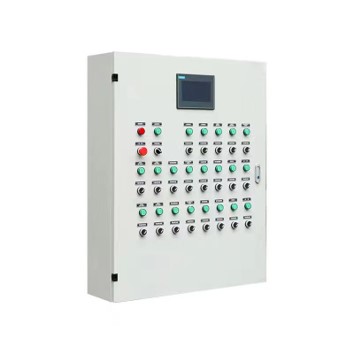
Poultry House Environmental Control System: Combines tunnel fans, evaporative cooling pads, and intelligent controllers to maintain optimal temperature (20-25°C) and humidity (50-70%), reducing heat stress-related mortality by up to 25%. Integrates with layer and broiler cage systems to ensure uniform flock performance year-round.
A Type Layer Chicken Cage System: A cost-effective, stepped A-frame design for open or naturally ventilated houses. Features front feed troughs, nipple drinkers, and easy-access cages that simplify bird inspection. Ideal for farms upgrading from floor systems, increasing stocking density by 40% while keeping initial investment manageable.
H Type Galvanized Layer Chicken Cage System: Engineered for intensive commercial farms, this vertical stacked system boosts stocking density by 60% vs. floor rearing. Hot-dip galvanized steel ensures longevity in humid environments, while integrated manure belts reduce ammonia levels by 35%, supporting healthier flocks and higher egg production.
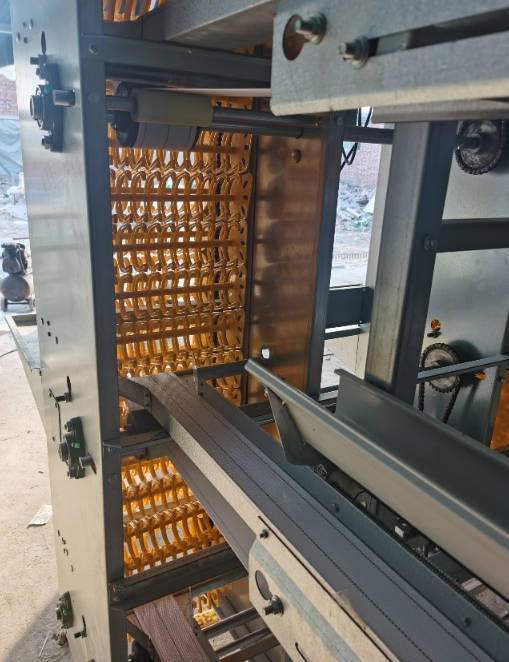
Stacked Egg Collection System – Vertical Elevator Egg Collector: Automates egg handling by gently conveying eggs from each cage tier to a central processing area via plastic carriers, reducing breakage by 20% compared to manual collection. Compatible with A Type and H Type cage systems, it cuts labor hours by 80% for medium to large operations. This efficiency gain is detailed in precision automation boosts poultry efficiency by 20 reduces egg loss 50, highlighting the role of precision in automated poultry farming.
From Investment to ROI: Real-World Results of Automated Poultry Systems
Case studies show farms integrating H Type Layer Cage Systems with Environmental Control report a 90% improvement in flock uniformity and 12% higher egg production within the first year, driven by stable climate and reduced stress.
Operations using Stacked Egg Chicken Cages and Overhead Travelling Feeding Machines typically see ROI within 18-24 months, with feed waste reduction and labor savings accounting for 70% of returns. For a comprehensive analysis, refer to poultry automation roi calculate true roi with 48 market data 3 hidden costs 14 to understand the full financial impact.
Turnkey poultry farm setups combining A Type Cages, Egg Collection Systems, and Manure Removal Systems reduce operational costs by $0.15-$0.20 per bird annually, critical for competing in tight margin markets.
Selecting Your Automation Partner: What to Look for in a Poultry Equipment Manufacturer
Prioritize manufacturers offering custom poultry cage systems tailored to farm size (e.g., 5000-bird stacked cages vs. large-scale H Type systems) and local climate needs (e.g., high-humidity-resistant galvanized steel).
Ensure end-to-end support: from poultry cage installation and staff training to after-sales service for Environmental Control and Feeding Machines. Export capabilities matter for global farms seeking consistent quality across regions.
Verify material quality: Hot-dip galvanized steel (for cages, feeding machines) and corrosion-resistant components (for Environmental Control Systems) ensure 15+ year lifespans, avoiding costly replacements.
Conclusion: Transform Your Farm Today – The Path to Scalable, Automated Poultry Production
The poultry industry’s future belongs to farms that embrace automation: reducing labor dependency, optimizing resource use, and mitigating risks from market volatility and regulatory changes. As explored in automation reshapes poultry labor 60 growth demands new hr strategy 2, adapting workforce strategies is essential for leveraging industrial poultry cages and automated poultry farming systems.
Whether upgrading a layer farm with Stacked Egg Cages or scaling a commercial operation with H Type Systems and integrated Environmental Control, the right automated poultry equipment turns challenges into profitability.
Take action: Contact our team for a farm assessment to design a custom poultry cage system—including feeding, housing, and environmental control solutions—that aligns with your growth goals. Let’s build your scalable, automated poultry farm together.
Want to know more?
Get in touch with us for more information about our services and products.