
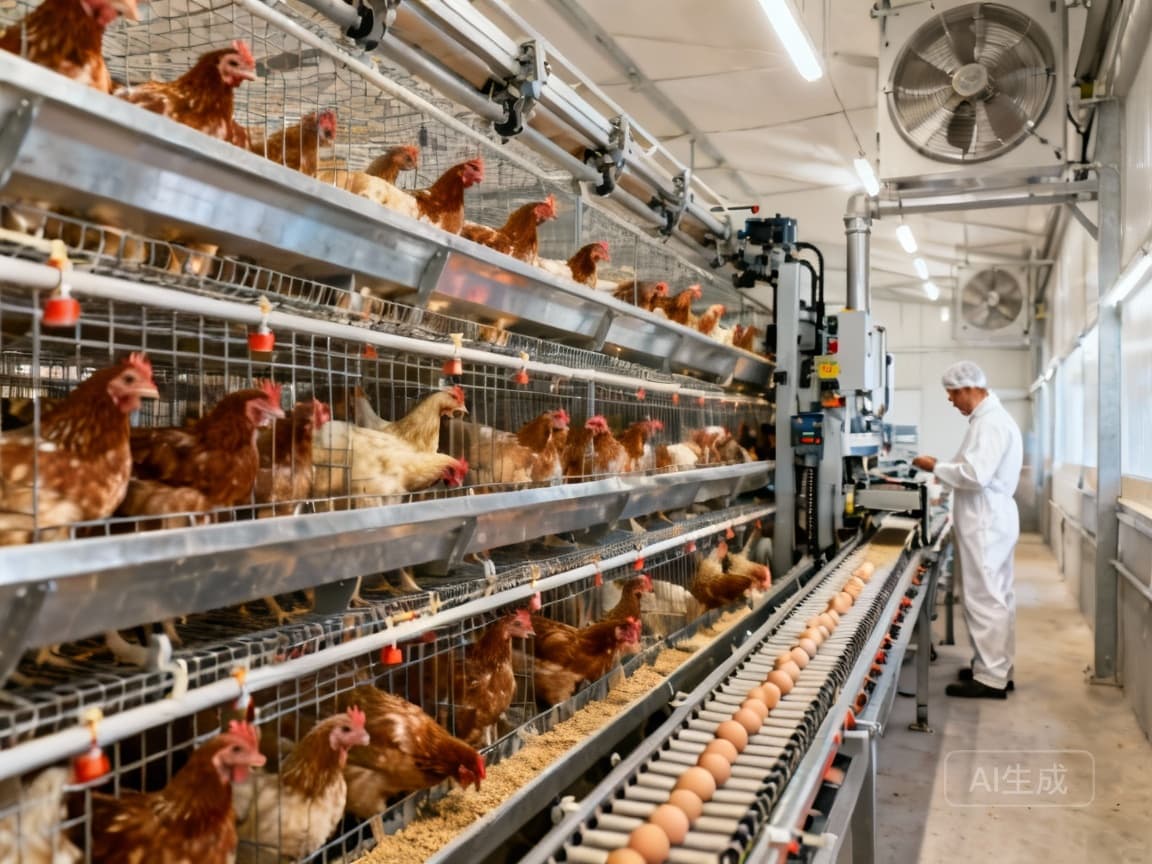
Vertical Poultry Automation: 10X Density & 60% Lower Operating Costs #59
Vertical Poultry Automation: Achieving 10X Stocking Density with 60% Lower Operating Costs
The automated poultry farm market is experiencing unprecedented growth, projected to reach USD 384.10 million in 2025 and growing at a CAGR of 12.20% to reach USD 682.98 million according to Mordor Intelligence. This explosive growth is driven by a fundamental challenge facing modern poultry operations: how to achieve scaled profitability within limited land resources while maintaining animal welfare and operational efficiency.
The Density Economics Revolution
Traditional poultry farming approaches have reached their physical and economic limits. The breakthrough comes from vertical automation systems that fundamentally redefine space utilization. Modern H-Type Smart Cages now accommodate 5,000–30,000 birds per unit compared to traditional systems handling only 3,000 birds—representing a 10x density improvement without compromising animal welfare standards.
The engineering behind this transformation involves advanced materials science. Hot-dip galvanized Q235 steel construction provides exceptional durability while reducing maintenance requirements from daily cleaning to every 3-5 days. This material innovation alone contributes to the 60% reduction in maintenance costs that leading operations are achieving.
Case Study: Jiayu County Ecological Layer Farm
The Jiayu County Qingshan Ecological Layer Farm implementation demonstrates the practical application of these principles. Their fully automated system maintains 65,000 birds while producing 3.8 tons of eggs daily with just 2-3 technical staff overseeing operations. The RMB 10 million investment generates daily sales revenue of RMB 24,000, achieving payback within operational parameters that traditional systems cannot match.
Investment Decision Framework
When evaluating vertical poultry automation, decision-makers should consider three critical financial dimensions:
1. Capital Expenditure Analysis
The initial investment must be evaluated against the extended equipment lifespan of 15-20 years compared to traditional equipment's 5-8 year lifecycle. This represents a fundamental shift in capital allocation strategy, transforming equipment from recurring expense to long-term infrastructure investment.
2. Operational Cost Structure
Labor costs typically represent 40-60% of traditional poultry operation expenses. Automated systems reduce human intervention requirements by 60-80%, creating a fundamentally different cost structure. The Qingdao Damu Machinery Company's research indicates that layered cage systems not only improve space utilization but also enhance disease control through reduced human-animal contact points.
3. Revenue per Square Meter
The density improvement directly translates to revenue density. Operations achieving 10x bird density within the same physical footprint can generate significantly higher revenue per square meter while maintaining or improving margin structures.
Implementation Roadmap: From Traditional to Smart Operations
Transitioning to vertical automation requires careful planning across multiple dimensions. Based on successful implementations, we recommend a phased approach:
Phase 1: Assessment and Planning (Weeks 1-4)
Conduct a comprehensive operational audit including:
- Current space utilization metrics and density calculations
- Labor cost analysis and automation potential assessment
- Infrastructure compatibility evaluation for automation systems
- Return on investment modeling based on your specific operational parameters
Phase 2: System Integration (Weeks 5-12)
Implement the core automation systems in sequence:
- Feeding Systems: Automated feed delivery with precision measurement
- Egg Collection: Gentle handling systems that reduce breakage rates
- Manure Management: Belt systems that remove waste automatically
- Environmental Control: Precision temperature, humidity, and ventilation systems
Phase 3: Operational Optimization (Ongoing)
Develop maintenance protocols based on the 3-5 day intervention cycle rather than daily routines. Implement data monitoring systems to track performance metrics and identify optimization opportunities.
Technical Standards and Best Practices
The engineering excellence behind successful vertical automation systems requires adherence to several critical standards:
Structural Integrity: Hot-dip galvanized steel components must meet corrosion resistance standards sufficient for the high-humidity, high-ammonia environment of poultry operations.
Automation Reliability: Systems must achieve 99%+ operational reliability with redundant critical components to prevent production interruptions.
Animal Welfare Compliance: Despite increased density, systems must meet or exceed animal space requirements and behavioral needs.
Future Outlook and Industry Direction
The poultry automation market is projected to grow from USD 4.0 billion in 2025 to USD 7.1 billion by 2035, representing a 6.0% CAGR according to Future Market Insights. The Asia-Pacific region, particularly China and India, is driving this growth with increasing adoption of smart farming technologies.
“The integration of IoT-enabled cage monitoring systems and advanced sensor technologies represents the next frontier in poultry automation,” notes industry analysis from LinkedIn’s market trends coverage. This technological evolution will further enhance the economic advantages of vertical systems.
Conclusion: Strategic Imperative for Modern Poultry Operations
Vertical poultry automation is no longer a luxury for large-scale operations but a strategic necessity for any poultry business seeking competitive advantage. The combination of 10x density improvement, 60% operating cost reduction, and extended equipment lifespan creates an economic model that traditional approaches cannot match.
As the industry moves toward USD 28 billion in automated systems by 2033 (according to market projections), early adopters of vertical automation technology will establish significant competitive advantages in cost structure, operational efficiency, and scalability. The question is no longer whether to automate, but how quickly and completely operations can transition to these superior systems.
Want to know more?
Get in touch with us for more information about our services and products.