
Transforming Poultry Production: How Automated Systems Solve Labor Shortages, Boost Efficiency, and Drive Profitability
Introduction: The Poultry Industry at a Crossroads – Labor, Efficiency, and Profitability Challenges
The poultry farming sector stands at a critical crossroads, grappling with labor-intensive processes that drain resources and hinder growth. Usher emphasizes automation as a vital solution to ongoing labor shortages, yet many farms struggle to implement technology that delivers meaningful, sustainable results. Beyond labor, challenges like disease outbreaks, feed cost fluctuations, and the need for consistent flock performance create significant barriers to growth—issues highlighted in industry research on the biggest hurdles facing poultry producers. This article explores how integrated automated poultry systems address these pain points, delivering tangible ROI through improved efficiency, reduced labor dependency, and enhanced profitability for modern farms.
The Current State of Poultry Farming: Key Challenges Holding Back Growth
Labor intensity remains a top concern: Manual feeding, egg collection, and manure removal processes drain resources, with the industry struggling to attract and retain workers amid rising operational demands. Robotics and automation adoption is further hindered by fragmentation—while robotics offer promise, many farms implement standalone tools instead of integrated systems, limiting effectiveness and ROI, as noted in research by U Özentürk. Biosecurity and environmental control gaps compound these issues: Inconsistent temperature, ventilation, and hygiene practices increase disease risk and mortality rates, directly impacting bottom-line performance. Compounding all this is feed cost volatility—without precise control over flock health and feed conversion, farms face higher waste and lower profitability in unpredictable markets.
Industry Trends: Why Automation is No Longer Optional for Competitive Poultry Farms
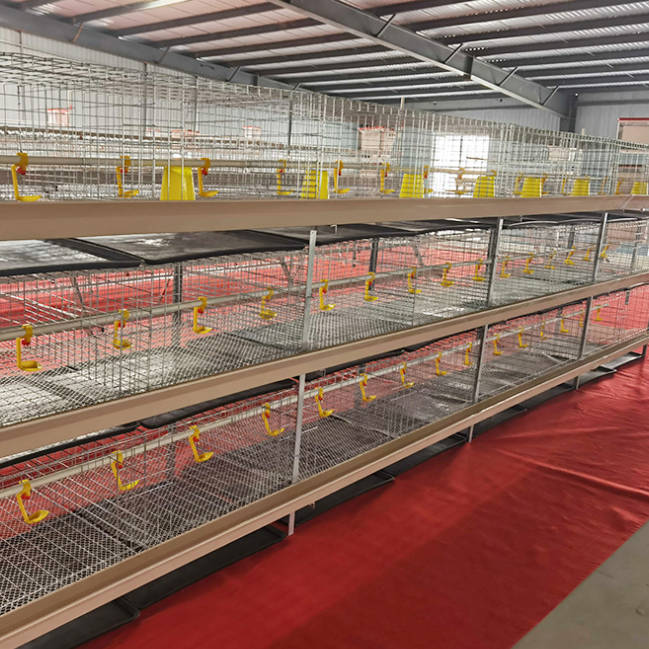
Leading poultry farms are investing in automation at scale: The State of the Chicken Industry Report 2024 reveals that 90% of high-performing commercial operations now prioritize integrated automation to stay competitive. Modern technologies for broiler and layer production are redefining industry standards—from intelligent environmental control to automated feeding systems, forward-thinking producers are leveraging innovation to outperform peers. Scalability drives adoption: As farms aim for larger operations, the need for systems that support high stocking density—without sacrificing bird welfare or performance—has never been greater. This makes commercial chicken cages and stacked cage systems essential for growth, enabling farms to expand without compromising efficiency.
Industry Trends: Why Integrated Automation is the Future of Poultry Production
The shift to poultry farm automation systems is reshaping the industry: Farms with integrated solutions report 30% higher productivity than those using manual or fragmented tools, according to the State of the Chicken Industry Report 2024. This aligns with research on vertical poultry automation, which shows how maximizing space and integrating systems drives cost savings. Demand for turnkey poultry farm solutions is also rising—producers increasingly seek full-package systems that include design, equipment, and installation, reducing implementation complexity and risk. Perhaps most importantly, environmental control has emerged as a profitability driver: Research links stable climate management to improved feed conversion, lower mortality, and uniform flock performance—key metrics for maintaining a competitive edge.
Integrated Automated Solutions: The Foundation of Next-Gen Poultry Farms
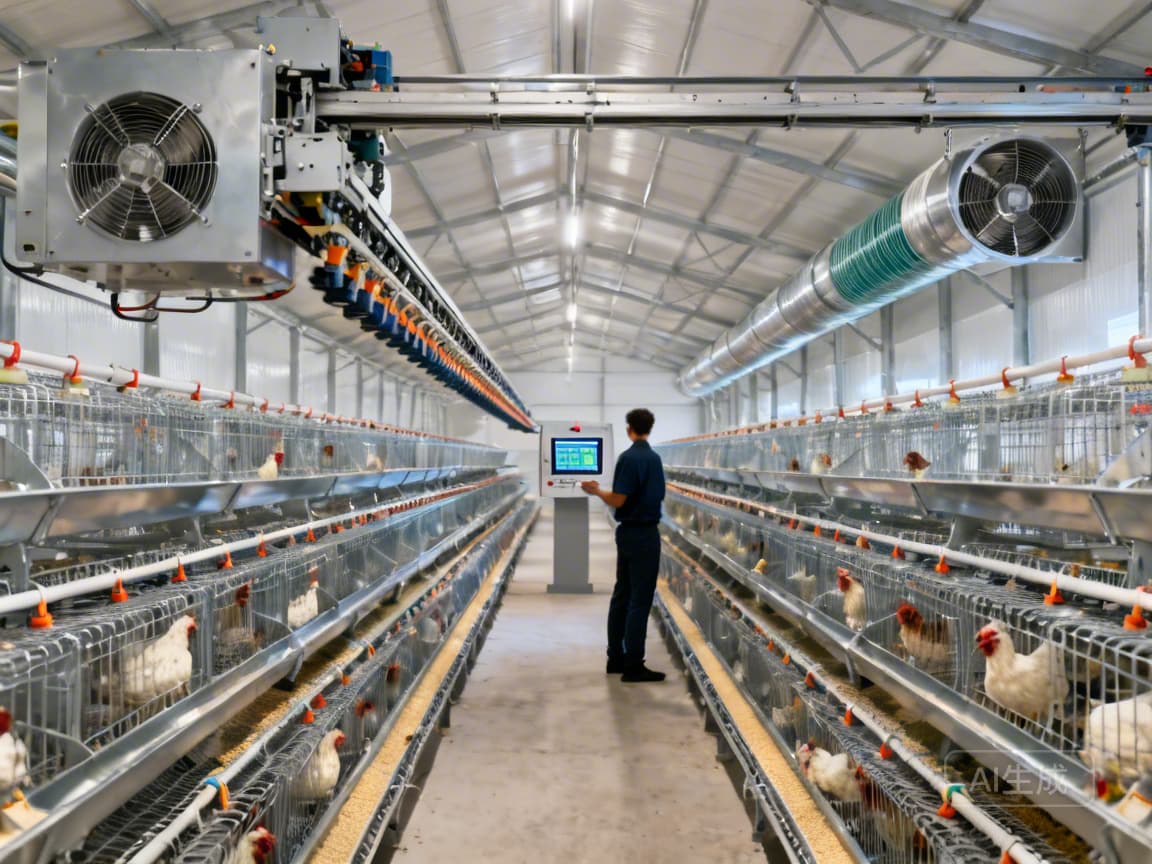
Effective automation requires cohesive systems, not standalone tools. Modern poultry housing systems integrate core functions—housing, feeding, environmental control, and waste management—to deliver seamless operations that address every pain point. Let’s break down the components of a successful integrated system:
Poultry House Environmental Control System: This critical component regulates temperature, humidity, and air quality via tunnel fans, cooling pads, and intelligent controllers, reducing heat stress and ensuring optimal flock comfort. By maintaining stable conditions, farms see up to 15% lower mortality and 20% improved feed conversion—directly impacting profitability.
H Type Galvanized Layer Chicken Cage System: Designed for intensive commercial production, this battery cage system for poultry maximizes vertical space with stacked tiers, integrating nipple drinking lines, front feed troughs, and manure collection belts. It’s part of a complete chicken cage production line that streamlines every aspect of layer farming. Hot-dip galvanized steel ensures durability, while automation reduces labor by 30% compared to floor rearing. This aligns with how automation reshapes poultry labor, allowing farms to reallocate workers to higher-value tasks instead of manual chores.
Overhead Travelling Feeding Machine: Eliminating manual feeding, this automatic feeding poultry system distributes feed uniformly across cage rows via electric-driven rails, ensuring consistent intake and reducing waste. Ideal for large-scale operations, it supports automatic chicken cage integration and 24/7 feeding scheduling—critical for maintaining flock performance.
Automatic Egg Tray Packing Machine: Reducing egg breakage by up to 90% versus manual packing, this stainless-steel system automates sorting, counting, and tray loading, streamlining post-production and accelerating market readiness. As precision automation data shows, minimizing egg loss directly boosts revenue by preserving product quality.
Scalable stacked systems: From large-scale hot-dip galvanized broiler cage installations to three-dimensional stepped breeding cages for mid-sized farms, these solutions adapt to your capacity while maintaining automation benefits. Whether you’re raising 5,000 layers or 50,000 broilers, a scalable system ensures you don’t outgrow your equipment.
Real-World ROI: How Automated Farms Outperform Traditional Operations
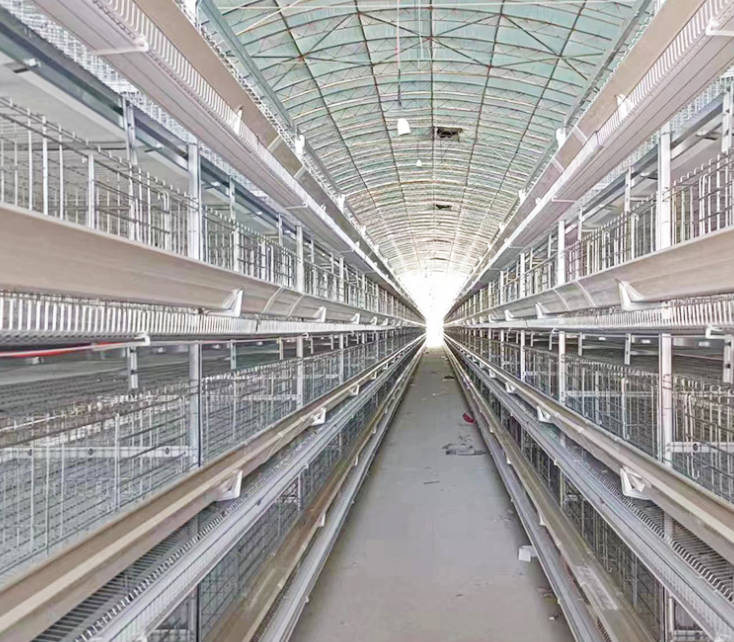
The proof of automation’s value lies in the numbers. Industry data from the State of the Chicken Industry Report 2024 shows farms with integrated automated systems achieve 30% lower labor costs, 25% higher feed conversion efficiency, and 20% increased egg/broiler production compared to non-automated counterparts. For example, a mid-sized layer farm that implemented the H Type Galvanized Layer Chicken Cage System and Poultry House Environmental Control System reported a 22% rise in daily egg production within six months—with a 12-month payback period on equipment investment.
Automation also addresses hidden costs: Automated manure removal systems (a key feature of automatic chicken cages) lower ammonia levels by 40%, reducing disease risk and cutting veterinary costs by up to 18%. This ties into how poultry automation ROI must account for indirect savings like reduced vet bills. Energy efficiency gains further boost profitability: Intelligent environmental controllers optimize fan and cooling pad usage, reducing energy consumption by 15–20% while maintaining optimal conditions for year-round production.
Choosing Your Automation Partner: From Custom Design to Turnkey Implementation
Success with automation hinges on partnering with a chicken cage manufacturer or factory that delivers custom poultry cage systems tailored to your farm’s size, species (layer, broiler), and goals—avoid one-size-fits-all solutions that limit scalability. Look for a chicken cage supplier that offers full-service support: from initial site assessment and system design to installation, training, and maintenance. This ensures seamless adoption and long-term performance.
Durability and compatibility are non-negotiable: Choose a chicken cage supplier that offers export chicken cages made from hot-dip galvanized steel and corrosion-resistant environmental control components—these withstand harsh poultry house conditions, reducing replacement costs and downtime. For new operations, explore turnkey poultry farm packages—these all-inclusive solutions combine poultry cage systems, environmental control, feeding, and egg collection into a single, managed project—ideal for minimizing risk and accelerating time-to-market.
Take the Next Step: Transform Your Farm with a Custom Automation Plan
Ready to address labor shortages, boost efficiency, and increase profitability? Our team of poultry automation experts offers no-obligation farm assessments to design a tailored system for your operation—whether you’re scaling a layer farm with three-story breeding cages or building a large-scale industrial poultry cage facility. We deliver integrated solutions that align with your goals and budget, using durable equipment like hot-dip galvanized broiler cages and automatic egg layer systems to ensure long-term success.
Contact us today to schedule your assessment and discover how automated systems can transform your poultry production—request a quote or demo to see our equipment in action. To get started, visit our contact page.
Want to know more?
Get in touch with us for more information about our services and products.