
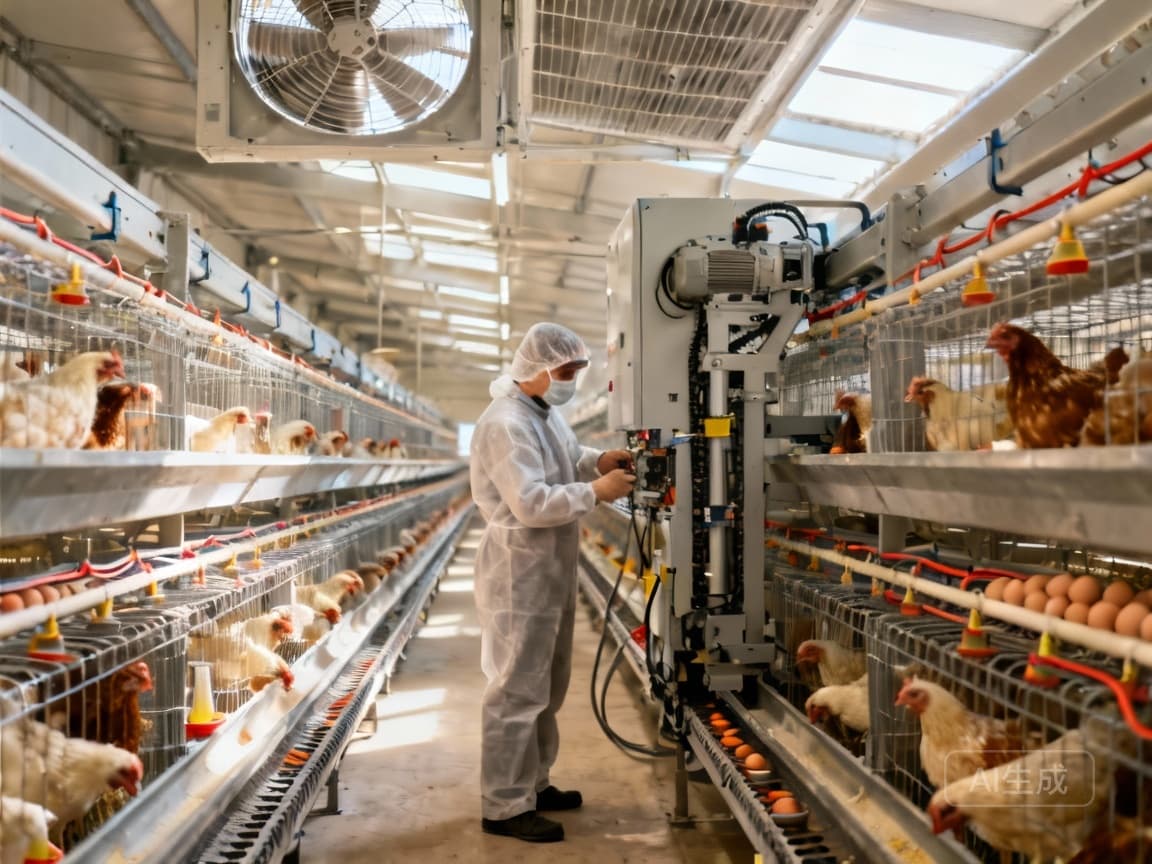
Smart Poultry Cages: 60% Lower Maintenance & 300% Longer Lifespan ROI #55
The Hidden Math Behind Poultry Automation ROI
When poultry farm operators evaluate automation investments, traditional ROI calculations often miss the complete financial picture. While most equipment manufacturers emphasize labor savings and efficiency gains, the true economic value of smart poultry cages lies in engineering innovations that create multiple revenue pathways and cost reduction opportunities throughout the equipment lifecycle.
The automated poultry farm market is projected to reach USD 384.10 million in 2025 with a 12.20% CAGR, growing to USD 682.98 million according to Mordor Intelligence. This growth isn't driven by simple efficiency claims but by fundamental engineering improvements that deliver measurable financial returns.
Beyond Simple Payback Periods
Traditional ROI analysis focuses on payback periods and simple efficiency metrics. However, smart cage systems require a more sophisticated approach that accounts for:
- Material science economics and corrosion resistance
- Space utilization and land value optimization
- Maintenance cost reduction over 15-20 year lifespans
- Environmental compliance and sustainability benefits
Qingdao Damu Machinery Co., Ltd. demonstrated the financial impact of this approach with CNY 134.62 million (USD 19.3 million) in operating cash flow during the first half of 2021, showcasing the stability that specialized equipment manufacturing can achieve.
Smart Cage Design: Where Engineering Meets Economics
The transition from traditional cages to smart H-type layer cages represents a fundamental shift in poultry farming economics. These systems increase bird capacity from approximately 3,000 to 30,000 birds per unit while reducing manual cleaning frequency from daily to every 3-5 days.
Materials Economics: The Q235 Steel Advantage
The use of Q235 steel with hot-dip galvanized coating isn't just about durability—it's an economic decision that reduces maintenance costs by 60% while extending equipment lifespan from 5-8 years to 15-20 years. This translates to significantly lower annualized capital costs and reduced operational downtime.
Smart high-capacity chicken cages represent the convergence of materials science, automation technology, and agricultural economics, creating systems that deliver superior financial returns through engineered durability and efficiency.
Space Optimization Economics
The layer stacking technology employed by companies like Qingdao Damu enables 3-layer or higher configurations that dramatically improve space utilization. This isn't just about fitting more birds—it's about maximizing the return on real estate investments and reducing the footprint required for operations.
In Jiayu County's Qingshan Ecological Layer Farm, this approach enabled maintaining 65,000 birds while producing 3.8 tons of eggs daily with daily sales revenue of CNY 24,000 (USD 3,400) on a total investment of CNY 10 million (USD 1.4 million).
Scaling Smart: Mid-Size Poultry Operations' Automation Advantage
While large-scale operations dominate automation discussions, mid-size farms representing 48.0% of the poultry farming equipment market in 2025 are finding particular value in smart cage systems. The projected 6.3% CAGR for automated equipment reflects this growing adoption.
Implementation Framework for Mid-Size Operations
Based on successful case studies, here's a practical implementation approach:
- Capacity Assessment: Evaluate current space utilization and identify density improvement opportunities
- Material Selection: Specify Q235 steel with hot-dip galvanized coating for long-term durability
- Automation Integration: Implement feeding, environmental control, and egg collection systems
- Manure Management: Incorporate waste collection systems for environmental compliance
- Monitoring Systems: Deploy IoT-enabled cage monitoring for real-time performance tracking
Financial Modeling for Automation Investments
When evaluating smart cage investments, consider these financial metrics beyond simple payback:
- Net Present Value (NPV): Account for 15-20 year cash flows from reduced maintenance and higher productivity
- Internal Rate of Return (IRR): Calculate returns incorporating space utilization benefits
- Capital Efficiency Ratio: Measure revenue generated per square meter of facility space
- Lifecycle Cost Analysis: Compare total ownership costs against traditional systems
The Asia-Pacific region, particularly China and India, is experiencing rapid adoption with the regional market valued at USD 2 billion in 2024 and expected to grow at 5.2% CAGR from 2025-2034, driven by these economic advantages.
Strategic Implementation Guidance
Successful smart cage implementation requires more than equipment purchase—it demands a systematic approach to operational transformation.
Phase 1: Technical Assessment and Planning
Conduct a comprehensive facility audit to identify automation readiness factors including structural integrity, power availability, and workflow optimization opportunities. The global chicken cages market, valued at USD 1.5 billion in 2024 and projected to reach USD 2.8 billion by 2033 at a 7.5% CAGR, reflects the growing recognition of these systems' value.
Phase 2: Customized Installation Approach
As demonstrated in the Jiayu County case study, successful implementation often requires customized installation that considers local conditions, available space, and operational requirements. This tailored approach ensures optimal performance and return on investment.
Phase 3: Integration with Ecological Models
The most successful implementations incorporate smart cages into broader ecological agricultural models, creating additional revenue streams through waste-to-value conversion and sustainable farming practices that command market premiums.
Future Outlook: Beyond Immediate ROI
The poultry farming equipment market is evolving toward greater automation and intelligence. Valued at USD 4.5 billion in 2024 with a projected 4.7% CAGR between 2025-2034, the industry is moving toward systems that offer not just economic benefits but also address growing concerns about animal welfare, environmental sustainability, and food safety.
Forward-thinking operators are already planning for next-generation systems that incorporate advanced monitoring, predictive maintenance, and integration with broader agricultural ecosystems. The companies that recognize the multidimensional ROI of smart cage systems—encompassing engineering economics, space utilization, and operational efficiency—will lead the industry into the next decade of poultry farming innovation.
Want to know more?
Get in touch with us for more information about our services and products.