
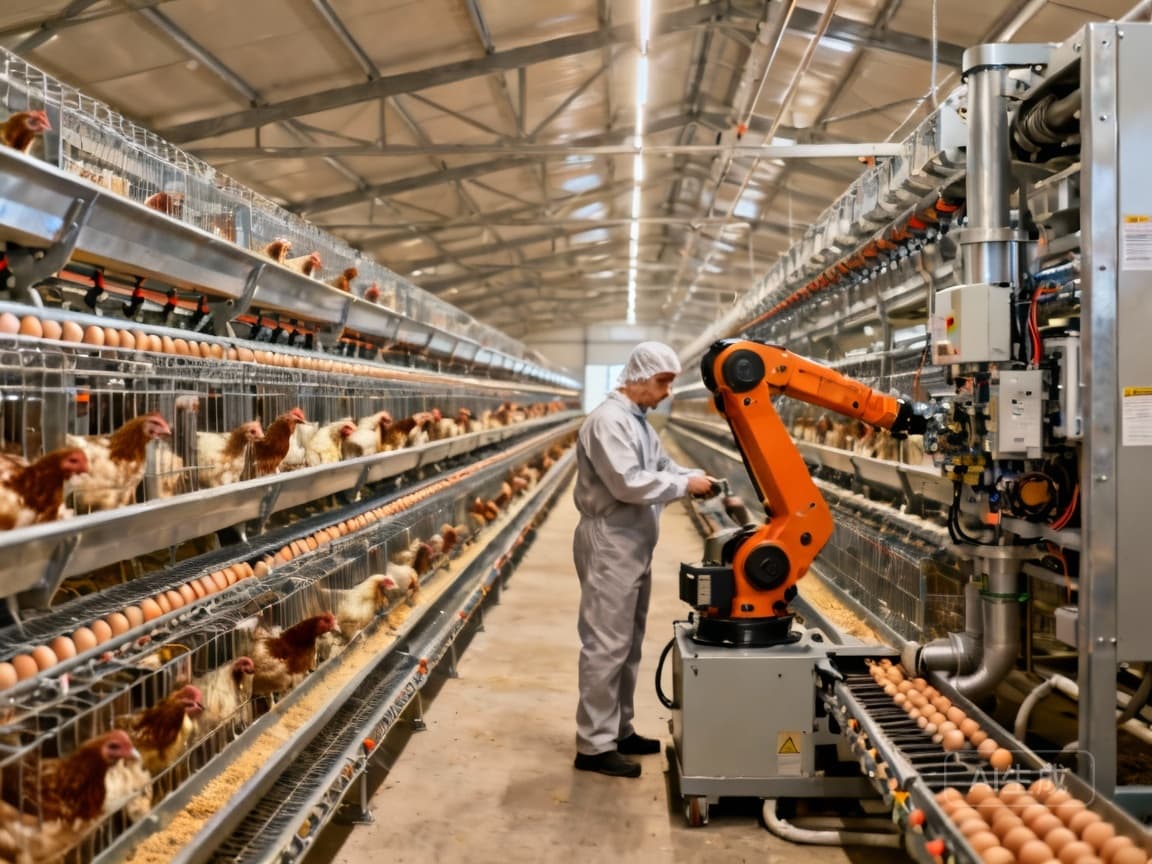
Poultry Automation: 60% Lower Maintenance & 15-20 Year Lifespan #56
Beyond ROI: The Operational Resilience Framework for Modern Poultry Automation
While traditional poultry automation discussions focus primarily on return on investment percentages, forward-thinking operations managers are recognizing a more profound transformation occurring in the industry. The shift from manual to automated systems represents not just cost savings, but a fundamental restructuring of operational resilience and long-term viability. Based on market data showing the automated segment capturing 48.0% of poultry farming equipment revenue, it's clear that industry leaders are moving beyond simple ROI calculations toward comprehensive operational frameworks.
The Structural Shift in Poultry Operations
The poultry equipment market is experiencing significant transformation, projected to grow from USD 4.0 billion in 2025 to USD 7.1 billion by 2035, representing a 6.0% compound annual growth rate. This growth isn't merely quantitative—it reflects a qualitative shift in how successful operations approach automation investments.
Density and Efficiency: The Nonlinear Relationship
Modern H-Type smart cages demonstrate a fundamental shift in operational economics. Where traditional cages typically accommodated approximately 3,000 birds per unit, new systems handle 5,000–30,000 birds per unit. The critical insight emerges at the 15,000-bird threshold, where scale efficiencies create an operational inflection point that transforms maintenance requirements and labor allocation.
Market analysis indicates the automated poultry farm market will reach USD 384.10 million in 2025, growing at 12.20% CAGR to reach USD 682.98 million by 2030, reflecting the accelerating adoption of advanced automation systems.
The Maintenance Revolution: 60% Cost Reduction Explained
The most significant operational transformation comes from maintenance restructuring. Traditional systems required daily cleaning and frequent maintenance interventions, creating constant operational disruption. Modern systems with hot-dip galvanized coatings reduce maintenance frequency from daily to every 3-5 days, representing a fundamental shift in labor allocation and operational consistency.
Technical Economics of Hot-Dip Galvanizing
Q235 steel with hot-dip galvanized coating doesn't simply reduce maintenance costs—it transforms the maintenance paradigm. The 60% maintenance cost reduction stems from corrosion resistance that protects against ammonia exposure and moisture, particularly critical in poultry environments. This technical advancement changes operational planning from reactive maintenance scheduling to predictive, planned interventions.
Redefining Investment Cycles: The 15-20 Year Lifespan Advantage
Traditional equipment lifespan of 5-8 years created constant capital reinvestment cycles that disrupted financial planning. Modern systems with 15-20 year lifespans align with building depreciation schedules, creating synchronized asset management that simplifies financial planning and reduces capital allocation uncertainty.
Case Study: Jiayu County Green Mountain Ecological Layer Farm
The implementation at Jiayu County demonstrates the practical application of these principles. With an investment of 10 million RMB for 65,000 birds, the operation achieved daily egg production of 3.8 tons and daily sales revenue of 24,000 RMB. The key success factors included:
- Customized installation based on existing infrastructure
- IoT infrastructure investment of approximately 5,000 RMB per 10,000 birds
- Integrated automated feeding, environmental control, and manure collection systems
Implementation Framework: Phased Automation Roadmap
Successful automation implementation requires a structured approach that considers operational scale, existing infrastructure, and long-term objectives. Based on successful implementations from companies like Qingdao Damu Machinery Co., Ltd. (established 2005 with 150 million RMB registered capital), we recommend the following framework:
Phase 1: Infrastructure Assessment
- Evaluate existing building structures and utilities
- Analyze current operational workflows and pain points
- Assess electrical and data infrastructure requirements
Phase 2: System Design and Customization
- Select appropriate cage system based on flock size and operational goals
- Design integrated feeding, watering, and environmental control systems
- Plan manure management and egg collection automation
Phase 3: Implementation and Integration
- Install hot-dip galvanized structures with precision alignment
- Integrate IoT monitoring systems and sensors
- Implement automated control systems with fail-safe mechanisms
Operational Resilience Metrics: Measuring Beyond ROI
Forward-thinking operations are tracking metrics that reflect true operational resilience:
- Maintenance Intervention Frequency: Reduced from daily to 3-5 day intervals
- Labor Reallocation Efficiency: Shift from manual labor to monitoring and management
- System Uptime Percentage: Increased operational consistency and reliability
- Asset Utilization Rates: Improved capacity utilization through automated optimization
Future Outlook: The Asia-Pacific Growth Engine
The Asia-Pacific region represents the fastest-growing market for poultry automation, driven particularly by China and India. With global meat consumption expected to reach 350 million tons in 2024, the demand for efficient poultry production solutions will continue to accelerate. The cage market alone, valued at USD 1.5 billion in 2024, is projected to grow at 7.5% CAGR to reach USD 2.8 billion by 2033.
Successful automation implementation requires understanding that you're not just installing equipment—you're implementing an operational philosophy that prioritizes long-term resilience over short-term savings.
Conclusion: The Strategic Imperative
The transition to automated poultry systems represents more than equipment modernization—it's a strategic repositioning for long-term operational viability. The combination of 60% reduced maintenance costs, 15-20 year equipment lifespans, and transformed operational efficiency creates a compelling case for comprehensive automation strategy. As the industry continues evolving toward greater automation integration, operations that embrace this resilience framework will maintain competitive advantage through improved consistency, reduced operational risk, and enhanced long-term viability.
Forward-thinking operations managers are recognizing that the true value of automation lies not in individual cost savings, but in the creation of operational systems that withstand market fluctuations, labor challenges, and evolving consumer demands while maintaining consistent production quality and operational efficiency.
Want to know more?
Get in touch with us for more information about our services and products.