
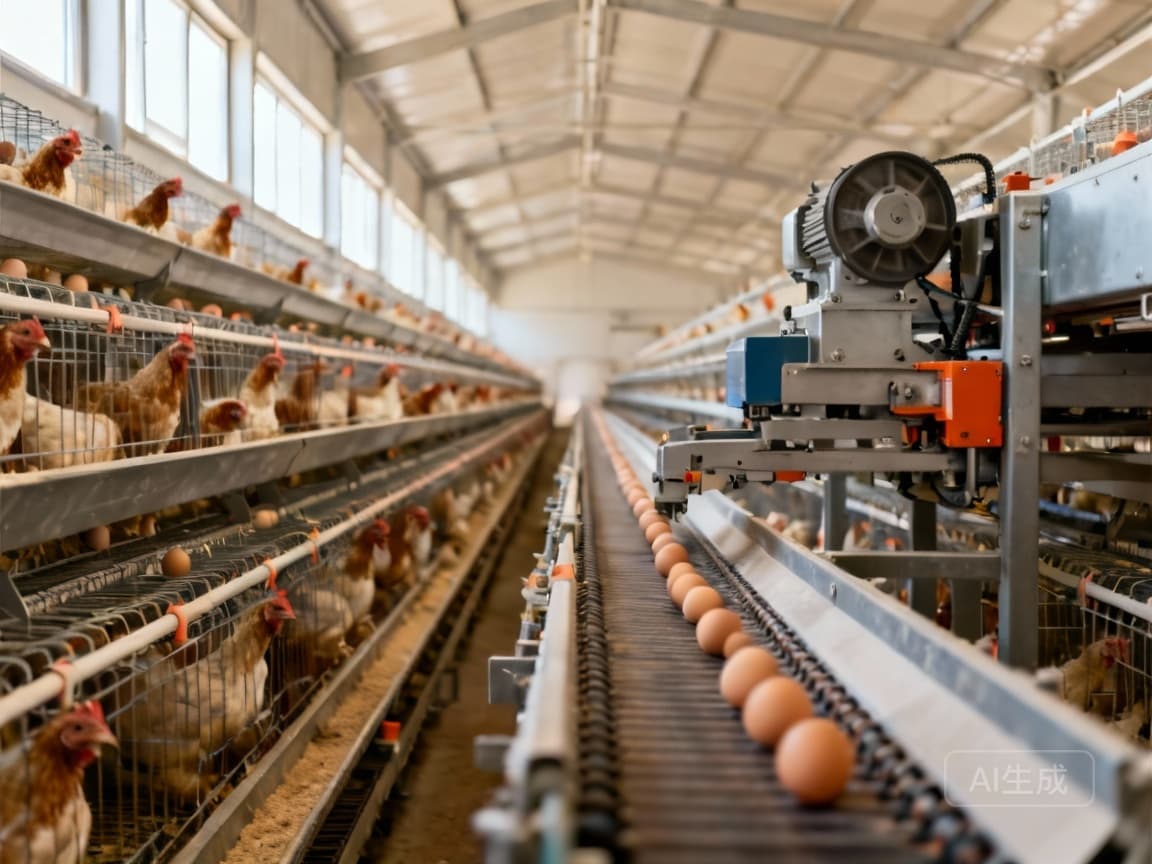
Beyond ROI: How Automated Layer Cages Cut Labor Costs 30% & Mitigate Compliance Risk #78
Beyond ROI: How Automated Layer Cages Cut Labor Costs 30% & Mitigate Compliance Risk
For years, the conversation around automated poultry equipment has orbited a single star: Return on Investment (ROI). While the financial payback period is undeniably critical, a narrow focus on this metric overlooks the profound strategic transformation modern automation enables. Today's leading poultry operations are not just buying machinery; they are investing in a resilient operational architecture designed to withstand unprecedented industry headwinds. Based on global market data and verifiable case studies, this article argues that the true value of advanced automated layer cage systems lies in their dual role as a powerful cost-saving engine and a strategic risk mitigation tool, fundamentally future-proofing the business.
The New Calculus: From Direct Savings to Strategic Risk Mitigation
The global poultry landscape is defined by converging pressures that make the status quo unsustainable. Data from Future Market Insights confirms that the automation segment is poised to contribute 48.0% of revenue share in the poultry farming equipment market by 2025, driven by the urgent need to reduce manual intervention and maintain consistent control. This isn't merely about efficiency; it's about survival in an era of systemic challenges.
The traditional ROI model, which calculates savings on labor and feed against capital expenditure, is now incomplete. A modern Total Cost of Ownership (TCO) analysis must incorporate the cost of *not* upgrading. This includes the financial impact of labor unavailability, penalties from tightening environmental regulations, and lost market access due to evolving animal welfare standards. Automated layer systems directly address these vulnerabilities.
The Labor Imperative: Converting Fixed Costs into Managed Variables
Persistent labor shortages are no longer a cyclical issue but a structural reality. Automated systems provide a definitive solution. The experience of TAIYU INDUSTRIAL GROUP CO., LTD. is instructive: their implementation of an H-type stacked cage system led to a reduction in labor requirements by 30%. This transformation goes beyond headcount. It reallocates human resources from repetitive, physically demanding tasks (manure collection, egg gathering) to higher-value roles in system monitoring, data analysis, and preventative maintenance.
"The automation category is expected to dominate the poultry farming equipment industry at a CAGR of 6.3% during the forecast period, largely to address labor shortages and meet stringent standards." - Future Market Insights
Implementation Guidance: When evaluating automation's labor impact, conduct a "task audit." Map every manual process in your laying house—feeding, watering, climate control, egg collection, manure handling. A comprehensive automated system should address over 80% of these tasks. The resulting labor model shifts from a large crew of general laborers to a smaller, skilled team of technicians, improving both operational reliability and employee retention.
Environmental Compliance: From Reactive Cost to Proactive Control
Environmental regulations, particularly around ammonia emissions and manure management, are becoming stricter globally. The EU's Green Deal and "Farm to Fork" strategy exemplify this trend, pushing investment into low-emission systems. Here, automation delivers a powerful environmental benefit. In the TAIYU case, the integrated environmental control within the automated cage system reduced ammonia levels by 60%. This isn't just a welfare improvement; it's a direct mitigation of future compliance risk and potential fines. Automated ventilation, heating, and cooling maintain optimal conditions consistently, something impossible with manual interventions, leading to better bird health and productivity.
Implementation Guidance: Prioritize systems with fully integrated environmental control sensors and software. Look for solutions that offer real-time monitoring and automated logging of temperature, humidity, and gas levels (NH3, CO2). This data provides an auditable trail for regulatory compliance and enables proactive adjustments. Before investing, model your current ammonia output and project the cost implications of potential future emission taxes or penalties in your region—this becomes part of your risk-adjusted ROI.
The Data Dividend: Transforming Capital Equipment into a Strategic Asset
The second paradigm shift is recognizing that a modern automated cage system is not just a physical asset but a data generation terminal. Every aspect of its operation—feed consumption per tier, water usage, egg counts by section, and microenvironmental data—creates a continuous stream of information. This transforms management from intuition-based to data-driven.
The reported 15% increase in egg production in the TAIYU case can be attributed to this precise control. Stable, optimal environments reduce stress, while automated feeding ensures precise nutrition delivery. Managers can now identify underperforming sections in real-time, adjust feeding curves based on production data, and predict health issues before they manifest clinically.
Implementation Guidance: Ensure any system you consider has an open or well-documented data interface. The goal is to integrate operational data with your flock management software. Start with three key metrics: 1) Feed Conversion Ratio (FCR) by house or zone, 2) Peak lay persistence and uniformity, and 3) Water-to-feed ratio. Monitoring these through the automation system will yield immediate insights for optimizing input costs and maximizing output.
Strategic Scaling: Building a Foundation for Growth
This is particularly crucial for the dynamic Asia-Pacific market, identified by DataHorizzon Research as the fastest-growing region for automatic layer cages, driven by rapid industry expansion. For a growing operation, the choice of system dictates future agility. A modular, scalable automated system, like the advanced stacked cages implemented by farms in Sri Lanka, allows for phased growth without obsolescence.
Investing in a monolithic, non-expandable system creates future bottlenecks. In contrast, a modular design lets you add capacity incrementally, aligning capital expenditure with business growth. This "pay-as-you-grow" approach preserves cash flow and prevents the massive disruption and cost of a full system replacement.
Implementation Guidance: Develop a 5-10 year expansion plan before selecting equipment. Key questions to ask suppliers: Can additional tiers or rows be added seamlessly? Can the control software and central conveyance systems (for feed, eggs, manure) handle increased capacity? What is the lead time for additional modules? Choose a partner whose system architecture aligns with your long-term vision.
A Practical Roadmap for Implementation
Moving from concept to execution requires a structured approach. Here is a phased guidance framework:
- Stage 1: Diagnostic & Benchmarking (Weeks 1-4)
- Document all current costs: labor (hours per task), feed waste, energy, water, and mortality rates.
- Audit current environmental conditions (ammonia, temperature variance).
- Define your primary drivers: Is it labor crisis, imminent regulation, or expansion plans?
- Stage 2: Solution Design & TCO Modeling (Weeks 5-8)
- Engage with suppliers who offer consultative design, not just product catalogs.
- Model a comprehensive TCO: Include hard savings (labor, feed 3-5%), risk mitigation value (estimated compliance penalty avoidance), and strategic value (data capability, scalability).
- Insist on visiting an operational installation of the proposed system.
- Stage 3: Phased Deployment & Training (Months 3-12)
- Plan a pilot installation in one house to manage risk and train staff.
- Develop new Standard Operating Procedures (SOPs) centered on system monitoring and data review.
- Re-train existing labor as system operators and data analysts.
- Stage 4: Optimization & Iteration (Ongoing)
- Establish weekly reviews of system-generated performance data.
- Use data to fine-tune environmental set points and feeding programs.
- Work with your supplier on preventative maintenance schedules.
Conclusion: Investing in Operational Resilience
The market trajectory is clear. Mordor Intelligence projects the automated poultry farm market to grow from $384.1 million in 2025 to $682.98 million by 2030, at a remarkable CAGR of 12.20%. This growth is fueled by the compound pressures of labor, sustainability, and welfare. As evidenced by real-world results, automated layer cage systems deliver a compelling direct ROI, often between 12-18 months. However, their greater value lies in building an operation that is less vulnerable to external shocks, compliant with the regulatory future, and capable of scalable, data-optimized growth. In this light, the investment transitions from a capital expense for equipment into a strategic expenditure for long-term business resilience and competitive advantage. The question for forward-thinking producers is no longer "Can we afford to automate?" but rather, "Can we afford the escalating risk and lost opportunity of operating without it?"
Want to know more?
Get in touch with us for more information about our services and products.