
Beyond ROI: Build a Risk-Resilient Poultry Farm with 60% Lower Ammonia in 12-18 Months #75
Beyond ROI: Building a Risk-Resilient Poultry Farm with 60% Lower Ammonia in 12-18 Months
The global poultry farming equipment market is on a clear trajectory, projected to grow from $4.19 billion in 2024 to $5.85 billion by 2033, with the automation segment leading the charge. In the automatic layer cage niche, growth is even more explosive, with a forecasted CAGR of 12.20% from 2025 to 2030. For farm owners and corporate agribusiness decision-makers, these numbers signal a critical juncture. Automation is no longer a speculative luxury; it's a strategic imperative. Yet, amidst this growth lies a paradox: while the market expands, its concentration remains low, presenting a maze of options with varying quality and integration capabilities. The conversation must evolve from simply calculating Return on Investment (ROI) to a more profound strategic question: How do we build a resilient operation that mitigates systemic risk? This article provides a framework for doing exactly that, transforming automation from an efficiency tool into the core of a risk-resilient poultry farming system.
Redefining the Paradigm: From Efficiency to Risk Management
Historically, the justification for automation investment has centered on labor savings and productivity gains. While these remain vital, the modern landscape demands a broader lens. The data reveals that automation's dominance is being "strengthened by the need to address labor shortages and meet stringent hygiene and production standards." Furthermore, trends like the EU's 2023 hen cage design rules and major retailers committing to 100% cage-free eggs by 2025 introduce new compliance risks.
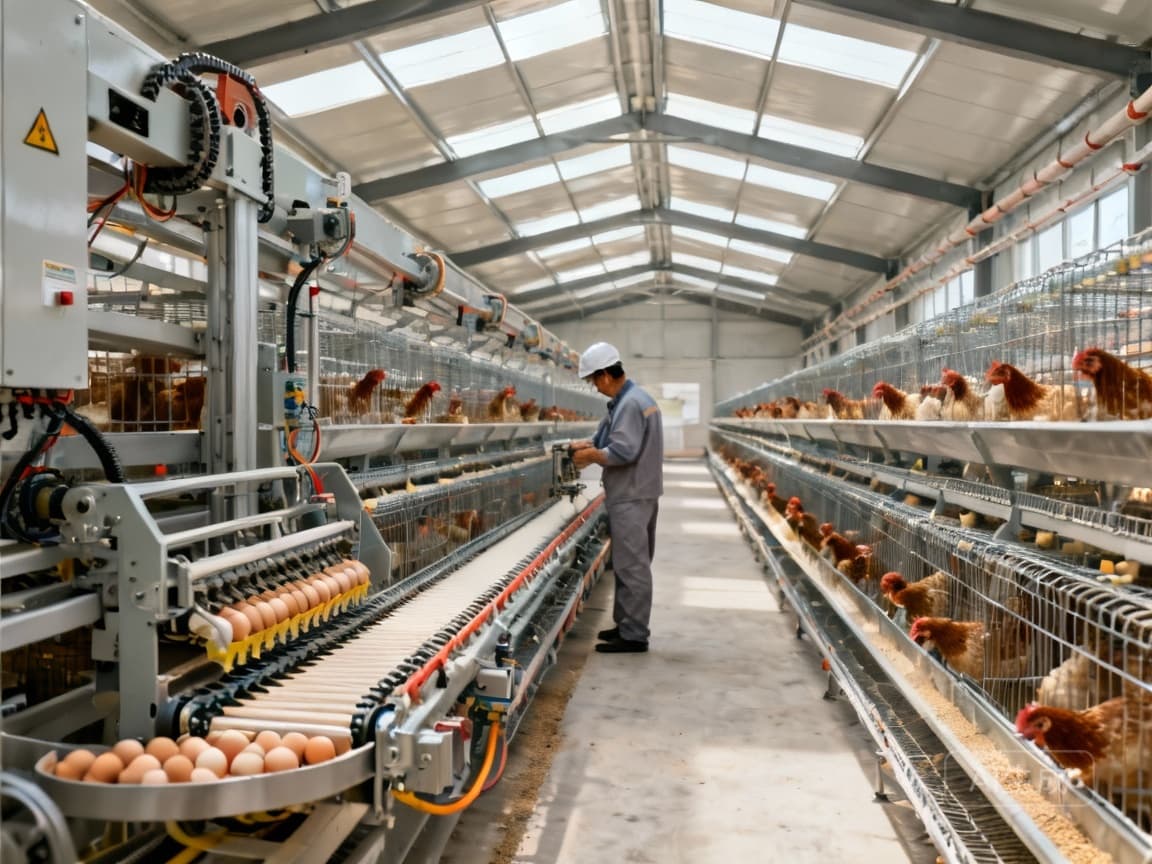
Consider the success of TAIYU Industrial Group. By implementing a German-designed H-type stacked cage system, they achieved a 60% reduction in ammonia levels, a 15% increase in production, and a 30% reduction in labor. The standard interpretation focuses on these impressive outputs. The risk-resilience framework, however, interprets them as inputs for mitigating critical threats:
- Ammonia Reduction (60%): This is not just an environmental metric. It directly mitigates animal welfare risks (respiratory disease) and biosecurity risks (weakened immune systems), while simultaneously addressing tightening regulatory compliance risks.
- Labor Reduction (30%): This transcends cost savings. It directly addresses the operational risk of labor volatility and shortage, a key driver identified in market trends, ensuring consistent operation.
- Production Increase (15%): This enhances financial resilience and provides a buffer against market price fluctuations and input cost increases.
The investment pays for itself in 12-18 months, but the risk protection it provides is immediate and continuous. This shift in perspective—viewing automation as a risk management system—is what separates tactical upgrades from strategic transformation.
The Risk-Resilience Assessment Matrix: A 5-Dimensional Framework
Moving from theory to practice requires a structured evaluation tool. When selecting an automated system, move beyond price and basic specs. Evaluate suppliers against these five key dimensions of operational resilience.
1. Biosecurity & Environmental Control Dimension
This is the frontline of risk mitigation. The primary goal is to create a controlled environment that minimizes disease vectors and emissions. The TAIYU case is instructive: the H-design, integrated manure belts, and optimized ventilation work in concert to remove waste quickly and efficiently, drastically cutting ammonia. Your evaluation checklist should include:
- Manure Removal System: Is it a fully enclosed, frequent-removal belt system? How does it prevent cross-contamination between tiers?
- Cage Design: Does it facilitate easy cleaning and disinfection? Does it minimize dust accumulation?
- Ventilation Integration: Is the system designed to work seamlessly with your climate control to ensure uniform air quality, preventing moisture buildup and pathogen-friendly microclimates?
2. Scalability & Spatial Elasticity Dimension
Your operation is not static. Market data shows the Asia-Pacific region, led by China and India, is the fastest-growing market, demanding scalable solutions. Your system must adapt to your growth trajectory without requiring a complete overhaul. Contrast the implementations for different scales:
- Large-Scale Farms (TAIYU model): High-density H-type stacked systems maximize land use. The key question is modularity—can you add identical modules easily?
- Mid-Scale Farms (Zhengzhou Livi model): Systems must balance high efficiency with manageable initial capital outlay. Can the system start at a core capacity and allow for phased expansion?
The "multi-tier design improves space utilization" insight is about more than density; it's about preserving future expansion options on limited land, a critical risk mitigation against rising real estate costs.
3. Labor Transformation & Knowledge Risk Dimension
Automation reduces manual labor but introduces a new risk: dependency on technical knowledge. A 30% reduction in routine labor should be seen as an opportunity to reallocate human capital to higher-value roles that the system cannot perform. Your implementation plan must address:
- Upskilling Path: Train existing staff in system monitoring, data interpretation, and preventive maintenance.
- Technical Support: Evaluate the supplier's local support network, especially critical in high-growth regions like Asia-Pacific. Can they provide timely troubleshooting and spare parts?
- System Transparency: Is the control interface intuitive? Does it provide clear error logging and performance data to empower your team?
4. Investment Resilience Dimension
The quoted 12-18 month ROI period is a powerful average, but your reality may differ. Building investment resilience means stress-testing this timeline against your specific variables. Conduct a sensitivity analysis by asking:
- Energy Consumption: What is the system's power draw for ventilation, manure belts, and egg collection? How does this impact your operational costs in a volatile energy market?
- Maintenance & Durability: What is the expected maintenance frequency and cost? Are critical components made from durable materials like hot-dip galvanized steel to withstand harsh climates (e.g., high humidity in Southeast Asia)?
- Parts Commonality: Does the system use proprietary parts or industry-standard components? The latter reduces long-term supply chain risk.
5. Regional & Regulatory Adaptability Dimension
A system successful in North America may fail in Thailand. The fastest growth is in Asia-Pacific, a region of immense climatic and regulatory diversity. Your chosen system must be adaptable.
- Climate: For high-humidity regions, corrosion resistance and enhanced ventilation capacity are non-negotiable. For areas with large temperature swings, look for systems with excellent insulation properties and integrated climate control compatibility.
- Regulations: Is the supplier's design philosophy aligned with evolving animal welfare standards (like the EU's new rules)? Can the system be configured for enriched colony or cage-free environments if market demands shift?
Navigating a Fragmented Market: The Integration Imperative
The market insight that "market concentration is low" is not just a statistic; it is a primary risk factor for buyers. A low-concentration market means you will encounter numerous suppliers, but many may only offer cages, or only feeders, or only climate controls. The greatest operational risk is a poorly integrated system where components from different vendors fail to communicate, creating management blind spots and inefficiencies.
This fragmentation makes the case for choosing a supplier with proven system integration capability. The ideal partner provides a holistic solution—cages, feeding, watering, egg collection, manure removal, and environmental controls—designed to work as a unified system. They should offer a single control interface and assume responsibility for the entire system's performance. As seen in the deep technical integration required for TAIYU's 60% ammonia reduction, true results come from synergy, not standalone components.
Implementation Roadmap: From Assessment to Resilience
Transforming this framework into action requires a phased approach.
- Internal Audit (Months 1-2): Form a cross-functional team (operations, finance, management). Use the 5-Dimension Matrix to conduct an honest assessment of your current operation's vulnerabilities.
- Supplier Shortlisting & Deep Dive (Months 2-4): Go beyond brochures. Require potential suppliers to present detailed case studies (like TAIYU or Zhengzhou Livi). Ask for site visits to existing installations. Scrutinize their integration capabilities and local support structure.
- Pilot Project or Phased Rollout (Months 5-12+): If possible, implement the system in a single house or module first. This allows you to validate performance data (especially ammonia reduction and labor reallocation), train your team, and refine processes before full-scale deployment.
- Continuous Monitoring & Optimization (Ongoing): Establish Key Performance Indicators (KPIs) tied to risk mitigation: ammonia ppm levels, bird mortality rates, feed conversion ratios, and system uptime. Use this data for continuous improvement.
The astronomical growth of the automated poultry farming market is a clarion call to action. However, the winning strategy is not to chase automation for its own sake, but to harness it deliberately to build a more resilient enterprise. By focusing on mitigating biosecurity, scalability, labor, investment, and regional risks, you move the conversation beyond a simple ROI calculation. You invest in a system that protects your assets, ensures compliance, secures your supply chain, and future-proofs your operation against the inevitable uncertainties of the market. The result is not just profitability, but durability—a business built to thrive for the long term.
Want to know more?
Get in touch with us for more information about our services and products.