
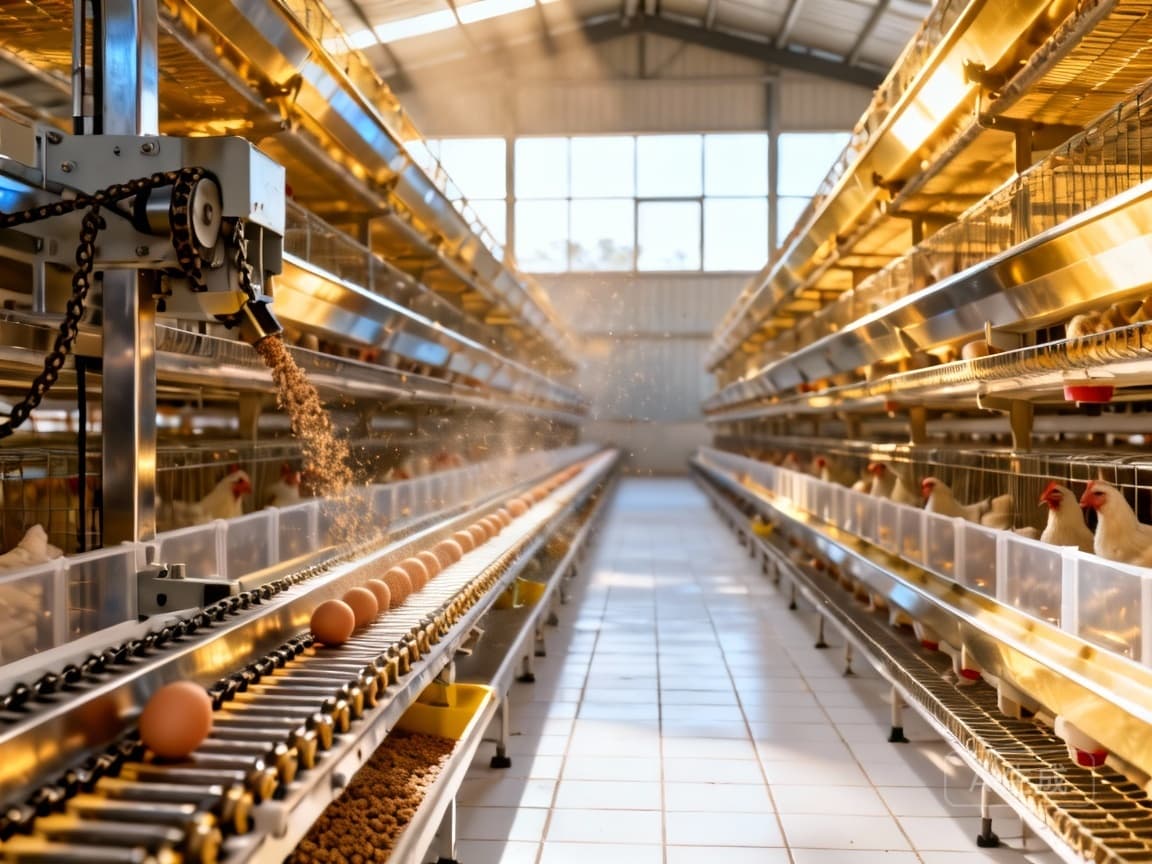
Automated Layer Cage ROI: 11% CAGR Growth & 5 Key Performance Levers #68
Automated Layer Cage ROI: Navigating the 11% CAGR Growth with 5 Key Performance Levers
For senior decision-makers in poultry farming and agribusiness, the question is no longer whether to automate, but how to do so profitably and strategically. The global automated layer cage market is projected to grow at a Compound Annual Growth Rate (CAGR) of 11% through 2033, significantly outpacing the broader poultry farming equipment market's 4.7% CAGR. This divergence signals a critical shift: automation is the primary lever for securing competitive advantage and superior returns. However, transitioning from a capital expenditure to a verified return on investment requires moving beyond generic efficiency claims. This article provides a strategic framework, grounded in real market data and technical standards, to act as your chief risk officer and value architect, ensuring your multi-million dollar investment delivers on its promise.
From Growth Story to Risk Map: The Strategic Imperative
The compelling growth narrative is clear. Future Market Insights reports that by 2025, automated operations will contribute 48.0% of the revenue share in the poultry farming equipment market, becoming the dominant mode. Drivers like labor shortages, stringent hygiene standards, and the demand for improved animal welfare are universal. The Asia-Pacific region, particularly China and India, is leading this charge due to rapid industry expansion. Yet, within this opportunity lies a landscape of potential pitfalls. A successful case study from a consulting firm underscores that detailed feasibility studies and capital plans are paramount to project success. The high-growth environment can pressure rushed decisions, leading to investments in systems that fail to meet operational benchmarks or require costly retrofits.
The first step in mitigating this risk is conducting rigorous technical due diligence. This moves the conversation from vendor specifications to verifiable standards. For instance, the technical specifications issued by Hubei Province's Department of Agriculture mandates that cage wire galvanizing must comply with GB/T 13912, a specific national standard. A prospective buyer's checklist must include demanding proof of such compliance. This level of scrutiny transforms the procurement process from a sales transaction into a value assurance protocol, directly addressing the core anxiety of large-scale investors.
The Five Key Performance Levers for Quantifiable ROI
Abstract promises of "increased efficiency" hold little weight in the boardroom. Real ROI is built by optimizing specific, measurable performance levers. By analyzing technical standards and market insights, we can define a clear value realization path centered on five critical areas.
1. Egg Integrity and Yield Preservation
The most direct impact on revenue is the number of saleable eggs. The Hubei technical specifications set a clear benchmark: a breakage rate of ≤2% for the egg collection system. Every percentage point above this threshold represents a direct loss of product and profit. Implementation guidance must, therefore, focus on system design and maintenance. This includes evaluating the softness and alignment of egg collection belts, the smoothness of transfer points, and the shock absorption in the final packing system. Regular auditing of this KPI is non-negotiable, as it directly correlates to top-line revenue.
2. Operational Throughput and Labor Arbitrage
Automation's primary economic driver is the substitution of capital for labor. The standard's requirement for a central egg collection line efficiency of ≥10,000 eggs per hour provides a quantifiable target. This metric must be modeled against your specific farm size and labor costs. The goal is not just to meet this number but to understand its implications: how many manual collection hours does it eliminate? Does it allow for the consolidation of barn management tasks? The financial model should clearly show the labor cost savings against the capital and energy costs of running the high-throughput system.
3. Feed and Water Conversion Efficiency
While often highlighted in manual systems, automated feeding and watering present a more nuanced efficiency lever. Precision in delivery reduces waste, but the greater value lies in consistency and data. Automated systems should provide uniform access, reducing bird competition and stress, which positively impacts feed conversion ratios (FCR). The implementation focus here is on calibration and monitoring. Ensure feed lines deliver consistent portions across the entire cage row and that nipple drinkers maintain optimal pressure. Small gains in FCR across a large flock compound into significant savings in feed costs, one of the largest operational expenses.
4. Animal Welfare as a Value Driver
Market insights clearly show that animal welfare is a core growth driver, especially in North America and Europe where demand for cage-free eggs is strong. Modern automated cage designs can significantly improve welfare over older systems through better space allocation, environmental control, and reduced injury rates. This lever translates into value through multiple channels: qualifying for premium market segments or certification programs, reducing mortality rates, and improving overall bird health and productivity. When evaluating systems, assess features like manure belt design (for air quality), lighting systems, and cage floor geometry not just as costs, but as investments in product differentiation and brand resilience.
5. System Uptime and Lifecycle Cost Management
The sophisticated machinery of an automated barn represents a significant asset whose downtime is catastrophic. The ROI calculation is incomplete without a robust plan for operational reliability. This involves two key actions. First, during procurement, insist on preventive maintenance schedules and readily available spare parts as part of the supplier agreement. Second, develop internal Standard Operating Procedures (SOPs) for daily checks—monitoring drive motors, belt tensions, and control panel alerts. The Hubei specifications' emphasis on material quality and construction standards is fundamentally about maximizing Mean Time Between Failures (MTBF) and extending the total system lifecycle, thereby lowering the annualized capital cost.
The transition to automation is not merely an equipment upgrade; it is a fundamental re-architecture of the farm's operational and economic model. Success depends on managing it as a holistic business transformation.
Building Your Strategic Investment Framework: A Practical Guide
Armed with an understanding of these five levers, executives can implement a disciplined, four-phase framework to guide their automation investment.
Phase 1: Strategic Assessment & Feasibility
Begin by modeling the financial impact of the five levers using your farm-specific data. Create a spreadsheet that inputs your current:
- Labor costs and headcount in collection, feeding, and cleaning.
- Current breakage rates and mortality figures.
- Feed consumption and cost metrics.
- Local energy costs.
Phase 2: Technical Due Diligence & Procurement
This is where you operationalize the risk map. Develop a supplier Request for Proposal (RFP) that mandates evidence, not just claims. Require:
- Certification of material standards (e.g., GB/T 13912 for galvanization).
- Performance guarantees for key metrics like egg breakage rate and collection efficiency, tied to contractual penalties.
- A clear plan for installation supervision, commissioning, and staff training.
- Evidence of IoT/data output capability to ensure future readiness for smart farming integration, a key future trend identified by market analysts.
Phase 3: Implementation & Commissioning
Adopt the mindset of a commissioning agent, not just a recipient. Before final acceptance, run rigorous tests:
- Measure actual egg breakage rate by sampling eggs from various system points.
- Time the egg collection cycle to verify throughput.
- Check feed and water distribution uniformity across the entire cage block.
Phase 4: Continuous Optimization & Management
Post-installation, establish a continuous monitoring regime. Track the five key performance levers as your core business KPIs. Use the data generated by the system (if equipped) to move from preventive to predictive maintenance. Regularly review performance against your Phase 1 financial model to identify gaps and opportunities for further tuning. This transforms the automated system from a static asset into a dynamic source of competitive intelligence and incremental profit.
Conclusion: Securing Advantage in the Automation Era
The data is unequivocal: the automated layer cage segment, growing at 11% CAGR, is where the industry's future profitability is being forged. For B2B investors, the winning strategy is not to simply buy automation, but to master its economics. By shifting from a procurement-focused view to a value-architecture approach—meticulously mapping risks, quantifying performance levers, and implementing a disciplined governance framework—you can ensure your investment delivers more than efficiency. It delivers a structural, defensible advantage in an increasingly competitive and technologically driven market. The goal is to own not just the equipment, but the superior return it was designed to generate.
Want to know more?
Get in touch with us for more information about our services and products.