
Automate Poultry Farms: Achieve 15% Higher Yield & 60% Lower Ammonia Emissions #79
The Dual Imperative: How Smart Automation Addresses Both Productivity Explosion and Sustainability Demands in Asia-Pacific Poultry
The Asia-Pacific poultry industry stands at a critical juncture. Driven by population growth and rising incomes, the region is experiencing a production boom, with a projected CAGR of 12.20% for the automated poultry farm market from 2025 to 2030. Simultaneously, a global wave of stringent sustainability and animal welfare regulations, most notably the European Union's Green Deal and Farm to Fork Strategy, is reshaping market access and consumer expectations. For farm owners and operators, this creates a dual imperative: scale production efficiently while future-proofing operations against regulatory and environmental risks. This article moves beyond generic ROI claims to explore how integrated automation systems provide a strategic framework to navigate this complex landscape, transforming from a capital expense into a cornerstone of resilient, high-value, and compliant farming.
Redefining "Efficiency": From Space Saving to Strategic Density
Traditional discussions of poultry automation often start with labor savings. While significant—with cases like TAIYU INDUSTRIAL GROUP reporting a 30% reduction in labor—the true strategic value in Asia-Pacific's context lies in achieving "strategic density." This concept transcends mere physical space optimization. It's about maximizing the output, quality, and value per square meter of land and per dollar of fixed asset investment.
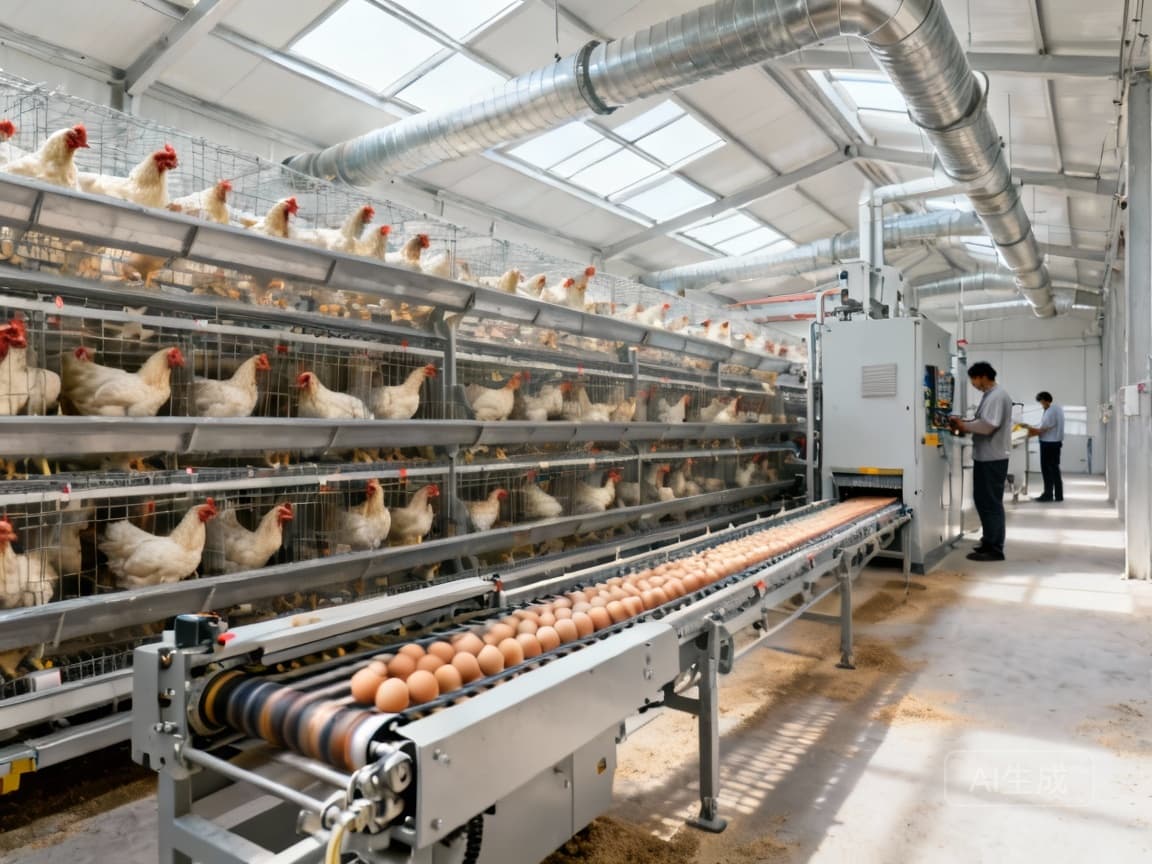
With land at a premium and modernization costs high—evidenced by China's $12 billion push for farm upgrades—simply housing more birds is insufficient. Modern automated layer cage systems, such as the German-designed H-type system used by TAIYU, enable strategic density by integrating vertical farming with precise control. The result is a quantifiable leap in both volume and quality. TAIYU's implementation led to a 15% increase in egg production alongside improved space utilization. This synergy is critical: strategic density means consistently producing more market-standard eggs (with lower breakage and higher cleanliness) from the same footprint, directly boosting asset turnover and enabling scalable growth within physical constraints.
"The Asia-Pacific region is the fastest-growing market for automatic layer chicken cages, driven by rapid industry expansion in China and India and a focus on improving productivity and animal welfare." – Datahorizzon Research Market Analysis.
Implementation Guidance: Building a Strategic Density Plan
To translate this concept into action, farm operators should undertake a three-step assessment:
- Conduct a Current State Analysis: Map your farm's existing spatial efficiency. Calculate key metrics: eggs produced per square meter per year, current labor hours dedicated to feeding and egg collection, and baseline egg quality rates (e.g., cracks, dirt).
- Model Tiered Automation Scenarios: Don't assume a full-scale overhaul is the only path. Model different configurations. For a mid-sized farm, a phased approach starting with automated egg collection and environmental monitoring can yield quick wins in quality and labor consistency, as seen in Zhengzhou Livi Machinery's projects in Sri Lanka. Compare the potential output and quality improvements of 3-tier versus 4-tier systems against your specific building dimensions.
- Calculate Total Asset ROI: Move beyond simple payback periods. Build a financial model that includes:
- Direct savings (labor, feed waste reduction).
- Revenue enhancement (higher yield, premium for quality).
- Asset value appreciation (a modern, automated facility has a higher resale/credit value).
Automation as the Foundation for Compliance and Brand Value
The second pillar of the dual imperative is sustainability compliance. Here, automation shifts from a "cost-saving tool" to an essential "risk mitigation and brand-building tool." Global supply chains and conscious consumers are demanding transparency and responsibility. The EU's regulatory push is a leading indicator, increasing demand for "low-emission waste management systems" and driving investment away from conventional cages.
Automated environmental control systems are pivotal in this transition. They provide the precise, data-driven management required to meet stringent standards. In TAIYU's case, their integrated system achieved a 60% reduction in ammonia levels. This is not a minor improvement; it directly addresses critical issues of animal health, worker safety, and environmental impact. Consistent ventilation, temperature, and manure removal—core functions of a modern cage system—create a stable microenvironment that minimizes stress, reduces antibiotic use, and controls emissions.
"The market outlook is positive, driven by... increasing focus on sustainability and environmental regulations. The EU’s Green Deal and Farm to Fork Strategy are driving investments in... automatic feeders, and low-emission waste management systems." – Future Market Insights Poultry Farming Equipment Market Report.
Implementation Guidance: The Path to Audit-Ready Operations
Preparing for current and future compliance requires a systematic approach:
- Digitize Environmental Data: Implement sensors to continuously log temperature, humidity, ammonia, and particulate matter. This data history is invaluable for internal management and provides verifiable proof of compliance during audits.
- Integrate Manure Management: Choose systems with automated manure belts that remove waste promptly and predictably. This is the single most effective engineering control for reducing ammonia and greenhouse gas emissions on-site.
- Document Animal Welfare Parameters: Automated feeding and watering systems ensure consistent access to nutrition. Use this capability to document adherence to welfare standards. The data trail from your automation system becomes a key asset in certifying responsible production practices.
Building a Resilient Supply Chain: Mitigating Labor and Production Volatility
The third strategic angle addresses a fundamental business risk: operational resilience. Labor shortages are not just a cost issue; they threaten supply chain stability and production consistency. By 2025, the automated segment is projected to hold a 48.0% revenue share of the poultry farming equipment market, a clear signal that the industry is prioritizing continuity.
Automation builds resilience by decoupling critical processes from manual variability. Automated feeding delivers precise rations on schedule, regardless of staff availability. Automated egg collection minimizes handling damage and ensures timely gathering. Most importantly, integrated environmental controls maintain optimal conditions 24/7, safeguarding bird health and productivity against human error or oversight. This creates a predictable, scalable operation that can withstand external shocks and maintain biosecurity protocols more effectively.
Implementation Guidance: Phasing Automation for Operational Resilience
For farm managers, building resilience can be a phased journey:
- Identify Single Points of Failure: Analyze your operation. Where do labor shortages or human inconsistency most directly impact yield or animal health? For many, this is environmental control (ventilation failures) or egg collection (quality drops).
- Prioritize Core Process Automation: Start by automating the most critical vulnerability. Installing an automated climate controller with alarms is a foundational step that protects your entire flock and has a rapid ROI.
- Scale to Full Integration: Once core systems are stable, expand integration. Link environmental data to fan and heater operations. Connect feed lines to monitoring systems that track consumption. This creates a closed-loop, resilient production system where technology ensures consistency, allowing human labor to focus on higher-value supervision and management tasks.
Conclusion: The Framework for a Future-Ready Poultry Farm
The convergence of explosive growth in Asia-Pacific and tightening global standards is not a temporary challenge but the new permanent reality for poultry farming. Success requires a strategic partner, not just a equipment vendor. The future-ready farm is built on an automation framework that delivers strategic density to maximize valuable assets, ensures compliance and brand value through data-driven environmental control, and guarantees operational resilience in the face of market and labor volatility.
The data is clear: the market is moving decisively toward automation. With a global poultry farming equipment market valued at $4.19 billion in 2024 and growing, the question for forward-looking farm operators is not *if* to automate, but *how strategically* to do so. By adopting a phased, value-focused approach centered on these three pillars, farms can transform this necessary investment into their most powerful competitive advantage for the decade ahead.
Want to know more?
Get in touch with us for more information about our services and products.