
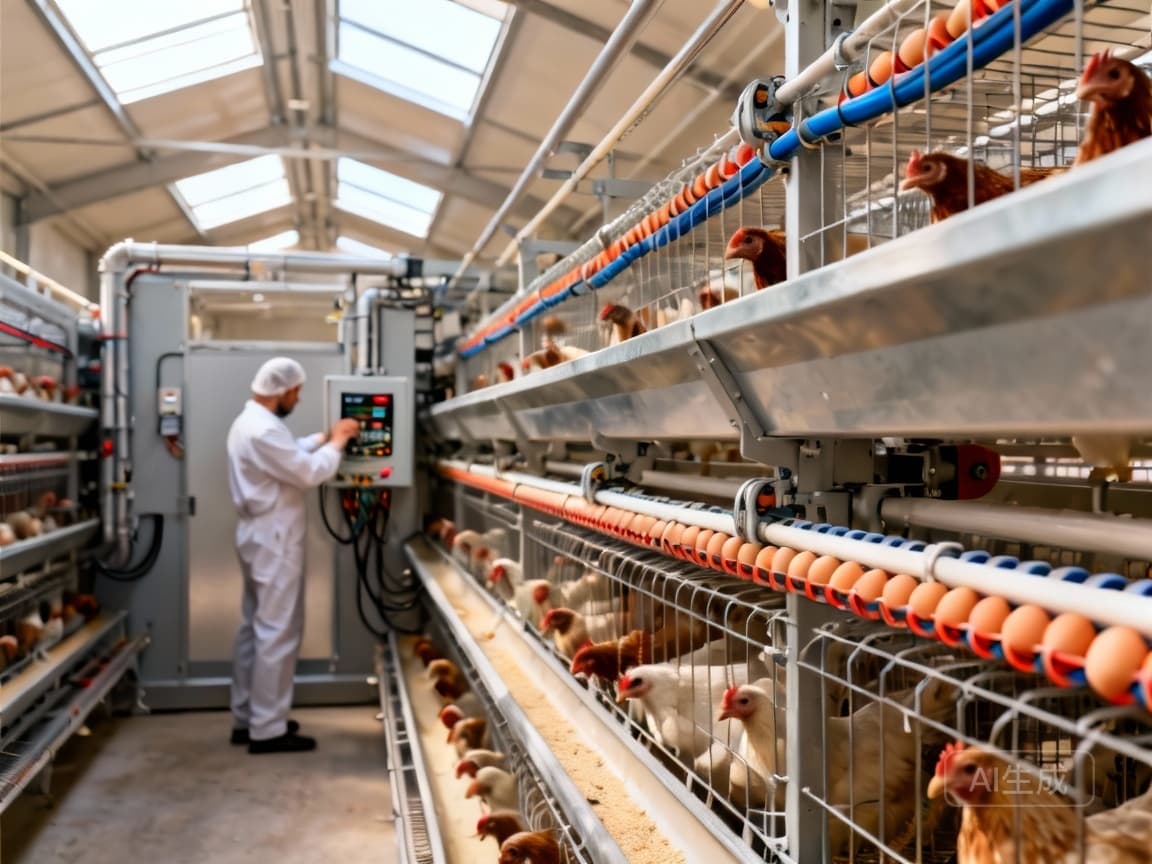
Automate Poultry Farming: Cut Integration Costs 30% & Secure ROI #63
Beyond the Purchase: Building a Data-Driven, Resilient Poultry Production System
The poultry automation market is booming. Driven by labor shortages, stringent standards, and the relentless pursuit of efficiency, automated equipment is projected to contribute 48.0% of the poultry farming equipment market's revenue share by 2025. The automated poultry farm market itself is forecast to grow from $384.1 million in 2025 to $682.98 million by 2030, a robust 12.20% CAGR. Yet, beneath this wave of investment lies a stark contradiction: a significant portion of these projects fail to deliver. Data indicates that 68% of poultry automation investments fail to meet their ROI targets, often due to hidden integration costs that can consume 25-30% of the budget and double the payback period.
This reveals a critical insight for B2B decision-makers: the core challenge is not purchasing advanced equipment, but successfully integrating and operating it as a cohesive, living system. The path to value lies not in the hardware alone, but in a strategic framework for managing its entire lifecycle. This article moves beyond generic efficiency claims to provide a roadmap for transforming a capital expenditure into a resilient, data-driven production system that secures and sustains ROI.
Pillar 1: Deconstructing Hidden Costs and Redefining ROI
The first step toward a successful automation project is a complete and honest financial assessment. Traditional budgeting often focuses on line-item equipment costs, overlooking the substantial "soft costs" of integration, training, and ongoing system management. This gap is where ROI expectations unravel.
The true measure is Total Cost of Ownership (TCO). A comprehensive TCO model must account for:
- Direct Hardware & Software: Cages, feeders, climate computers, ERP/MES platforms.
- System Integration: Engineering, middleware, API development, and testing to ensure disparate systems communicate.
- Human Capital Development: Phased training programs for existing staff, cross-training, and potential new hires for data analysis roles.
- Operational Integration: Costs associated with redesigning management workflows, creating new SOPs, and change management.
- Long-Term Sustainability: Preventive maintenance schedules, spare parts inventory, and a plan for future technology updates.
Case in point: One implementation partner found that by proactively addressing these hidden layers with a structured methodology, they were able to reduce integration costs by 30%, directly protecting the project's ROI timeline and establishing a system built for long-term operation.
Actionable Guidance: Before any purchase order, develop your own TCO checklist. Model not just the 3-year, but the 10-15 year horizon, considering the lifespan of modern equipment like H-type smart cages, which can last 15-20 years with proper maintenance.
Pillar 2: The Three-Stage Implementation Framework: From Foundation to Optimization
Avoiding the "big bang" approach is crucial. A phased, value-driven rollout builds organizational confidence and allows for course correction. The following framework, derived from successful field implementations, provides a realistic 24-month roadmap.
Stage 1: Data Foundation (Months 1-3)
Goal: Establish a single source of truth. The primary pain point is often data silos—where environmental sensors, feed lines, and egg collection systems operate in isolation. This stage is about connectivity and standardization.
- Action: Audit all existing equipment and data outputs. Prioritize unifying the data format for 3-5 critical Key Performance Indicators (KPIs), such as feed consumption per house, water usage, and mortality rate.
- Quick Win: Simply automating manual data collection and reporting can reduce manual time by 20-30%, providing immediate visibility and freeing staff for higher-value tasks.
Stage 2: Analytical Integration (Months 4-12)
Goal: Move from data to insight. With standardized data flowing into a central dashboard, you can begin to establish correlations and proactive alerts.
- Action: Create cross-system rules. For example, link temperature and humidity data from climate computers to feed line algorithms, or set alerts for when egg collection rates deviate from flock age benchmarks.
- Outcome: This phase drives tangible efficiency gains, such as reducing feed and energy waste by 8-12% and boosting equipment utilization by 15-25% through predictive maintenance alerts.
Stage 3: Optimization & Closed-Loop Control (Months 13-24+)
Goal: Achieve autonomous optimization. The system begins to prescribe and even execute actions based on predictive analytics.
- Action: Implement closed-loop controls. For instance, an algorithm could analyze growth curve data and real-time feed conversion ratios to automatically adjust feeder settings for the next flock cycle, optimizing for the specific genetics of your birds—a key future trend noted in market insights.
- Outcome: This is where true production system resilience is achieved, allowing you to consistently meet the demands of a growing market, such as the 5.3% CAGR forecast for the global broiler chick market.
Pillar 3: Operational Integration: Weaving Data into Daily Management
Technology integration is futile without workflow integration. The ultimate goal is to change how managers and staff make daily decisions. This is the "operational layer" of integration.
Consider the shift prompted by major retailers like Walmart and Kroger committing to 100% cage-free eggs by 2025. An automated, data-driven system is essential to manage the higher complexity and welfare monitoring in such environments. Operational integration means:
- Daily management reports are automatically generated, highlighting exceptions rather than requiring manual compilation.
- Maintenance teams receive work orders on their mobile devices triggered by equipment health algorithms, not just breakdowns.
- Nutritionists adjust formulations based on real-time intake and flock health data streams rather than weekly summaries.
A critical lesson learned from the field: Invest in phased training programs starting 3-6 months before equipment installation. This ensures your team evolves alongside the technology, cementing its value into your operational culture.
Pillar 4: Future-Proofing for Scalability and Evolution
Your automation investment must be a platform for growth, not a technological dead end. With the commercial segment holding a 79% share of the poultry farming equipment market, scalability is a business imperative.
When selecting equipment and software, demand future compatibility:
- Modular Design: Choose systems like modular H-type cages that allow you to expand capacity incrementally. Their high density (5,000–30,000 birds per unit) supports scaling production without proportionally increasing footprint.
- Open Standards & Protocols: Insist on equipment that supports industry-standard communication protocols (e.g., OPC UA, MQTT). This avoids vendor lock-in and simplifies integrating next-generation sensors or robotics.
- Data Architecture: Build your data platform to be agnostic. It should be able to incorporate new data types, whether from gene expression monitoring tools or advanced pathogen detection sensors, aligning with the market's trajectory toward genetic improvement and biosecurity.
This forward-looking approach is what separates a cost-center project from a strategic asset that can capitalize on long-term trends, such as the projected growth of the poultry cage system market to $5.52 billion by 2033.
Securing Your Investment: From 68% Failure to 100% Value Realization
The automation journey in poultry farming is no longer optional; it is a competitive necessity to meet global protein demand, evolving consumer preferences, and operational challenges. However, success is not guaranteed by the technology itself. It is secured by a management philosophy that views automation as a dynamic production system.
By adopting this four-pillar framework—mastering TCO, executing a phased implementation, integrating data into daily ops, and insisting on scalability—you move the conversation from mere procurement to guaranteed performance. You transform the daunting statistic of a 68% failure rate into a 100% commitment to value realization, building a resilient operation poised for profitability in the modern agricultural landscape.
Your Next Step: Conduct an internal audit using the principles outlined. Identify your largest data silo, draft a preliminary 3-stage plan for one poultry house, and begin conversations with technology partners who can articulate a clear vision for both integration and long-term operational support. The market growth is established; your strategic response will define your place within it.
Want to know more?
Get in touch with us for more information about our services and products.