
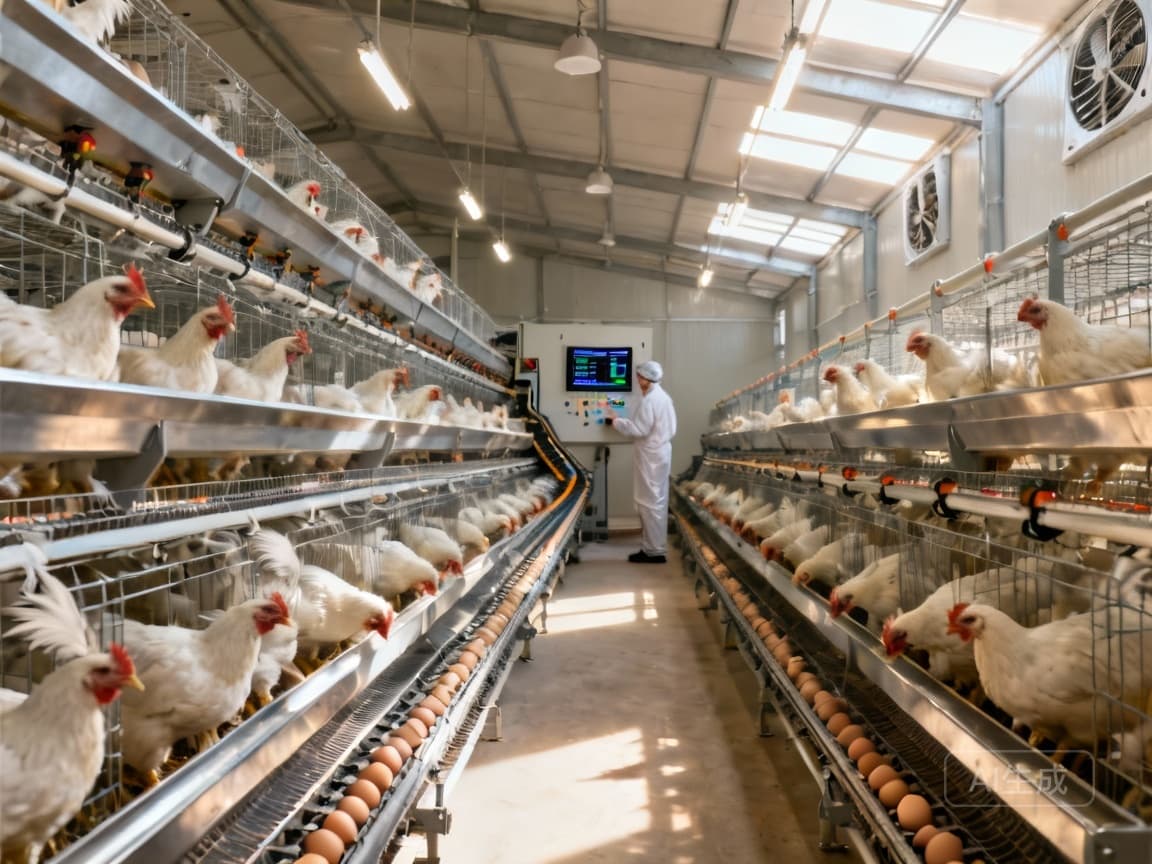
Automate Poultry Farming: 60% Lower Costs, 15-20 Year Equipment Lifespan & 12.2% Market Growth #57
Rethinking Poultry Farm ROI: Beyond Equipment Costs to Total Capital Efficiency
The poultry farming industry stands at an inflection point where traditional operational models are being fundamentally reshaped by automation technologies. While many discussions focus on technical specifications, the real transformation occurs in financial performance metrics. The global automated poultry farm market is projected to reach USD 682.98 million by 2025, growing at a 12.2% CAGR, signaling a fundamental shift in how successful operations are managed.
Consider the case of Jiayu County Qingshan Ecological Layer Farm, which achieved remarkable results through comprehensive automation: 65,000 birds capacity with daily sales revenue of RMB 24,000 from 3.8 tons of daily egg production. The total investment of RMB 10 million demonstrates how strategic capital allocation in automation creates superior financial returns compared to traditional approaches.
The Capital Efficiency Transformation
Traditional poultry farming operations typically face equipment lifespans of 5-8 years, requiring frequent capital reinvestment and creating significant depreciation expenses. Modern automation systems using Q235 steel with hot-dip galvanized coating extend equipment lifespan to 15-20 years, fundamentally altering depreciation schedules and improving long-term cash flow projections.
Maintenance cost reductions represent another critical financial advantage. Automated systems reduce cleaning frequency from daily to every 3-5 days while cutting maintenance costs by 60%. This operational efficiency translates directly to improved bottom-line performance and reduced labor dependency.
The poultry farming equipment market is projected to grow from USD 4.0 billion in 2025 to USD 7.1 billion by 2035, representing a 6.0% CAGR, indicating sustained investment in automation technologies.
The Automation Investment Matrix: Choosing the Right Technology Stack for Your Scale
Selecting appropriate automation technology requires careful consideration of operational scale, existing infrastructure, and financial capacity. The investment matrix varies significantly based on operation size, with different optimal solutions for small, medium, and large-scale operations.
Small to Medium Operations (5,000-30,000 birds)
For smaller operations, H-Type Smart Cages offer an ideal entry point into automation. These systems typically accommodate 5,000–30,000 birds per unit compared to traditional systems handling approximately 3,000 birds. The modular nature allows for phased implementation, reducing upfront capital requirements while delivering immediate efficiency improvements.
Large-Scale Operations (30,000+ birds)
Large operations benefit most from comprehensive layer cage systems with 3 or more tiers. These systems dramatically improve space utilization efficiency while enabling centralized management of feeding, environmental control, and waste management. The structural integrity of hot-dip galvanized Q235 steel ensures durability under high-capacity conditions.
Technical specifications matter significantly in investment decisions. Equipment using Q235 steel with hot-dip galvanized coating demonstrates proven longevity and reduced maintenance requirements. The initial premium for superior materials typically delivers 200-300% return through extended service life and reduced downtime.
Phased Automation Implementation: Minimizing Risk While Maximizing ROI
Successful automation implementation requires strategic phasing to minimize operational disruption while maximizing return on investment. The most effective approach follows a structured implementation roadmap:
- Assessment Phase: Conduct comprehensive operational audit to identify automation priorities and compatibility with existing infrastructure
- Pilot Implementation: Install automated systems in one production unit to validate performance and train staff
- Full-Scale Deployment: Expand successful systems across entire operation with customized installation based on facility layout
- Optimization Phase: Fine-tune systems for maximum efficiency and integrate additional automation modules
The experience from Qingdao Damu Machinery Co., Ltd., established in 2005 with registered capital of RMB 150 million, demonstrates that professional equipment manufacturing requires continuous R&D and technological innovation. Their implementation experience shows that layered cage systems stacked in 3 or more tiers significantly improve land use efficiency while maintaining operational flexibility.
Risk Mitigation Strategies
Implementation risks can be effectively managed through several proven strategies:
- Maintain parallel traditional systems during transition period to ensure production continuity
- Implement comprehensive staff training programs to build operational competence
- Establish maintenance protocols and spare parts inventory before full deployment
- Develop contingency plans for system failures or technical issues
Future-Proofing Your Poultry Operation: Technologies Worth Investing In Today
The poultry equipment market is evolving rapidly, with several technologies delivering exceptional future-proofing value. The chicken cages market, valued at USD 1.5 billion in 2024, is expected to reach USD 2.8 billion by 2033, growing at a 7.5% CAGR from 2026-2033. This growth is primarily driven by automation adoption, particularly in the Asia-Pacific region where China and India are leading demand growth.
Smart Monitoring Systems
IoT-enabled cage monitoring systems represent the next frontier in poultry automation. These technologies provide real-time data on bird health, environmental conditions, and equipment performance, enabling predictive maintenance and optimized operational decisions. By 2025, automated equipment is expected to comprise 48% of market share, indicating rapid adoption of smart technologies.
Environmental Control Advancements
Modern environmental control systems deliver significant energy efficiency improvements while maintaining optimal conditions for bird health and productivity. These systems typically reduce energy consumption by 25-40% compared to traditional environmental management approaches.
Waste Management Integration
Advanced automation systems integrate waste management directly into operational workflows. The Jiayu County case demonstrates how automated manure collection and processing creates additional revenue streams through organic fertilizer production, effectively turning waste into profit center.
The Asia-Pacific poultry farming equipment market was valued at USD 2.0 billion in 2024 and is expected to grow at a 5.2% CAGR from 2025-2034, highlighting the region's leadership in automation adoption.
The financial engineering behind modern poultry automation represents a fundamental shift in how successful operations are built and managed. By focusing on total capital efficiency rather than simply equipment costs, forward-thinking operators can achieve superior returns while building sustainable, future-proof operations. The data clearly demonstrates that strategic automation investment delivers compelling financial returns through reduced operating costs, improved productivity, and enhanced operational resilience.
Want to know more?
Get in touch with us for more information about our services and products.