
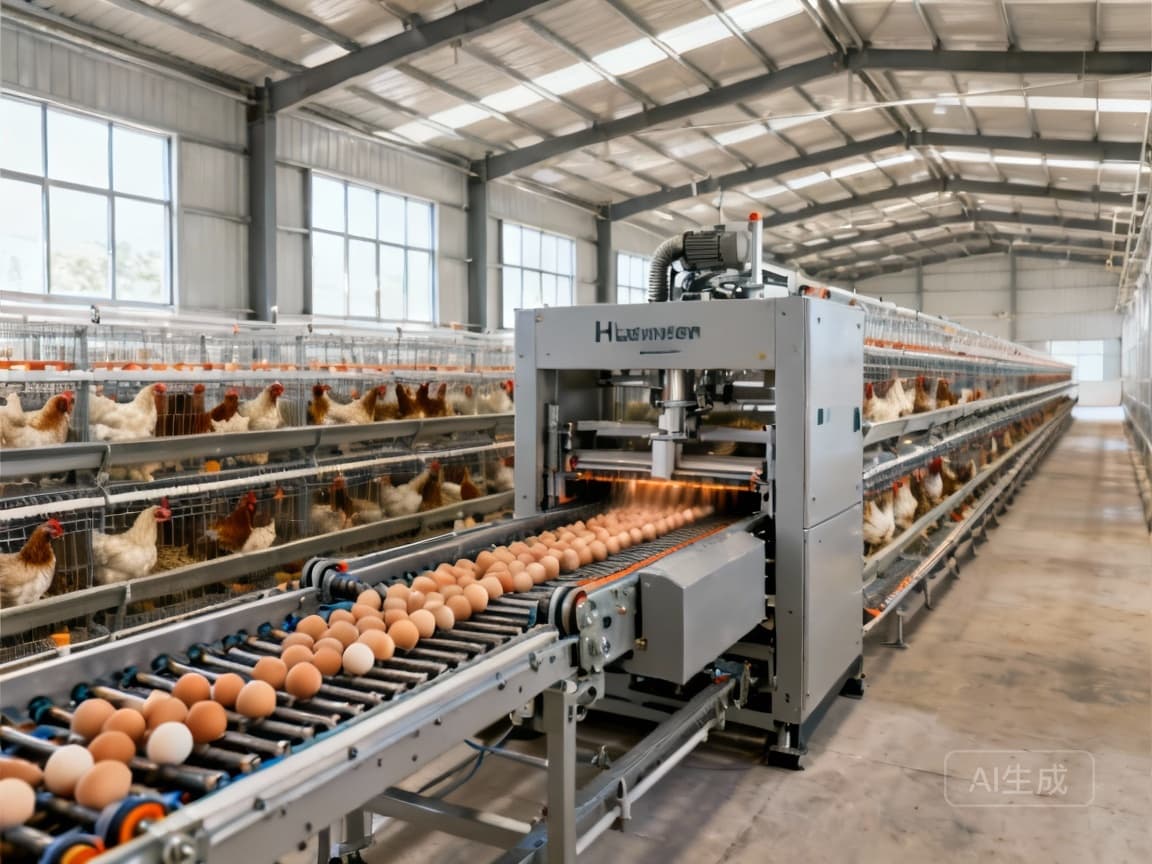
Automate for Growth: 12-18 Month ROI & 30% Labor Savings in Poultry Farming #76
The New Paradigm for Poultry Farming in Asia-Pacific: Building Sustainable Scale Through Strategic Automation
The Asia-Pacific poultry industry stands at a critical juncture. Driven by rising protein demand, the market is experiencing explosive growth, with the automated poultry farming sector alone projected to surge at a CAGR of 12.20% from 2025 to 2030. Yet, this rapid expansion is colliding with systemic headwinds: acute labor shortages, intensifying environmental regulations, and persistent biosecurity threats. For farm owners and operators, the traditional playbook is no longer sufficient. Success in this new era hinges on adopting a strategic approach to automation—one that transcends viewing equipment as a mere capital expense and instead positions it as the core operating system for a resilient, profitable, and sustainable business.
Redefining the Value of Automation: A Three-Pillar Framework
While Return on Investment (ROI) remains a crucial metric, a narrow focus on payback periods alone overlooks the transformative potential of modern systems. Leading farms are evaluating automation through a strategic lens, measuring its impact across three interconnected dimensions of value.
1. Financial Value: Quantifiable Efficiency and Payback
This is the foundational layer, where the direct cost-benefit analysis occurs. Industry data and case studies provide compelling evidence. The global poultry farming equipment market, propelled by automation, is on a steady growth path. More tellingly, the automation segment itself is forecast to contribute 48.0% of the market's revenue share by 2025, establishing it as the dominant operational model. Concrete results from the field validate this trend. For instance, TAIYU Industrial Group's implementation of an automated H-type layer cage system delivered a 15% increase in yield and a 30% reduction in labor. Critically, such investments are proving to be rapidly justifiable, with ROI periods consistently achieved within 12 to 18 months, as seen in cases from TAIYU to farms utilizing Zhengzhou Livi equipment in Sri Lanka.
2. Operational Value: Predictability and Risk Resilience
Beyond the spreadsheet, automation's greatest gift to farm managers is control and predictability. A 15% yield increase isn't just about more eggs; it's about consistent, high-quality output achieved through standardized feeding, climate management, and reduced bird stress. This consistency is key to securing financing and meeting supply contracts for scalable growth.
Furthermore, automation directly builds operational resilience. The 30% labor saving is not merely a cost reduction; it fundamentally reduces dependency on a scarce resource and minimizes human traffic—a major vector for disease. As one analysis notes, the drive for automation in Asia-Pacific is heavily influenced by the need to "address labor shortages in the poultry sector." In times of health crises or labor market volatility, automated farms maintain core operations, transforming from a vulnerability into a strategic asset.
3. Strategic Value: Compliance, Market Access, and Brand Equity
This is where automation transitions from a tactical tool to a long-term strategic advantage. Environmental management is a prime example. TAIYU's project resulted in a 60% reduction in ammonia levels. This isn't just a better-smelling farm; it's a direct investment in animal welfare (improving respiratory health), product quality, and regulatory compliance. With initiatives like the EU's Green Deal influencing global supply chains, and consumers increasingly valuing ethical production, such environmental control becomes a ticket to premium markets.
"The region's focus on improving animal welfare... creates significant opportunities for automatic layer chicken cages." – Datahorizzon Research Analysis on the Asia-Pacific Market.
Automation enables the precise husbandry and data collection needed to credibly tell a story of sustainability and animal care, unlocking brand溢价 and ensuring future-proofing against tightening regulations.
Deconstructing Success: What Leading Farms Did Right
Examining real-world implementations reveals how strategic intent translates into technical execution.
Case Study: TAIYU Industrial Group – Systemic Solution for Large-Scale Farming
Facing challenges in manure control and ammonia reduction at scale, TAIYU didn't just seek a new cage. They implemented an integrated H-type stacked cage automation system. The H-design was crucial for effective manure management, which, combined with automated ventilation, directly addressed the core environmental challenge. The automation system then layered in labor savings and precision feeding. The result was a holistic solution that tackled a strategic problem (sustainability and community relations) while delivering core financial and operational benefits, proving effective across diverse geographies from Dubai to Nigeria.
Case Study: Zhengzhou Livi in Sri Lanka – Affordable Scale for Mid-Sized Farms
This case exemplifies the "leapfrog" opportunity in Asia-Pacific. A mid-sized farm seeking growth opted for a multi-tier cage system. This approach allowed for significant expansion of bird capacity within a smaller footprint, a critical consideration for many farms. The key takeaway is that automation enabled scalable, efficient growth that was appropriate and affordable for their operational scale, delivering a compelling ROI and positioning them for future competition.
The common thread in these successes is clear: automation was deployed not as a technology for technology's sake, but as a targeted solution aligned with a specific business objective—be it environmental compliance, scalable expansion, or risk mitigation.
Your Action Framework: From Assessment to Strategic Implementation
Moving from insight to action requires a structured approach. Follow this four-step framework to develop your strategic automation plan.
Step 1: Conduct a Strategic Self-Diagnosis
Evaluate your current operation against the three pillars. Use this checklist to identify your most pressing vulnerabilities and opportunities:
- Productivity & Predictability: Is yield inconsistent? Are feed conversion ratios optimal and stable?
- Sustainability & Compliance: Are ammonia or emissions a concern for regulators or the local community? Is animal welfare documentation a challenge?
- Operational Resilience: How dependent is daily operation on skilled labor? How robust are your biosecurity protocols against human traffic?
Step 2: Define Your Priority Investment Thesis
Based on your diagnosis, align your automation goals with your 3-5 year business plan. For example:
- If securing a contract with a premium retailer is the goal, prioritize systems that enhance animal welfare metrics and environmental control.
- If scaling capacity 50% in two years is critical, focus on space-efficient, multi-tier systems with centralized automation that reduce per-bird labor.
Step 3: Plan Your Technical Pathway
Match technology to priority. A farm prioritizing ammonia reduction must look differently at cage design (e.g., H-type for manure drying) and ventilation control systems than a farm solely focused on labor reduction for feeding. Consider phased implementation—starting with core environmental or feeding automation—to manage capital outlay while building towards a fully integrated system.
Step 4: Measure Success with Leading Indicators
Go beyond final ROI. Establish Key Performance Indicators (KPIs) that track progress toward your strategic goals:
- Production Consistency: Track the standard deviation in daily egg yield and grade percentages.
- Resource Efficiency: Monitor liters of water or kWh of energy used per kilogram of eggs produced.
- Operational Stability: Measure reductions in bird mortality rate, medication use, and time spent on manual tasks like feed distribution.
Conclusion: Building the Future-Ready Poultry Farm
The data is unequivocal: automation is the cornerstone of the modern poultry enterprise. In the Asia-Pacific region—the world's fastest-growing market for automated layer cages—the question is no longer "if" but "how." The winning strategy moves past a transactional purchase of equipment to embrace a holistic vision. By leveraging automation to build predictable productivity, compliance-driven sustainability, and systemic operational resilience, forward-thinking farm owners are not just cutting costs. They are constructing a durable competitive advantage, ensuring profitability and responsibility go hand-in-hand for the long term. The journey begins with a strategic assessment and a commitment to viewing automation as your farm's new operating system for growth.
Want to know more?
Get in touch with us for more information about our services and products.