
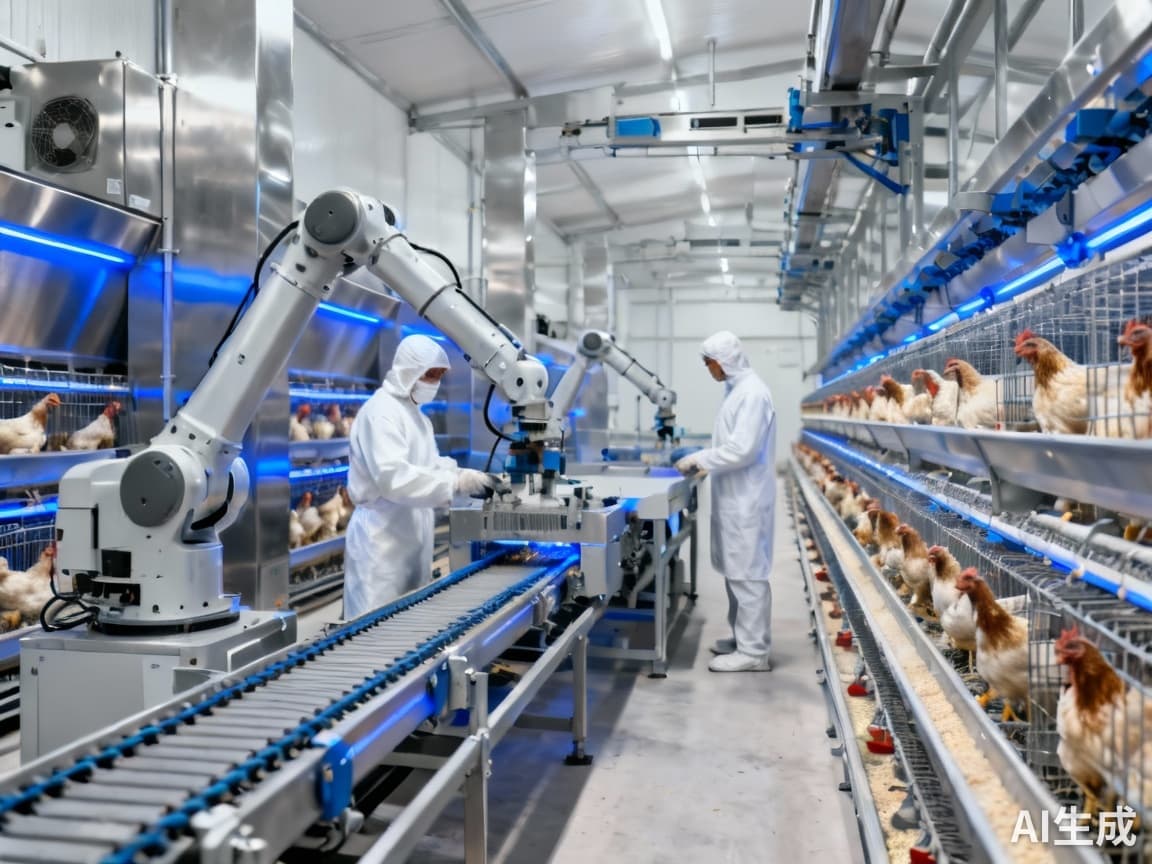
2025 Cage free Transformation: How Automation Equipment Balance 4.7% Efficiency Growth and Labor Rights # 17
The 2025 Cage-Free Transition: Balancing 4.7% Efficiency Gains with Workforce Rights
The global poultry farming equipment market stands at a critical crossroads. With the market valued at $4.5 billion in 2024 and projected to grow at a 4.7% CAGR through 2034, manufacturers and producers face unprecedented challenges. The 2025 cage-free transition deadline, backed by over 2,500 global commitments, creates a perfect storm where automation efficiency must be balanced with workforce sustainability.
The Dual Challenge: Technological Transformation and Human Impact
Industry data reveals a complex landscape where regional growth patterns intersect with labor considerations. While the Asia-Pacific region leads with a 5.2% CAGR, Europe's $800 million market grows at 4.2%, indicating varying implementation challenges across markets. This growth isn't merely about installing automated egg collection systems or hot-dip galvanized layer cages—it's about redefining entire operational ecosystems.
The Taiwan Ministry of Labor case study demonstrates the hidden human costs of automation. Their research through surveys and enterprise interviews revealed that:
- Labor conditions and work environments undergo systematic transformation
- Traditional occupational safety standards fail to address highly automated farming environments
- Companies must redefine human resource functions and training systems
2025 represents a critical inflection point where equipment investments must consider both technical specifications and their impact on workforce structure and rights.
A Framework for Balanced Implementation
Phase 1: Pre-Installation Workforce Assessment
Before deploying automated systems, conduct comprehensive workforce evaluations using standardized questionnaires that assess:
- Current skill levels and automation readiness
- Safety protocol understanding and compliance history
- Workforce demographics and adaptability indicators
- Existing labor condition benchmarks for post-installation comparison
Phase 2: Human-Machine Collaboration Standards
Develop customized checklists based on deep-interview methodologies that address:
- Safety protocols for automated equipment operation and maintenance
- Ergonomic considerations in automated environments
- Emergency response procedures specific to automated systems
- Training requirements for different automation exposure levels
Phase 3: Continuous Monitoring and Adjustment
Establish metrics that simultaneously track equipment efficiency and workforce wellbeing:
- Quantitative safety environment assessments
- Skill transition success rate measurements
- Employee satisfaction correlation with equipment performance
- Regular compliance audits against evolving standards
Regional Implementation Strategies
Asia-Pacific High-Growth Markets (5.2% CAGR)
For rapidly scaling markets, focus on cultural adaptation and rapid deployment:
- Implement modular training programs that accommodate diverse educational backgrounds
- Develop visual safety protocols for multilingual workforces
- Create scalable certification programs that recognize regional skill variations
- Establish pilot programs that account for local farming practices and traditions
European Compliance-Focused Markets (4.2% CAGR)
For markets with stringent regulations, prioritize integration with existing standards:
- Map automation requirements against EU labor directives and welfare standards
- Develop documentation systems that satisfy regulatory reporting requirements
- Create audit trails that demonstrate compliance throughout automation implementation
- Establish certification processes recognized across European jurisdictions
Measuring Success: Beyond ROI Calculations
Traditional return-on-investment models fail to capture the full impact of automation transitions. Companies must develop balanced scorecards that include:
- Equipment efficiency metrics: Uptime percentages, output consistency, maintenance costs
- Workforce impact indicators: Retention rates, skill acquisition timelines, safety incident frequency
- Compliance measures: Audit results, regulatory alignment, certification achievements
- Long-term sustainability markers: Workforce satisfaction, community impact, industry reputation
The poultry equipment market's growth trajectory, particularly the layer cage equipment segment expanding from $310 million to $410 million by 2033, indicates sustained automation adoption. However, the Taiwan case study proves that companies integrating workforce considerations from the outset achieve smoother transitions and more sustainable outcomes.
Implementation Roadmap: 12-Month Preparation Timeline
For companies targeting 2025 compliance, the following timeline ensures balanced implementation:
- Months 1-3: Conduct comprehensive workforce assessments and skill gap analyses
- Months 4-6: Develop customized training programs and safety protocols
- Months 7-9: Install equipment while simultaneously training operational teams
- Months 10-12: Implement monitoring systems and establish continuous improvement processes
This approach acknowledges that equipment installation represents only one component of successful automation adoption. The human element—proper training, adapted safety standards, and ongoing support—determines whether technological investments deliver their promised returns while maintaining ethical workforce practices.
As global poultry production scales toward 47.5 billion pounds of broiler meat in 2025, the industry's ability to balance automation efficiency with workforce rights will separate leaders from followers. The companies that recognize this dual challenge—and implement solutions addressing both technological and human dimensions—will emerge as sustainable industry leaders through the cage-free transition and beyond.
Want to know more?
Get in touch with us for more information about our services and products.