
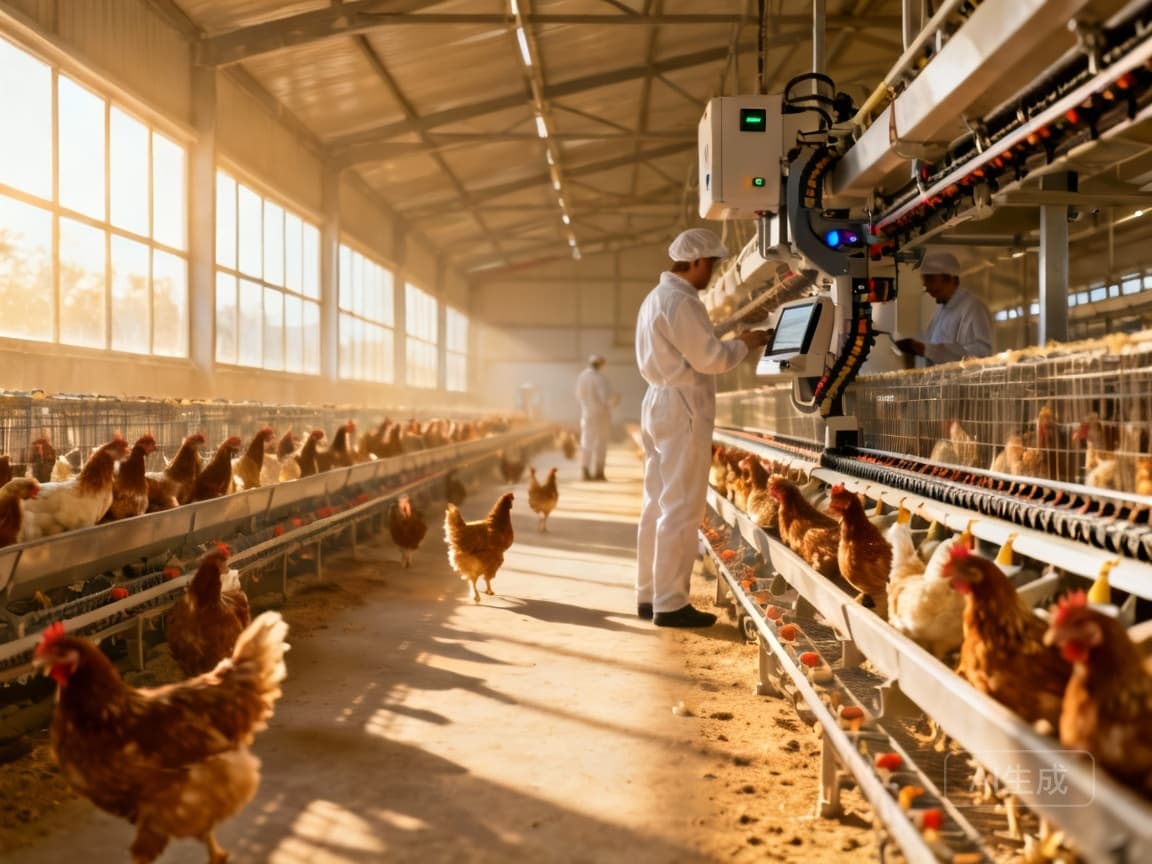
2025 Cage-Free Mandate: Automate Poultry Operations with 48% Market-Leading ROI #52
2025: The Strategic Convergence Point for Poultry Automation
The poultry industry stands at a critical inflection point where regulatory mandates, market demands, and technological advancements are creating unprecedented pressure for transformation. According to Future Market Insights, the poultry farming equipment market is valued at USD 4.5 billion in 2024, with projections indicating growth to USD 7.1 billion by 2034 at a 4.7% CAGR. The automatic segment alone is forecasted to contribute 48.0% of market revenue share in 2025, driven by labor shortages, hygiene standards, and technological advancements.
What makes 2025 particularly significant is the convergence of major cage-free commitments from global food giants. As Christine Ro reports in Forbes, "2025 is a critical year for cage-free meat and eggs transition in US." PepsiCo has committed to 100% cage-free globally by the end of 2025, while Kroger maintains its 2025 goal intact though expecting to reach 70% cage-free by 2030.
"The automatic poultry farming equipment segment shows a CAGR of 6.3% during the forecast period, indicating accelerated adoption as producers recognize automation is no longer optional but essential for compliance and competitiveness."
Case Studies: Early Adopters Reveal Strategic Advantages
Rose Acre Farms: Meeting US Market Demand
Rose Acre Farms faced the challenge of meeting growing demand for cage-free eggs in the US market. Their solution involved launching a new cage-free egg production facility in Missouri, resulting in a 25% production capacity increase. This expansion was necessary to meet retail commitments to cage-free transition, positioning them to capitalize on the 93.1 billion eggs annual US production in 2024.
UkrLandFarming: EU Market Expansion Strategy
UkrLandFarming pursued a different strategic objective: expanding market reach to the European Union. Their implementation involved increasing chicken egg production to nearly 1.5 billion in the latter half of 2024. This strategic production increase was necessary for EU market penetration, where demand for organic and cage-free eggs continues growing.
These cases demonstrate how automation investments serve different strategic purposes: compliance-driven in established markets versus expansion-driven in growth markets.
The 3-Tier Investment Framework for 2025 Readiness
Tier 1: Compliance Layer Infrastructure
The foundation of your 2025 strategy must address basic regulatory compliance. This tier includes:
- Cage-free housing systems meeting animal welfare standards
- Environmental control systems for temperature and humidity management
- Basic automation for feeding and watering systems
Investment in this layer ensures you meet the minimum requirements for supplying major retailers and food service providers with cage-free commitments.
Tier 2: Efficiency Optimization Systems
Beyond compliance, automation delivers operational efficiency that directly impacts profitability:
- Automated egg collection systems reducing labor requirements by up to 40%
- Climate control automation improving feed conversion ratios
- Data monitoring systems providing real-time flock health analytics
This tier generates the operational ROI that makes compliance investments financially sustainable.
Tier 3: Expansion Enablement Technology
The most strategic investments enable market expansion and future-proofing:
- Modular systems that can scale with demand fluctuations
- Integration capabilities with supply chain partners' systems
- Technology platforms supporting traceability and certification requirements
This tier positions producers to capitalize on emerging market opportunities beyond basic compliance.
24-Month Implementation Timeline for Cage-Free Transition
Months 1-6: Assessment and Planning Phase
Begin with a comprehensive operational assessment:
- Conduct current state analysis of facilities and equipment
- Evaluate compliance gaps against 2025 requirements
- Develop financial models for different automation scenarios
- Select technology partners based on scalability and integration capabilities
This phase should include stakeholder alignment across operations, finance, and supply chain teams.
Months 7-15: Phased Implementation
Implement automation in strategic phases to minimize disruption:
- Prioritize facilities supplying customers with earliest cage-free deadlines
- Install modular systems that can be tested and optimized before full deployment
- Train operations teams on new equipment and processes
- Establish performance metrics to track ROI throughout implementation
Months 16-24: Optimization and Scaling
The final phase focuses on maximizing returns from automation investments:
- Analyze performance data to identify optimization opportunities
- Scale successful implementations across additional facilities
- Integrate systems with supply chain partners for enhanced visibility
- Develop continuous improvement processes for ongoing efficiency gains
Strategic Considerations Beyond Basic ROI
Risk Mitigation Through Automation
Beyond financial returns, automation provides critical risk mitigation:
- Reduces dependency on increasingly scarce and expensive labor
- Ensures consistent compliance with evolving regulatory requirements
- Minimizes product quality variations through standardized processes
- Provides data transparency for certification and audit requirements
Market Access and Value Creation
Automation enables access to premium markets and customers:
- EU market entry requires specific production standards only achievable through automation
- Major retailers increasingly require automated traceability systems
- Premium pricing available for producers demonstrating advanced animal welfare practices
- Export markets demand certification only feasible with automated monitoring systems
Conclusion: Strategic Imperative for 2025
The convergence of regulatory deadlines, market demands, and technological advancements makes 2025 a pivotal year for poultry producers. The automation investments that deliver 48% market-leading ROI are no longer optional efficiency improvements but essential components of survival and growth strategies.
Producers who implement the structured approach outlined here—addressing compliance requirements while building operational efficiency and expansion capabilities—will be positioned to thrive in the post-2025 poultry market. Those who delay risk not only missing market opportunities but facing potentially existential compliance challenges.
The time for strategic automation investment is now, with a clear 24-month implementation pathway available to forward-thinking producers. The question isn't whether you can afford to automate, but whether you can afford not to.
Want to know more?
Get in touch with us for more information about our services and products.